
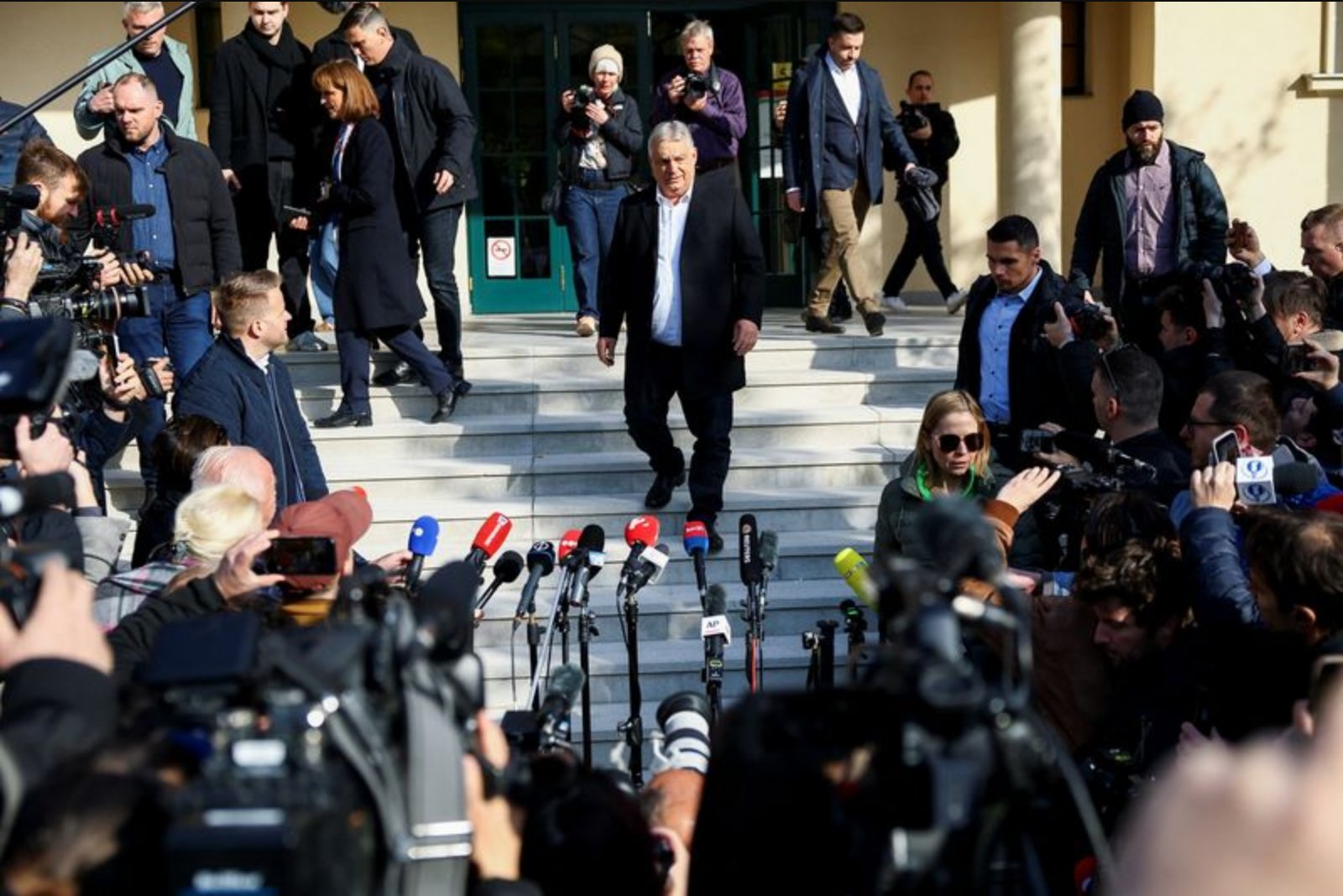
Viktor Orban’s loss in Sunday’s election signals the removal of one of the most visible champions of Europe’s hard right, ending a prolonged run in office that many nationalist politicians elsewhere had pointed to as proof an illiberal playbook could succeed.
During 16 years as Hungary’s leader, he advanced a program rooted in ethno-nationalist rhetoric, tightened controls on civil society and independent media, and positioned his government against immigration, LGBTQ rights and wider liberal norms. Those features of his governance earned praise from international figures who have advocated similar policies.
Orban’s relationship with elements of the U.S. MAGA movement was especially pronounced and visible. His position as the European leader with the closest ties to that movement was demonstrated recently when U.S. Vice President JD Vance visited Budapest to give an explicit endorsement. For many on the continent who looked to Orban as a living example, his defeat - attributed in reporting to voter unhappiness over economic conditions, perceived corruption and the narrowing of democratic space - removes not just a political exemplar but also a sizeable source of financial and logistical support for like-minded forces.
A figurehead for a broader movement
Observers of the far right said Orban’s tenure had made Hungary a focal point for nationalists across Europe and beyond. Gabriela Greilinger, a doctoral researcher in the United States who studies the European far right and democratic erosion, said Orban had functioned as a model because he had maintained power for so long and embedded his ideology into state institutions - an outcome many other far-right parties had not achieved.
"Orban has been pretty much the figurehead of the European far right for the last few years and even beyond the European far right," Greilinger said. "He has been the model because he was able to cling to power for so long and really entrench himself and his ideology in the state. And that’s something that most other far-right parties have not been able to do so far."
Some of Orban’s European peers and sympathizers hailed his record even after his defeat. Alice Weidel, co-leader of Alternative for Germany, said his work for Hungary and contributions to Europe would continue to inspire those advocating for national sovereignty. Ben Habib, the leader of the Advance UK party, characterized Orban’s frequent use of Hungary’s veto within the European Union - which at times blocked EU financing for Ukraine or impeded Russian sanctions - as a strategic asset for those who wished to limit the EU’s cohesion.
Close ties to the MAGA orbit - asset and liability
Orban cultivated a visible rapport with prominent U.S. conservative organizations and MAGA-aligned figures. Daniel Fried, a fellow at the Atlantic Council in Washington, D.C., described Budapest under Orban as a destination for delegations from the MAGA world, noting that the city hosted conferences attracting think tanks and advocacy groups from Europe and the United States.
That closeness has been a point of contention among some right-wing actors. Matthias Moosdorf, a lawmaker with Alternative for Germany, criticized what he called Orban’s "ostentatious friendship" with the current U.S. administration as a burden that had weighed on the Hungarian leader.
European rivals and allies alike have noted that this alignment with U.S. MAGA figures can be a double-edged sword. Elements of U.S. foreign policy and statements from U.S. leaders have at times made the association unpopular with voters in parts of Europe, contributing to a narrative that external alignment can hurt domestic standing.
Institutions and funding that spread an ideology
Beyond personal relationships, much of Orban’s influence came from resources he directed toward institutions that propagated his views. The Hungarian government and entities linked to it provided substantial funding to organizations such as the Mathias Corvinus Collegium (MCC) and the Danube Institute. According to reporting, the total support to these and similar bodies amounted to over a billion dollars, and other public and private flows reached into the hundreds of millions to promote aligned ideas.
Those institutes hosted conferences and exchanges that brought together groups from across Europe and the United States, including organizations that have been influential in the current U.S. administration. Jacob Ross, a research fellow at the German Council on Foreign Relations, said he was struck by how active the Hungarian embassy and delegations were in Washington engagement with conservative think tanks, particularly as the U.S. political cycle moved toward the next presidential term.
With the incoming government led by the pro-EU Peter Magyar, that flow of taxpayer-funded support to political institutes and party events is set to change - Magyar has said the government would stop financing organizations such as MCC. But analysts caution the institutes themselves have structural resilience and were created in part to perpetuate the ideas they promote beyond any individual leader’s tenure.
"Most of these organisations are also there to ensure that these ideas kind of live on even beyond the rule of the leader, or in this case, beyond the rule of Viktor Orban," Greilinger said.
Allies temper disappointment with broader optimism
Even after the loss in Budapest, some European figures aligned with Orban’s politics expressed belief the broader movement still had momentum. Tánger Corrêa, a member of the European Parliament within the Patriots for Europe group which includes Orban’s party, acknowledged the setback but said electoral fatigue is common for long-standing governments and that other parties on the right showed promising polling ahead of upcoming contests.
Corrêa cited positive signs for parties such as France’s National Rally and pointed to the growth of like-minded groups elsewhere in Europe, including a party that became the second-largest in Portugal’s parliament last year. "It’s not pleasant that one of our members lost an election," he said. "But it’s life, we move on."
What remains uncertain
Orban’s departure from power raises immediate questions about how effectively allied parties and organizations can continue to coordinate across borders without direct access to Hungary’s state resources, and how much the institutes and networks he helped fund will be able to influence policy debates going forward. The incoming administration’s stated intent to halt state financing for particular institutes changes one dynamic, but the long-term durability of the ideological networks Orban helped build is not settled.
For observers tracking the future of the European far right, the change in Budapest is consequential: it removes a long-standing model and patron, while leaving open the possibility that the ideas and organizational structures he supported could persist in other forms.