
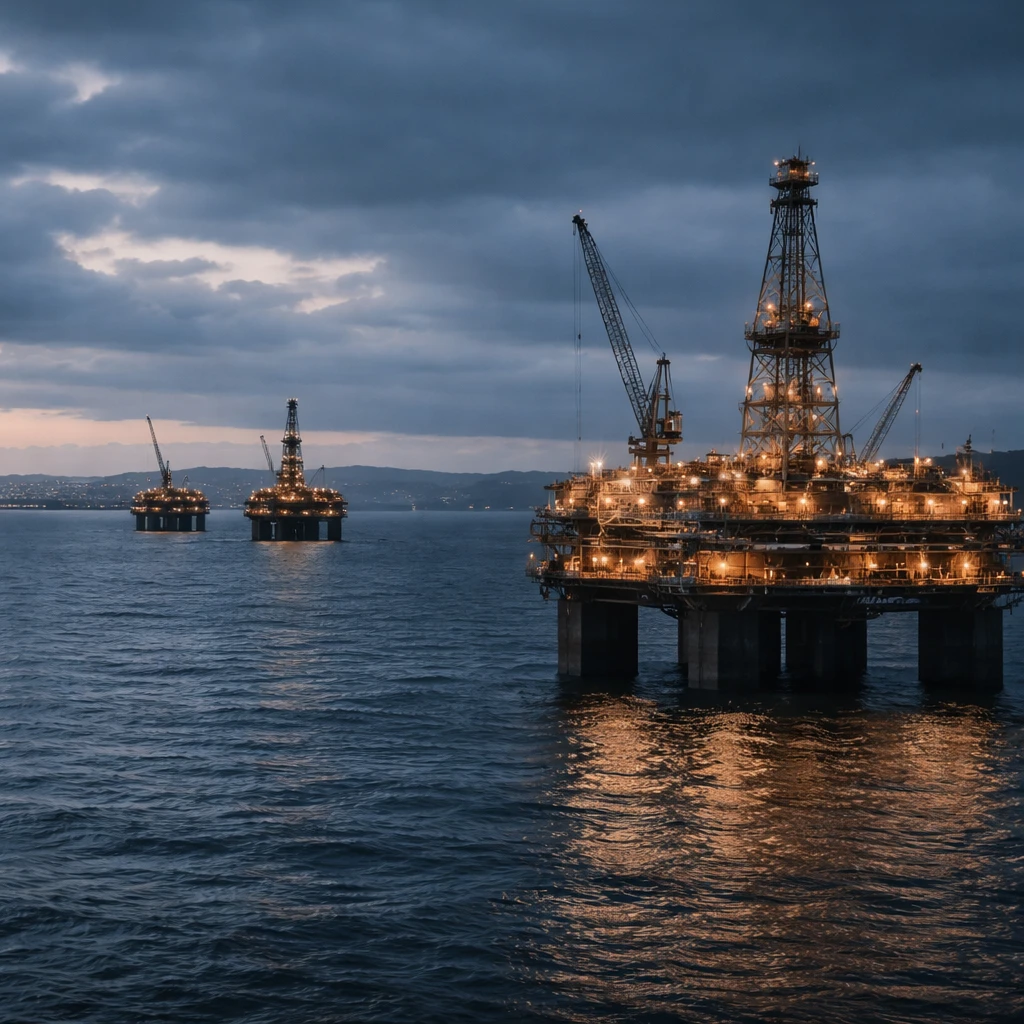
U.S. President Trump on Tuesday publicly rebuked the United Kingdom for what he described as an unwillingness to increase production from the North Sea, saying in a social media post that Europe is "desperate for Energy."
In his post, Trump said the U.K. is refusing to "open North Sea oil," which he labeled "one of the greatest fields in the World." He wrote that Aberdeen should be "booming" and asserted that Norway sells its North Sea oil to the U.K. at twice the price the U.K. could obtain domestically.
"U.K., which is better situated on the North Sea for purposes of energy than Norway, should, DRILL, BABY, DRILL!!! It is absolutely crazy that they don’t," Trump wrote.
Long-term trends show that oil output from the North Sea has fallen over recent decades, and forecasts indicate production will continue to decline. Despite that downward trend, the basin remains an important source of energy and employment for Britain, and it has emerged as a political flashpoint for Prime Minister Keir Starmer.
The previous Conservative government had pledged to maximize output of North Sea oil and gas. By contrast, Starmer's Labour administration campaigned on a platform that includes investment in clean energy technologies, specifying wind and nuclear as priorities.
After taking office, Starmer raised the tax rate applied to profits from oil and gas extraction to 78 percent, a level described in the article as among the highest worldwide. The article notes that taxes on the sector had already been increased under the prior Conservative government when oil prices rose following Russia's invasion of Ukraine.
While oil prices have since fallen, the piece reports that other European countries have lowered their tax rates on oil companies in response to changing market conditions. Britain, however, has maintained its higher extraction tax rate.
The debate over North Sea production centers on competing policy goals identified in recent political cycles: boosting domestic hydrocarbon output and preserving related jobs and revenues versus directing public resources toward renewable and nuclear investments. The dispute has drawn attention from international observers, including the U.S. president, and remains a live political and economic issue in the U.K.
Summary
President Trump criticized the U.K. for not expanding North Sea drilling, calling for increased production and arguing the U.K. is well positioned to tap the basin. North Sea output has been falling for decades and is expected to continue its decline. The issue figures prominently in U.K. politics after Prime Minister Keir Starmer raised extraction taxes while campaigning for clean energy investment.
Key points
- Trump publicly urged the U.K. to increase North Sea oil production, saying Europe is "desperate for Energy." - Impacts: energy sector, geopolitics.
- North Sea production has declined over recent decades and is forecast to keep falling; the basin still supplies energy and jobs for Britain. - Impacts: energy sector, employment.
- Starmer's government increased the tax rate on oil and gas extraction profits to 78 percent while campaigning for clean energy investment such as wind and nuclear. Other European countries have cut taxes on oil firms as prices fell, but Britain has not. - Impacts: fiscal policy, oil companies.
Risks and uncertainties
- Continued production decline in the North Sea could affect Britain's domestic energy supply and jobs tied to the basin. - Affects: energy sector, labor market.
- The tax policy divergence between Britain and other European countries creates uncertainty for oil and gas firms operating in the U.K. sector. - Affects: upstream oil companies, investment decisions.
- The political prominence of North Sea output under Prime Minister Keir Starmer introduces policy unpredictability as the government balances extraction taxation with clean energy commitments. - Affects: energy policy, government revenues.