
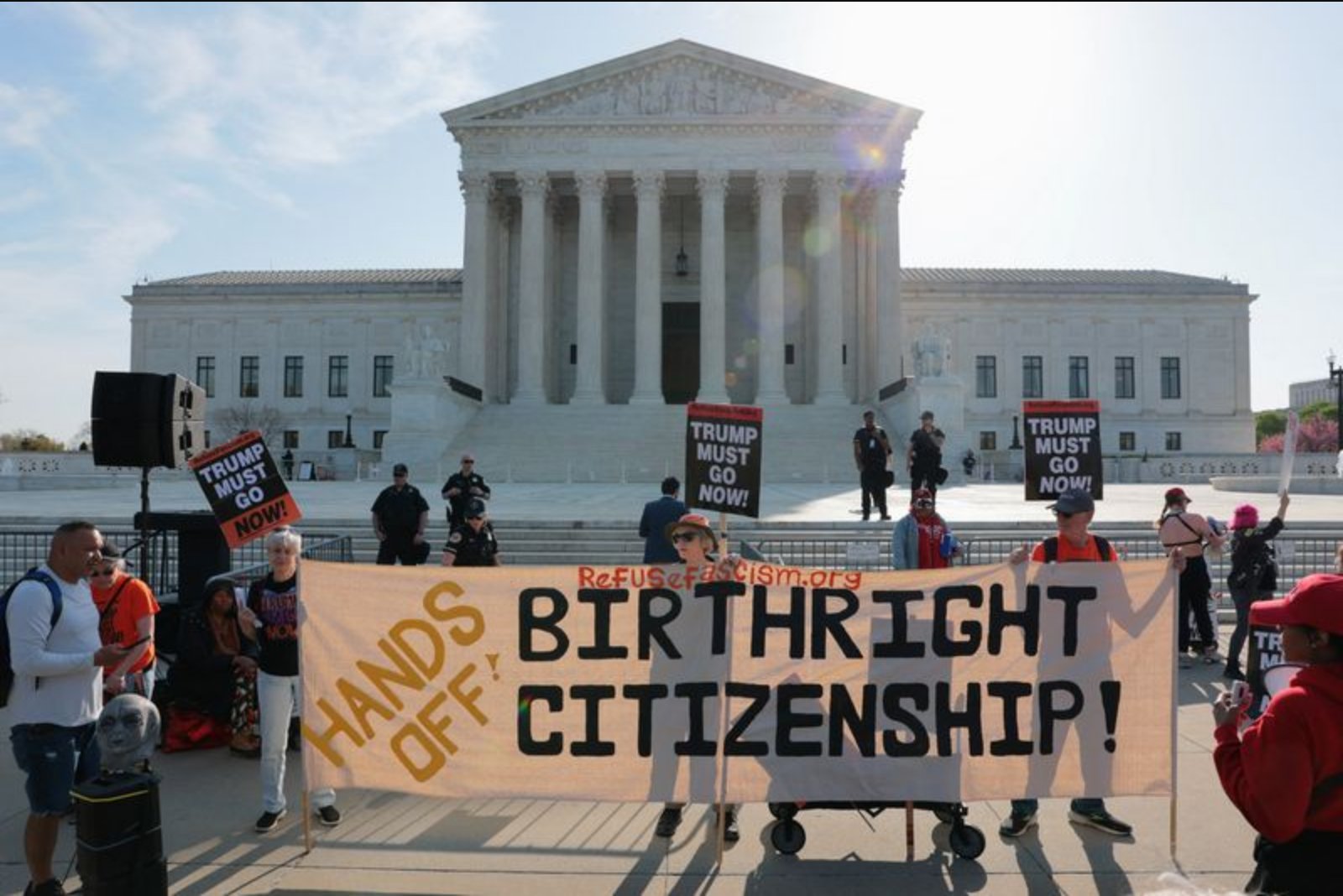
The U.S. Supreme Court is poised to deliver decisions in the coming weeks on a string of contentious topics - from birthright citizenship and transgender athletes in women’s sports to the counting of mail-in ballots - and a national Reuters/Ipsos poll conducted April 15-20 shows many Americans have clear views on those subjects.
The survey indicates 64% of respondents oppose ending birthright citizenship, while 32% support scrapping the policy that currently grants citizenship to babies born in the country. The question has taken on new prominence as the high court prepares to rule on President Donald Trump’s January 2025 executive order aiming to end birthright citizenship. That order was challenged in court, and justices are expected to issue a ruling by the end of June in what the administration and advocates describe as a landmark civil rights case and a test of Mr. Trump’s immigration agenda.
Public opinion on the matter breaks sharply along party lines. Among Democrats, only 9% favor eliminating birthright citizenship, while Republicans are more divided: 62% of Republicans reported they support ending the policy, and 36% favor maintaining it. Observers following the April 1 oral argument noted that the court, which has a 6-3 conservative majority, appeared unlikely to side with the executive order during that hearing.
Beyond birthright citizenship, the poll asked about policies affecting transgender athletes. In the cases before the court from Idaho and West Virginia, state laws restrict participation by transgender girls and women in female school and college sports. Nationwide, the Reuters/Ipsos poll found roughly 67% of respondents supported banning transgender people from competing in female school sports.
Support for such bans was especially strong among Republicans, with 92% indicating favor, while 44% of Democrats said they supported bans on transgender athletes in female school sports. Those cases are among the high-profile matters the court is expected to decide this term.
The poll also addressed a separate election-related question before the justices: whether states can count mail-in ballots that are postmarked by Election Day but arrive days later. Overall, 65% of respondents said they back counting ballots that meet the postmark criterion even if they are received after Election Day.
Opinion on that point was again split by party. Eighty-five percent of Democrats supported counting such ballots, compared with 51% of Republicans, according to the survey.
Another case headed to the high court concerns a Louisiana congressional map that was redrawn to increase Black-majority districts from one to two, an effort aimed at expanding Black voters’ representation. White voters challenging the map have asked the Supreme Court to block it, arguing the map was drawn with too much emphasis on race.
Public views on the role of race in drawing districts are complex. Three quarters of respondents - including 65% of Black respondents - said race should not be considered when drawing congressional maps. At the same time, roughly five in 10 respondents overall, and six in 10 Black respondents, said they believe communities that share characteristics such as race should be represented together in the same congressional district. Those survey results reflect nuance in public opinion on competing principles in redistricting.
The high court has in recent years handed down several significant rulings that have reshaped public policy, including decisions expanding gun rights, rejecting race-conscious college admissions, and narrowing the authority of federal agencies. The current conservative majority on the court includes three justices appointed by President Trump during his first term.
Perceptions of the Supreme Court have grown more partisan in recent years, the poll suggests. In a Reuters/Ipsos survey conducted in March, about 70% of Republicans viewed the court favorably, compared with 27% of Democrats. By comparison, a December 2021 Reuters/Ipsos poll found 66% of Republicans and 55% of Democrats viewed the court favorably at that time.
The most recent Reuters/Ipsos poll that provided these findings was conducted online and collected responses from 4,557 U.S. adults. The survey’s margin of error is about 2 percentage points.