
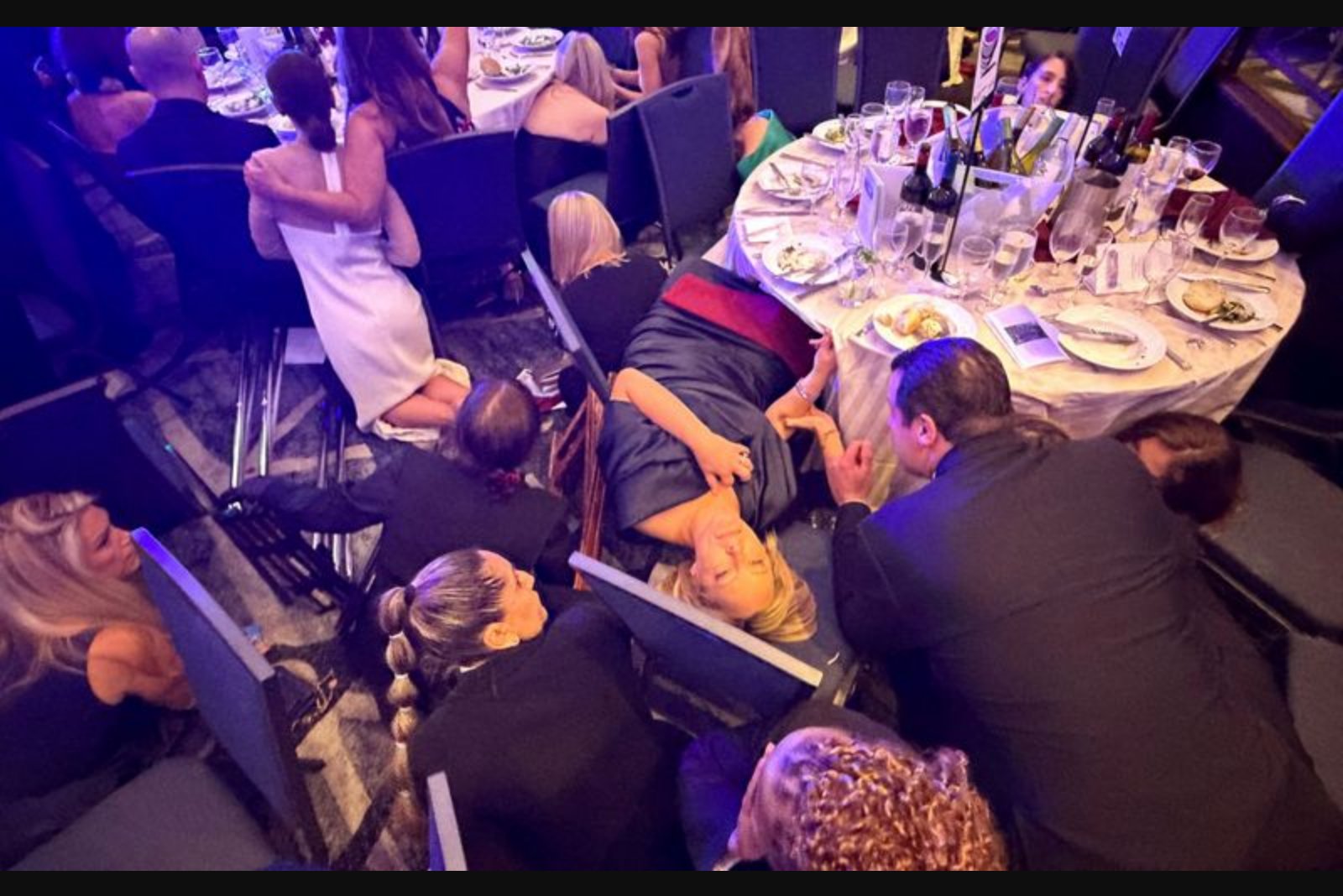
Shortly after 8:30 p.m. on Saturday, a string of unexplained thuds interrupted the muted conversation in the Washington Hilton’s grand ballroom, where roughly 2,600 journalists and their guests had just been served salad and wine at the White House Correspondents’ Association dinner. A few heartbeats later, the room erupted into alarm as the ballroom doors burst open and security personnel converged.
President Donald Trump sat at the long head table with First Lady Melania Trump and Vice President JD Vance, among other dignitaries. Uniformed servers crossed the room, but the evening’s formal cadence was suddenly displaced by law enforcement in multiple forms. Plainclothes officers moved quickly to restrain several cabinet members who had been seated at tables among the press corps, forcing them to the floor and rolling them beneath tables as a precaution. Armed agents drew handguns; others in full tactical gear appeared and positioned long guns on the crowd.
The reaction of attendees was immediate. Many guests dove onto the floor, sought cover beneath chairs and tables or crawled toward exits. Some of the most prominent officials in the room were hurried away by security. Agents escorted Vice President Vance and several others off the head table; Secretary of State Marco Rubio was moved out of the ballroom at speed. Homeland Security Secretary Markwayne Mullin was pushed into a side room and House Speaker Mike Johnson was led away, his tuxedo jacket tugged as agents guided him to safety. Within the chaos, Secret Service personnel focused on the president - whom they crouched and steered from his seat - while other agents pushed across chairs and tables to reach remaining officials on the floor and onstage.
Authorities later said the violence originated from a man who charged through a security checkpoint on the floor above the ballroom. Law enforcement identified the suspect as Cole Allen, said to be a California teacher staying at the hotel. Investigators alleged Allen fired rounds from a shotgun, striking a Secret Service agent before officers tackled him.
The incident prompted a swift, layered response: some officers pushed attendees down, others secured the stage in tactical gear, and armed personnel moved through the room. At least one cabinet official, Education Secretary Linda McMahon, departed the hotel with her security detail nearly an hour after the shooting.
For many in the ballroom, panic slowly ceded to a journalist’s instinct to record and report. Phones and cameras came out as roughly 2,600 people attempted to determine what had occurred. Rumors circulated in the confined space; attendees struggled to access WiFi, and some discovered that the event’s network password was the posted credential "MOREWINE."
Backstage, despite the upheaval, President Trump reportedly told leaders of the White House Correspondents’ Association that he intended to proceed with remarks. That position shifted after discussion with the Secret Service, which persuaded him to return to the White House. Organizers subsequently canceled the dinner for the night, though the president pledged to reconvene the event within the next 30 days.
As the atmosphere in the ballroom calmed, guests began to adjust their attire and leave. Gentlemen loosened bow ties and women removed high heels. Weijia Jiang, a White House correspondent for CBS News and president of the White House Correspondents’ Association, asked the crowd to depart the Hilton. Observers at the hotel bar stood near exits, phones raised to record as guests filtered out into the evening.
The hotel where the incident occurred was also the site of a past high-profile attack mentioned by authorities - an earlier lone gunman, John Hinckley Jr., shot President Ronald Reagan as he was leaving an event there in 1981, a historical detail that was noted in accounts of the night.
Immediate aftermath and scene management
Security personnel sealed the ballroom doors after the incident, and the room grew warm as guests remained inside awaiting instructions. Some officials and attendees remained under guard or in secure locations while law enforcement processed the scene and escorted those who could leave. The sequence of rapid evacuations, table-level shielding and tactical deployments underscores the layered response by federal and local officers in protecting principals and the wider crowd.
What happened to individuals in the room
Several high-level officials were physically moved from the ballroom: the president and first lady were swiftly escorted; the vice president and other senior officials were hustled from the head table; cabinet members present among the press corps were subdued by plainclothes officers as part of the immediate protective measures. One Secret Service agent was reported struck by shotgun fire and subsequently rendered aid after the suspect was tackled.
Outlook
The event was canceled for the night and organizers were directed to clear the venue. Officials indicated an intent to reschedule the president’s remarks within 30 days, and law enforcement continued to secure the scene and to manage departures. Attendees dispersed under the watchful eyes of security details and hotel staff, leaving a disrupted evening and a concentrated law enforcement response in their wake.