
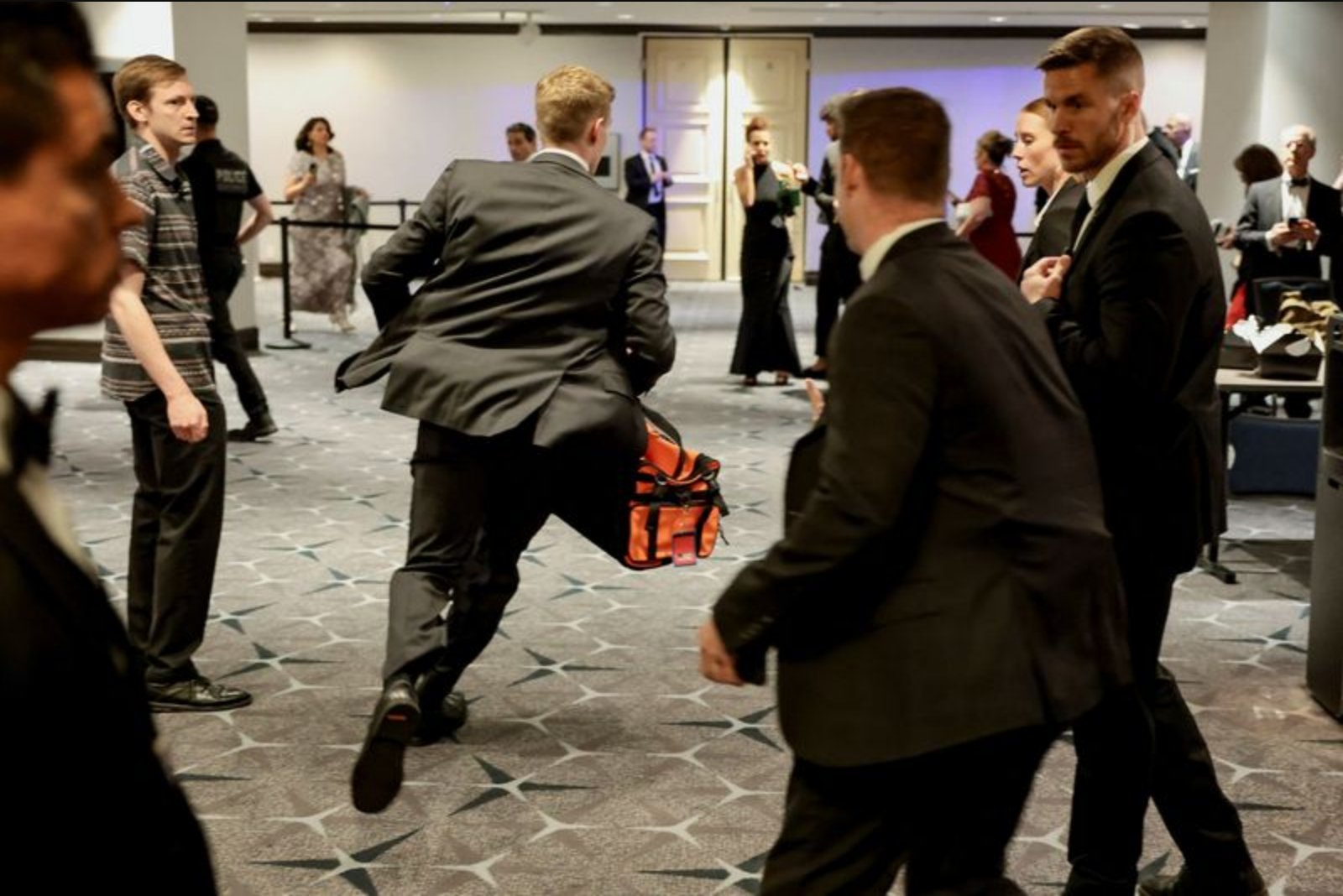
The shooting of a Secret Service agent on Saturday night at the Washington Hilton, where the White House Correspondents' Association dinner was held, has focused attention on how top officials are protected at major public gatherings. The alleged assailant, reported to have been armed with a shotgun, a handgun and knives, was said by the city police chief to have been staying at the hotel that hosted the dinner.
The annual event drew a large and notable crowd. President Donald Trump headlined the dinner this year and was seated at the long head table. Also in attendance were Vice President JD Vance; Secretary of State Marco Rubio; Pentagon chief Pete Hegseth; Attorney General Todd Blanche; Treasury Secretary Scott Bessent; Interior Secretary Doug Burgum; and other senior government officials, many of whom were accompanied by their own protective details.
Authorities assigned hundreds of agents from multiple law enforcement agencies to security duties for the dinner. Still, the suspect managed to get to a floor immediately above the ballroom where the gathering took place. Video that circulated after the incident shows the individual charging down a hallway past a security checkpoint, then shooting an agent before being tackled and handcuffed.
Attendees were still in the midst of their meals - described as a spring pea and burrata salad - when people toward the back of the basement ballroom reported hearing multiple gunshots. Agents from the Secret Service quickly moved to protect the president and the vice president, rushing both Mr. Trump and Mr. Vance off the head table. At the same time, protective agents assigned to various cabinet members and lawmakers, who were seated on the floor with journalists and guests, reacted in differing ways.
Witness accounts and footage show some security personnel scrambling through the packed room, standing on chairs and overturning tableware to reach the people they were tasked with protecting, while others pushed their protectees to the ground and used their bodies to shield them. Guests in the room ducked under tables as the situation unfolded. Security teams for cabinet members including Mr. Rubio, Mr. Bessent and Mr. Burgum were reported to have pushed those officials to the floor and formed human shields.
Most protectees were eventually escorted out of the ballroom, although the timing varied. Some were moved out almost immediately; others remained in place for several minutes before being led away. The differing timelines for removal of protectees highlights the varied responses by individual security details at the scene.
As officials responded to the incident, President Trump praised first responders and the Secret Service at an impromptu White House news conference. He also reflected on the risks of the office, noting that some previous presidents had been assassinated, and said that the suspect had not been close to "breaching" the doors of the ballroom. Speaking specifically about the venue, he commented, "It's not particularly a secure building," referring to the hotel, which is about a 10-minute drive from the White House and was previously the site of an assassination attempt against a president.
Access control procedures for the dinner required the roughly 2,600 attendees to pass through metal detectors to enter the basement ballroom itself. However, entry to the hotel was controlled only by ticket presentation, and the hotel remained open to other guests. With demonstrators surrounding the venue's entrance - many reportedly protesting the administration's actions in the war against Iran - attendees were waved through the entrance at points, which observers have noted altered the flow of people into the building.
Authorities stated that it is too early to determine definitively whether any failures or miscommunication among law enforcement contributed to the incident. The shooting comes fewer than two years after two separate assassination attempts against Mr. Trump during the 2024 presidential campaign, events that underscore the heightened security concerns surrounding senior political figures.
After considering the situation, Mr. Trump later told journalists that the Secret Service concluded the event could not continue. The agent who was shot was subdued at the scene, and the alleged gunman was taken into custody. Investigations into the exact sequence of events, the suspect's motives, and any potential lapses in security were described by authorities as ongoing.
Summary
- A Secret Service agent was shot by an alleged gunman armed with a shotgun, handgun and knives at the Washington Hilton, the venue for the White House Correspondents' Association dinner.
- The dinner was attended by President Trump and a concentration of cabinet officials and lawmakers; roughly 2,600 guests were inside the ballroom.
- Attendees passed through metal detectors to enter the ballroom, but the hotel itself remained accessible to registered guests with only ticket checks at the entrance.
Key Points
- The breadth of protection - involving hundreds of agents from multiple agencies - did not prevent a suspect from reaching a floor directly above the ballroom, highlighting a point of vulnerability in venue-layered security. (Sectors potentially impacted: private security, government contracting)
- High concentration of senior officials in a single, semi-public hotel venue created a scenario in which several protective details had to respond simultaneously, with varying tactics and timelines. (Sectors potentially impacted: hospitality and events, insurance)
- Access controls separated between ballroom entry (metal detectors) and hotel entry (ticket-only) were a central operational fact in how the suspect gained proximity to the event space. (Sectors potentially impacted: venue operations, event security services)
Risks and Uncertainties
- It remains unclear whether any law enforcement failures or miscommunications occurred in the lead-up to the shooting; investigators have not reached a definitive conclusion. (Impacted: public safety oversight)
- The presence of demonstrators at the venue entrance and the practice of allowing hotel entry with tickets only introduced uncertainty in crowd control and access screening procedures. (Impacted: hospitality and event management)
- The variable timing and methods used by individual protective details to remove protectees produced inconsistent outcomes in the evacuation process, leaving questions about standardized response protocols. (Impacted: protective services, training providers)