
UBS has raised its rating on Tesla stock to Neutral from Sell and left its price target unchanged at $352. The move reflects the firm's view that a substantial pullback in the share price has made the balance of risks and rewards more even, according to analyst Joseph Spak.
Spak said Tesla's share level now more fairly offsets near-term demand challenges and an extended period of elevated investment against the firm's longer-term potential in so-called physical AI. The analyst pointed to several developments that have pressured the stock during 2026.
Notably, Tesla's shares have fallen more than 21% in 2026, a decline that has significantly lagged the broader market. UBS attributes the underperformance to a confluence of factors: weakening demand for electric vehicles, a shortfall in energy results for the first quarter, rising operating costs and capital spending, and disappointingly slow progress on its robo-taxi and Optimus programs.
Despite these headwinds, Spak wrote that he still expects eventual advancements on the robo-taxi and Optimus initiatives and continues to regard Tesla as a leader in physical AI. He also described Tesla's equity as being driven more by sentiment and momentum than by fundamentals and warned that the stock could remain highly volatile.
Production and delivery outlook
On vehicle deliveries, UBS projects roughly 1.6 million units in 2026, effectively flat versus the prior year. The bank models deliveries growing at a 7% compound annual rate to about 2 million vehicles by 2030. That projection sits well below a Wall Street consensus figure of 3 million deliveries by the same year. Spak said the more conservative delivery path reflects intensifying competition from Chinese automakers, weaker U.S. EV demand, and a constrained product pipeline with few new models expected.
Robo-taxi program
Spak noted that expectations for Tesla's robo-taxi effort rose after the company suggested it would be operating in nine cities by the first half of 2026. However, he flagged concern about the slow pace of expansion from Tesla's Austin operations. UBS does not anticipate meaningful scaling in the near term, even while acknowledging a long-term opportunity for Tesla to reduce cost per mile and position itself among U.S. robotaxi leaders.
Optimus humanoid robot program
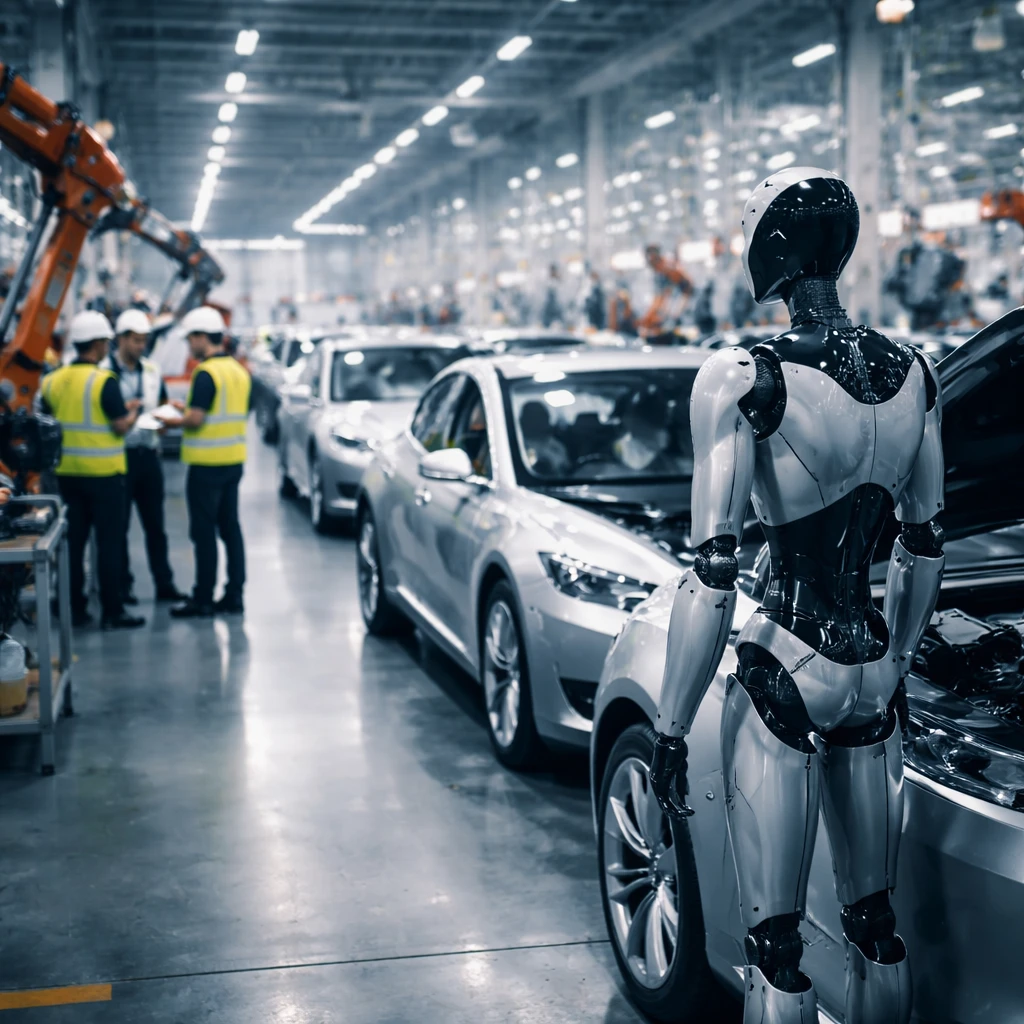
Regarding Optimus, Spak said he believes the humanoid robot effort will take longer than the targets stated by Elon Musk and could face supply chain constraints because of a reliance on Chinese components. UBS's model assumes roughly 5,000 Optimus units in 2027 and 30,000 by 2030, which contrasts with Musk's more aggressive projection of high-volume production beginning next year.
UBS's repositioning to Neutral reflects a recalibration rather than a change to its price target; the bank retained $352 as the valuation reference point while shifting its view of the stock's near-term risk-reward profile.
Additional note: An AI-driven stock selection tool mentioned in the broader coverage evaluates companies like Tesla using numerous financial metrics and cites past examples of large percentage gains in other tickers as part of its historical performance summary.