
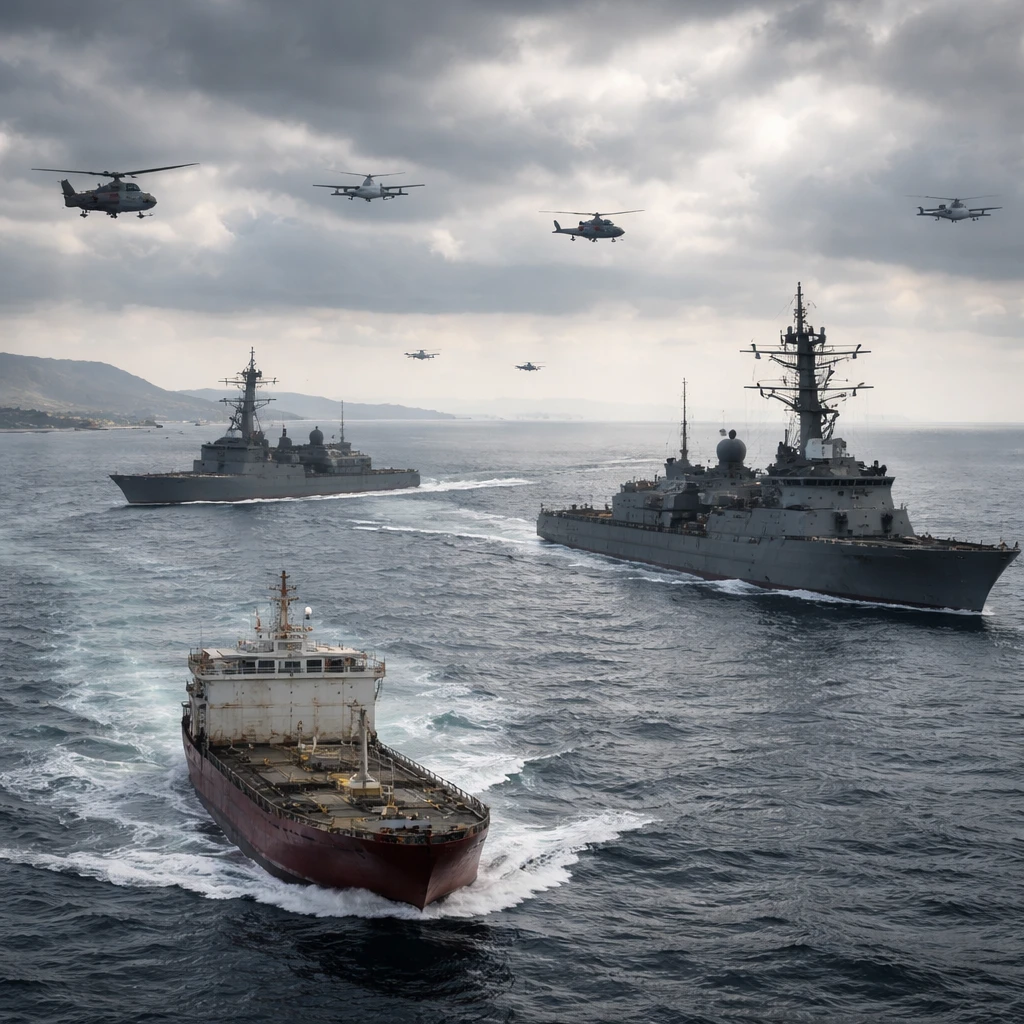
U.S. Central Command (CENTCOM) announced Tuesday that more than 10,000 U.S. sailors, marines, and airmen are engaged in enforcing a naval blockade of Iranian ports. The operation is supported by a force of over a dozen warships and dozens of aircraft, according to a CENTCOM statement posted on X.
The stated mission is to restrict maritime traffic to and from ports along Iran's coastline through the Strait of Hormuz. CENTCOM's announcement described the action as a maritime interdiction designed to limit the movement of ships entering and departing Iranian ports and coastal areas.
During the first 24 hours of the operation, CENTCOM reported that no vessels passed the U.S. blockade. The statement added that six merchant vessels complied with directions from U.S. forces to turn around and re-enter an Iranian port on the Gulf of Oman.
CENTCOM said the blockade is being applied to vessels of all nations entering or departing Iranian ports and coastal areas. The scope explicitly includes all Iranian ports on the Arabian Gulf and the Gulf of Oman. At the same time, U.S. forces stated they are supporting freedom of navigation for vessels transiting the Strait of Hormuz to and from non-Iranian ports.
The CENTCOM statement on X outlined the operational posture and initial compliance observed in the early phase of the mission. Beyond the numerical size of personnel and the equipment cited - more than 10,000 personnel, over a dozen warships, and dozens of aircraft - CENTCOM's posting focused on the geographic reach of the restrictions and the reported behavior of merchant vessels during the first day of enforcement.
The announcement did not provide additional operational details beyond the numbers and the compliance events during the initial 24-hour period. CENTCOM framed the effort as an enforcement of restrictions on maritime traffic involving Iranian ports while indicating ongoing support for transit associated with non-Iranian destinations through the Strait of Hormuz.
Key points
- More than 10,000 U.S. sailors, marines, and airmen are involved in the naval blockade, backed by over a dozen warships and dozens of aircraft.
- The blockade targets vessels entering or departing Iranian ports and coastal areas, including those on the Arabian Gulf and Gulf of Oman, while U.S. forces say they are supporting freedom of navigation for traffic to and from non-Iranian ports through the Strait of Hormuz.
- In the first 24 hours, CENTCOM reported no ships passed the blockade and six merchant vessels complied with orders to turn back to an Iranian port on the Gulf of Oman.
Risks and uncertainties
- Maritime traffic to and from Iranian ports is being restricted, creating uncertainty for vessel operators and shippers navigating the affected coastal areas.
- The blockade is being enforced against vessels of all nations entering or leaving Iranian ports, raising questions about the operational duration and how international shipping patterns will respond.
- Information provided by CENTCOM covers the initial 24-hour period; further developments and longer-term effects were not detailed in the announcement.
This report is based solely on the statement released by U.S. Central Command and reflects the facts and operational details contained in that statement.