
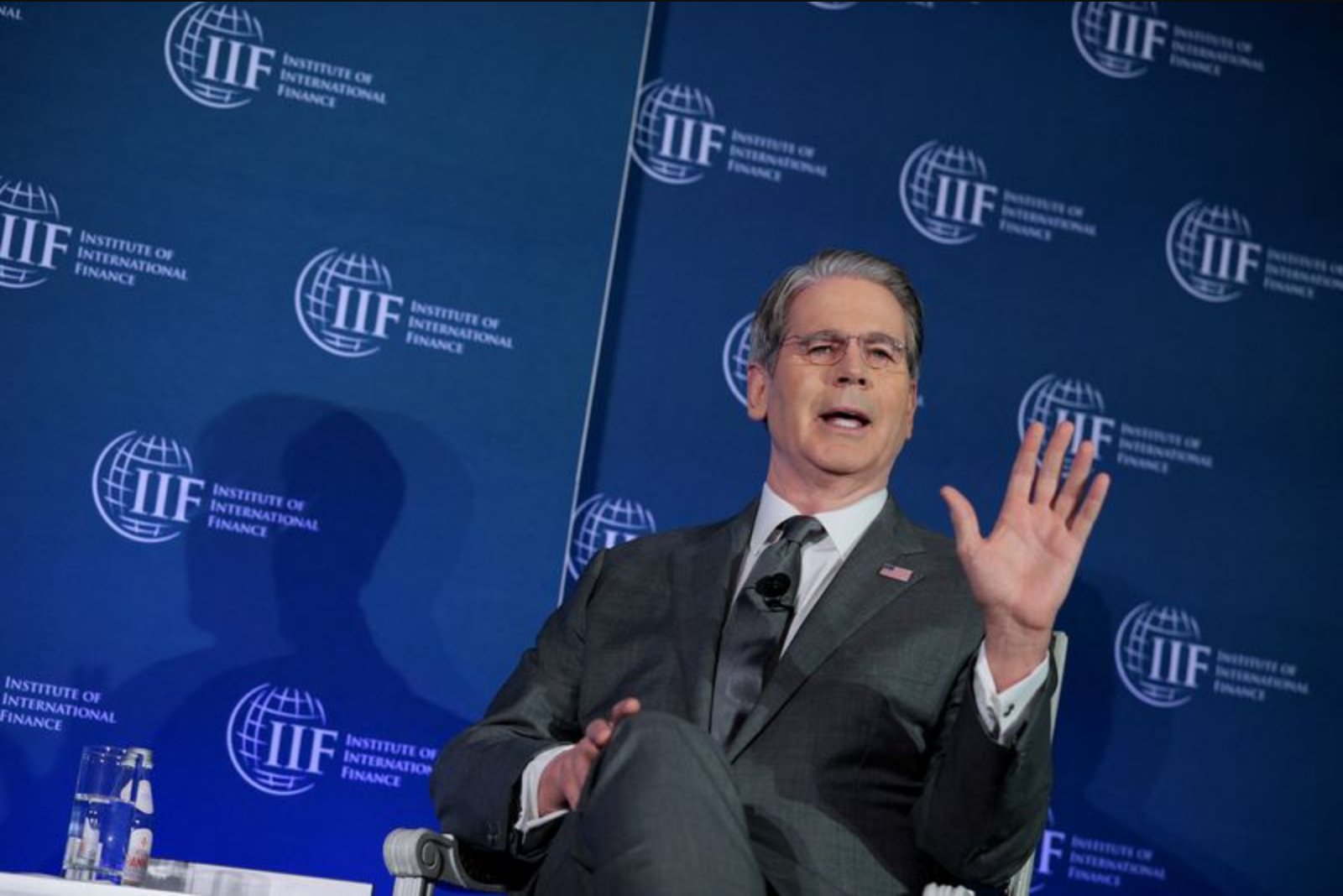
U.S. Treasury Secretary Scott Bessent on Tuesday pushed back on newly released forecasts from the International Monetary Fund and the World Bank that show lower global growth and higher inflation in the wake of the war in the Middle East.
At an event hosted by the Institute of International Finance and in subsequent remarks to reporters, Bessent said he believed the institutions' revisions went too far. "I think that they probably overreacted, but we'll see," he told reporters, while noting policy differences across regions.
Explaining his view, Bessent contrasted the likely inflation path in the United States with that of some European and Asian countries. He pointed to consumer or industrial subsidies those governments are deploying to address supply disruptions. According to Bessent, such measures could prolong inflationary effects and raise borrowing needs abroad, whereas he expressed confidence that the United States would move through higher prices quickly.
The IMF's new outlook, released on Tuesday, lowered its growth projections and presented a range of scenarios that all incorporate reduced growth and increased inflation tied to energy price spikes stemming from the conflict. The fund said that without the conflict, it would have upgraded its growth forecast by 0.1 percentage point to 3.4%.
Despite criticizing the recent projections, Bessent said he believed leaders at both the IMF and World Bank had responded to his prior calls for the institutions to concentrate on their core missions. He said those missions are macroeconomic stability and development and suggested they should move away from other issues he has previously raised.
Speaking at the same forum and to reporters later, Bessent said he saw clearer alignment between those institutions and U.S. priorities. He welcomed the World Bank's decision to lift a ban on nuclear power projects and noted the IMF's cooperation with the Treasury on Argentina and efforts to reintegrate Venezuela into the global financial system.
Bessent reiterated a more idiosyncratic request as well, repeating his prior call for the IMF to sell a golf course in a Maryland suburb of Washington.
He also pointed to personnel ties as evidence of close contact between Treasury and the IMF, noting that his former chief of staff, Dan Katz, now serves as the IMF's No. 2 official. "We're in close touch," Bessent said, adding that he believed the institutions understood the U.S. perspective and wanted to be cooperative partners. He said there had been some inertia and a need to reassess past programs, but that the U.S. and the institutions were now largely aligned.
The remarks put a spotlight on differing policy tools and responses to supply shocks across countries, the trajectory of inflation in the United States compared with other regions, and the ongoing dialogue between Washington and major multilateral financial institutions. Bessent's comments underscore a U.S. Treasury perspective that the immediate price effects of the conflict will be transitory domestically, while cautioning that subsidy-driven approaches elsewhere could lengthen inflation's duration and weigh on public finances abroad.