
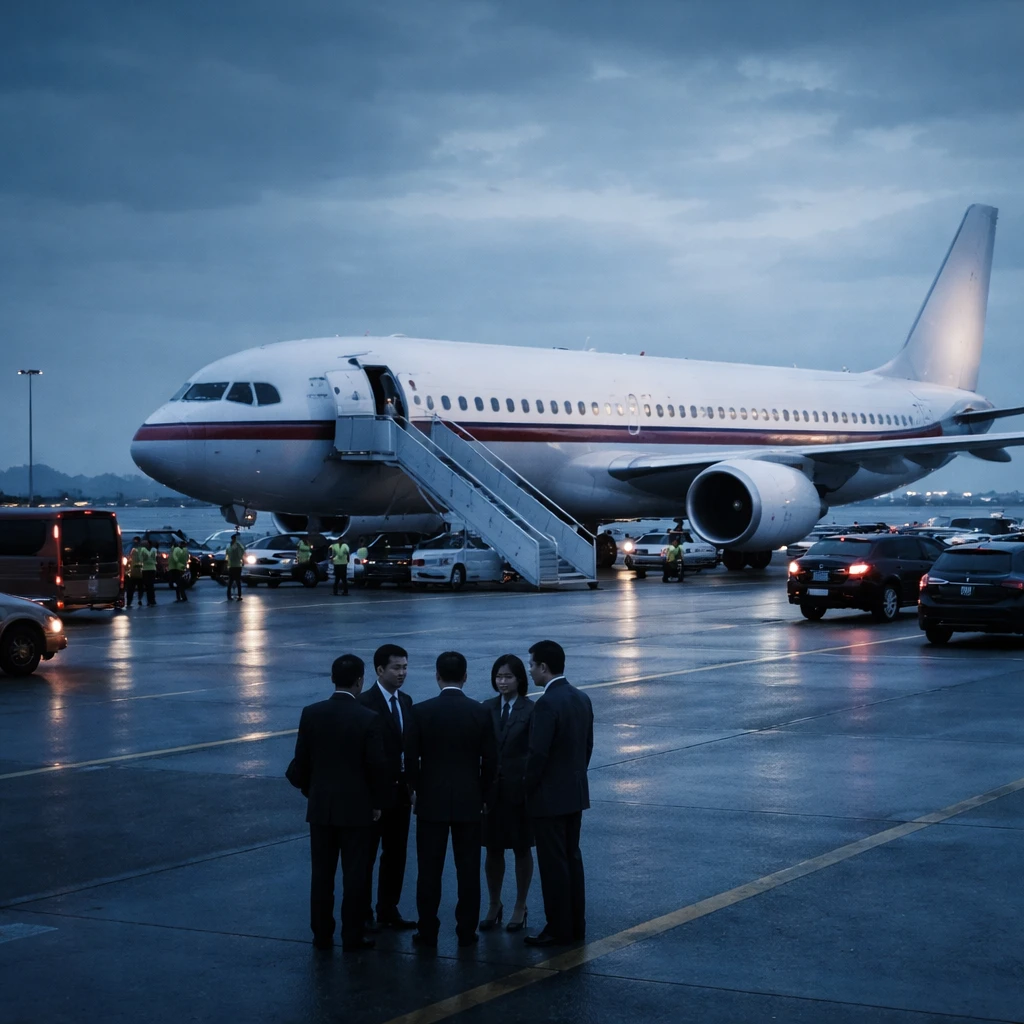
Taiwan's diplomatic agenda encountered a notable disruption last week when flight clearances for the presidential aircraft were abruptly withdrawn by authorities in the Seychelles, Mauritius and Madagascar, according to Taiwan's foreign ministry. The cancellations forced President Lai Ching-te to abandon an entire diplomatic mission - an outcome Taipei says was orchestrated by Beijing.
Beijing has denied applying direct pressure to prompt the revocations. At the same time, Chinese officials publicly praised the three countries for blocking the aircraft's transit, a reaction Taipei and others view as a signal of a potentially escalatory approach to limiting the island's international engagements.
In response to the setback, Taiwan moved to reinforce its diplomatic presence. Foreign Minister Lin Chia-lung flew to Eswatini this weekend to represent President Lai as a special envoy for the 40th anniversary of King Mswati III's accession. Upon arrival, Lin issued a statement saying his delegation had "overcame all obstacles" to reach the kingdom and asserting that Taipei's diplomatic reach would not be stifled by what he described as "authoritarian forces." The trip functions as a difficult but symbolic reaffirmation of Taiwan's intent to sustain formal relations with its 12 remaining diplomatic allies.
The incident prompted rapid diplomatic pushback from several Western governments. The United States led criticism of the actions that prevented the passage of the presidential plane. The European Union, Britain, France and Germany also expressed concern about what the episode may mean for freedom of transit and established diplomatic norms.
Analysts and observers frame the episode as part of a broader hardening of tactics in the Taiwan Strait. Rather than relying solely on military posturing, Beijing's assertion of sovereignty appears increasingly expressed through logistical and operational measures intended to limit Taiwan's visibility on the international stage.
For investors and market participants, the event highlights the rising prominence of so-called "gray zone" tactics, in which states use non-military levers to alter the status quo. The use of transit denials and similar measures introduces an additional vector of risk for regional logistics, diplomatic travel and the flows that underpin international commerce.
Taiwan's central role in global semiconductor and broader technology supply chains gives the episode economic resonance beyond diplomatic circles. While the current disruption affected diplomatic travel, observers warn that a sustained pattern of isolation or logistical obstruction could add new layers of uncertainty to an already fragile geopolitical backdrop, with potential knock-on effects for sectors dependent on Taiwan's technology output.
Summary: Flight permits for Taiwan's presidential aircraft were revoked by authorities in the Seychelles, Mauritius and Madagascar, compelling President Lai Ching-te to cancel a diplomatic mission. Beijing denied direct pressure but praised the actions. Taiwan sent Foreign Minister Lin Chia-lung to Eswatini as a special envoy, and the United States and several European governments publicly voiced concern. The episode underlines the use of logistical pressure as a diplomatic tool and raises market attention to risks for regional travel and technology supply chains.