
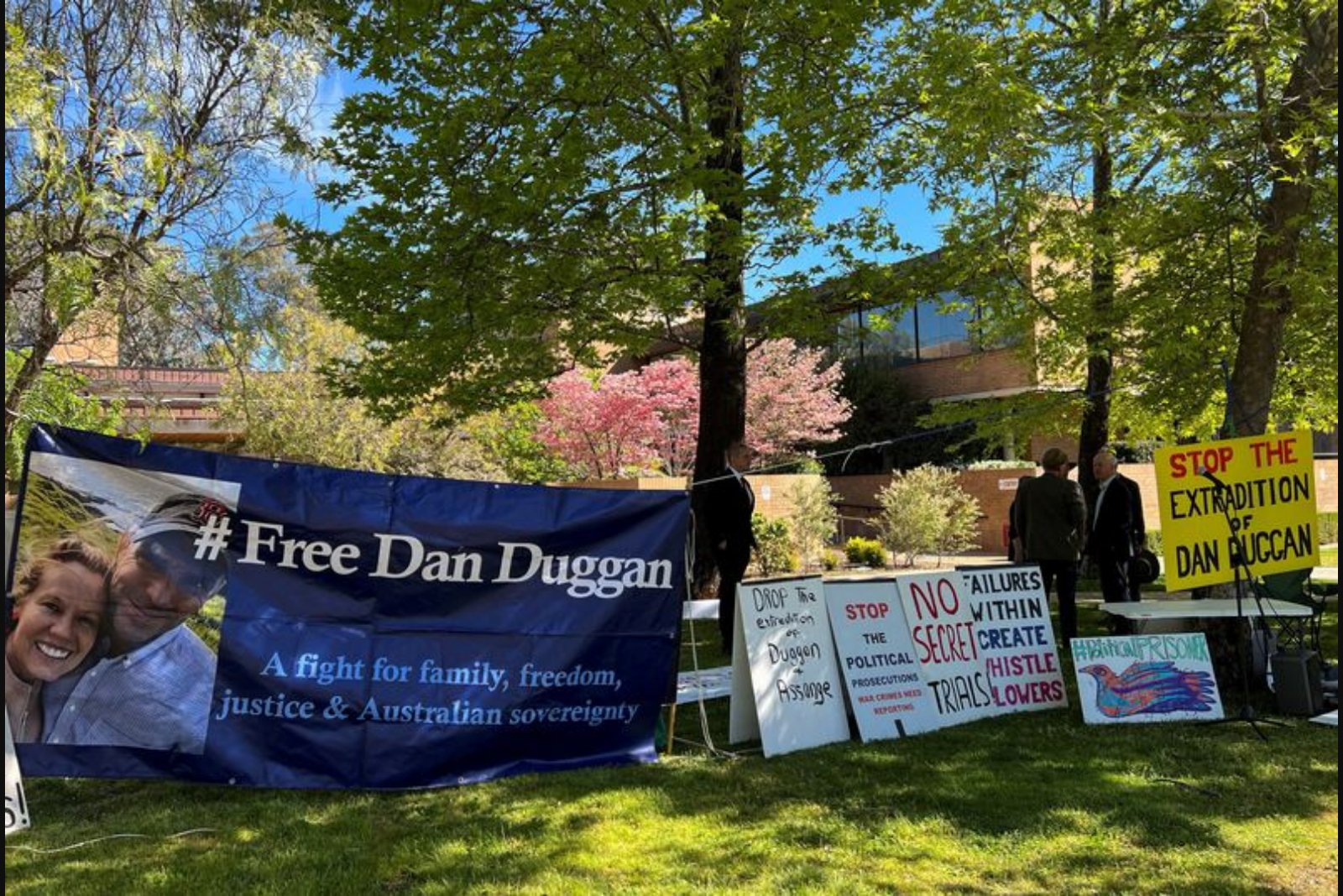
A former U.S. Marine Corps pilot who became an Australian citizen has failed in a legal bid to block his extradition to the United States on allegations that he violated U.S. arms control laws while involved in training Chinese pilots.
The man, Daniel Duggan, was arrested in New South Wales in October 2022 by the Australian Federal Police after returning from China, where he had resided since 2014. In December 2024, the then attorney-general of Australia, Mark Dreyfus, approved a U.S. request to extradite him to face criminal charges.
Duggan launched a challenge to that extradition decision. His argument centered on the contention that the attorney-general had erred legally by not properly applying Australia’s Extradition Act in light of the treaty governing extradition between Australia and the United States. He claimed those errors rendered the extradition decision invalid.
On Thursday, Federal Court of Australia Judge James Stellios dismissed the challenge. In handing down his ruling the judge stated that he was not satisfied the contested decisions suffered from jurisdictional error and therefore the application had to be dismissed. The court found no fault in the attorney-general's treatment of the relevant statutory requirements.
A spokesperson for the current attorney-general, Michelle Rowland, responded to the Federal Court ruling by noting the government had taken account of the decision. The spokesperson said Duggan will remain in extradition custody in Australia until his surrender to the United States of America.
Duggan has been detained since his arrest. He is a father of six children living in Australia. His wife, Saffrine, told the Australian Broadcasting Corporation that the family was disappointed by the court’s outcome but would evaluate their next steps. She said the family would not give up. The legal framework allows an appeal to be lodged within 28 days.
The United States has sought Duggan’s extradition on four charges related to his training of Chinese pilots in South Africa between 2009 and 2012. The indictment includes one count of conspiring to violate U.S. arms export laws and to defraud the United States, an offence that carries a potential five-year sentence. It also lists two separate arms export control violations, each with possible terms of up to 20 years, and one count of conspiracy to commit money laundering, likewise carrying a potential 20-year sentence.
In his appeal, Duggan’s legal team contended that the conduct alleged in the U.S. charges was not an offence in Australia at the time the conduct occurred or when the United States requested extradition. They argued this meant the requirement for dual criminality under the extradition treaty between Australia and the U.S. was not satisfied.
The Federal Court rejected that line of argument. The court held that the extradition treaty did not alter or amend the Extradition Act to impose an additional requirement of dual criminality beyond what the statute prescribes. Accordingly, the treaty did not obligate Australia to refuse the United States’ extradition request on the dual criminality basis asserted by Duggan’s lawyers.
With the Federal Court decision now recorded, Duggan remains in Australian custody. The immediate next procedural options available to him include lodging an appeal within the statutory 28-day period.