
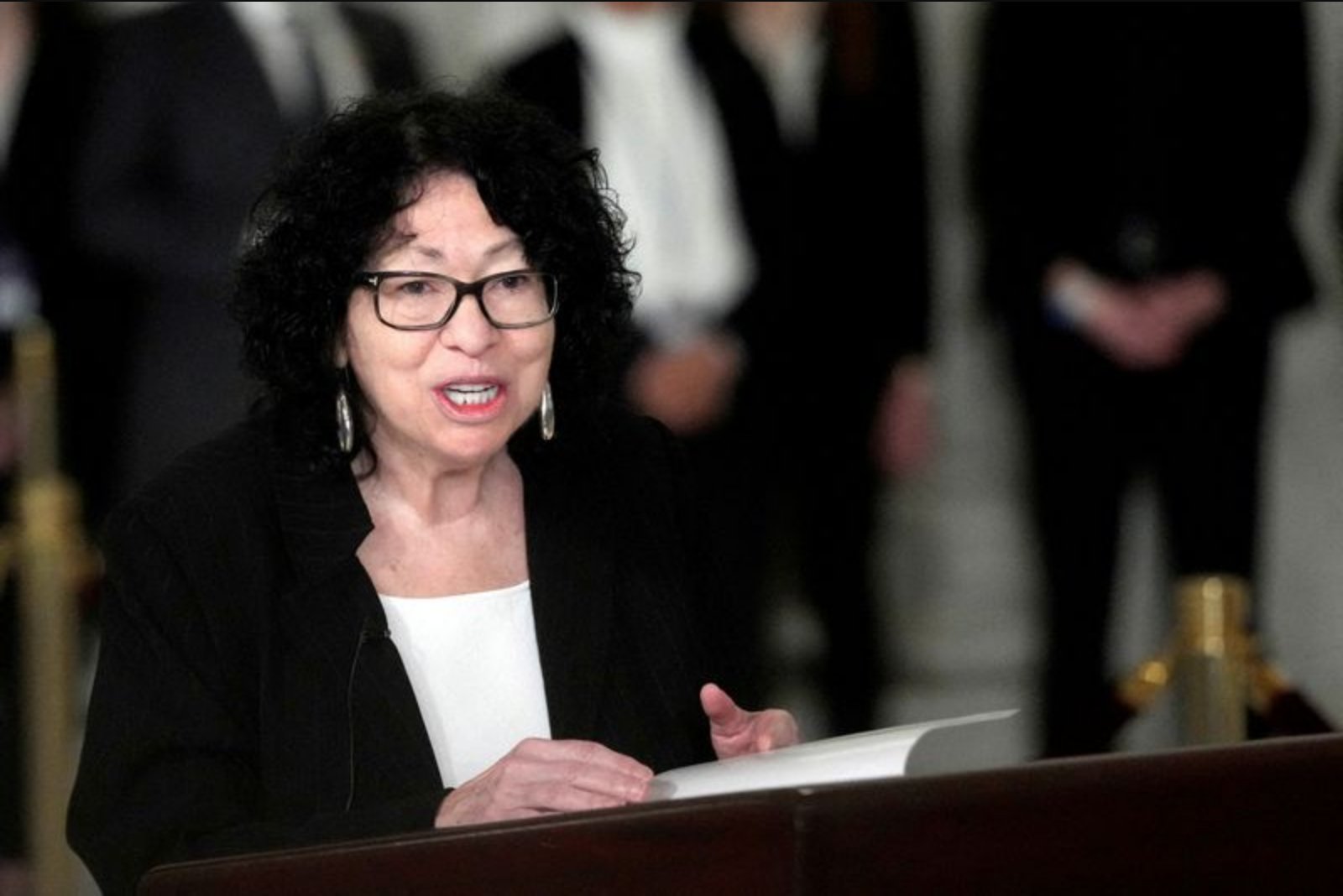
Justice Sonia Sotomayor offered an apology on Wednesday for remarks she made last week criticizing a fellow justice, a notable public expression of regret that underlines the deep divisions on the U.S. Supreme Court over its recent trajectory and handling of high-profile emergency matters.
In a statement released by the court, Sotomayor said she "referred to a disagreement with one of my colleagues in a prior case, but I made remarks that were inappropriate. I regret my hurtful comments." She added, "I have apologized to my colleague."
The statements concern a September matter in which the court allowed an emergency request from the Trump administration to permit immigration agents to proceed with roving raids in California that target people for deportation. A lower court had previously barred agents from stopping or detaining individuals without "reasonable suspicion" that they were in the United States illegally.
Justice Brett Kavanaugh, writing a concurring opinion in that case, set out his view that "apparent ethnicity alone cannot furnish reasonable suspicion" but that apparent ethnicity may be a "'relevant factor' when considered along with other salient factors." He further wrote, "If the officers learn that the individual they stopped is a U.S. citizen or otherwise lawfully in the United States, they promptly let the individual go." No other justice joined his concurring opinion.
At an appearance at the University of Kansas School of Law last week, Sotomayor criticized what she framed as a misunderstanding of how enforcement plays out on the ground. Without naming Kavanaugh, she referenced his concurring opinion and said that a colleague had described the interactions as "only temporary stops." According to a report of the remarks, Sotomayor continued: "This is from a man whose parents were professionals. And probably doesn’t really know any person who works by the hour."
Her comments echoed language from the written dissent she joined in the September decision, in which the liberal justices warned that the administration "has all but declared that all Latinos, U.S. citizens or not, who work low-wage jobs are fair game to be seized at any time, taken away from work, and held until they provide proof of their legal status to the agents’ satisfaction."
Sotomayor’s apology is unusual in its publicness. In recent years she has participated in public efforts to emphasize civility among the justices. The court previously issued a joint statement in January 2022 denying a media report of a dispute between Sotomayor and conservative Justice Neil Gorsuch over mask-wearing amid a surge in COVID-19 infections, noting that returning to work all the justices had worn masks in the courtroom except Gorsuch.
The incident involving Sotomayor’s comments is one of several moments in which internal disagreements on the bench have become visible to the public. Those divisions have surfaced around the court’s ideological shift to the right, disputes over ethical standards, and a pattern of emergency rulings that have repeatedly favored the Trump administration since he returned to the presidency in January 2025.
Voices among the court’s liberal wing have expressed broader concerns about the consequences of those emergency decisions. On Monday, Justice Ketanji Brown Jackson, speaking at Yale Law School, warned that emergency rulings were having a corrosive effect on the judicial system. Justice Elena Kagan, in remarks delivered in 2022, cautioned that the court’s legitimacy could be jeopardized if Americans perceive justices as imposing personal preferences on society - observations that were made in the aftermath of decisions by her conservative colleagues that limited abortion access and expanded gun rights.
Within the institution, the episode involving Sotomayor and Kavanaugh reflects competing perspectives on how legal doctrine translates into practical enforcement and on the optics of the court’s role in emergent, politically charged disputes. Sotomayor’s apology, and her statement that she has apologized to her colleague, leaves intact the factual record of the September decision, the concurring opinion, and the written dissent. It also illustrates how intra-court tensions can spill into public fora when justices speak outside their formal opinions.
Contextual note - The underlying dispute centered on whether immigration agents could resume roving enforcement operations in California while a lower court order requiring "reasonable suspicion" remained in place, and on the degree to which characteristics like apparent ethnicity may be considered alongside other factors in forming reasonable suspicion.