
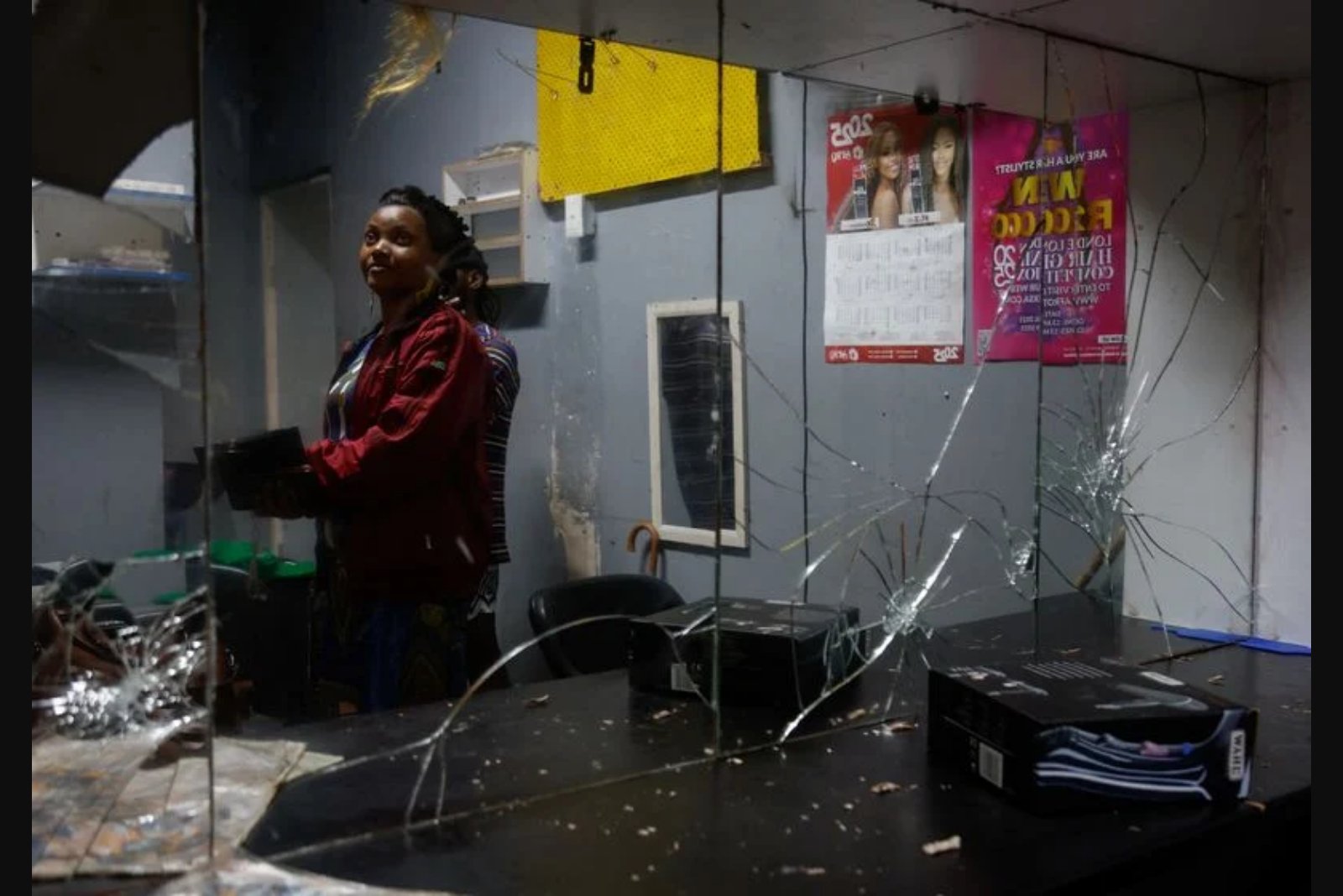
When Princess Adjei opened her hair salon in central Durban last November she did so as someone who has long regarded South Africa as home. Adjei, now 33, arrived from Ghana as a toddler, completed her schooling here, has local friendships and speaks Zulu, the common language of the eastern port city.
On May 18 that sense of belonging was violently disrupted. Demonstrators linked to an anti-immigration movement forced their way into her first-floor salon and looted it. In the aftermath Adjei said people she had known for years began telling her to go "home" to a country she has only visited once.
Surveying the wreckage, she described smashed mirrors, broken chairs and the empty hooks where hair pieces once hung. "They took everything," she said, pointing to the space where acrylic nails, six hair dryers and a range of shampoos had been displayed. The shop they took from her was the business she had invested in: she spent 50,000 rand renovating the salon in February.
Without the income the salon generated, Adjei said she can no longer afford rent. This month she moved out of her central apartment. Now, she and her 14-year-old son sleep beneath a blanket alongside some 200 other migrants who have set up a makeshift camp outside the office of the national Department of Home Affairs, hoping officials there can verify their residency status.
Adjei is one among scores of mainly African foreign nationals who say they were singled out during protests organised by a group known as March and March. While campaigners accuse foreign nationals of entering South Africa illegally and competing for jobs and services, many of the people affected hold legal papers and have deep roots in the country.
Other migrants have fled towns and cities to shelter on nearby hillsides and rough, exposed ground after violence swept through communities, killing at least five people and prompting a diplomatic rift with other African nations. Interviews conducted with a number of migrants in Durban included at least four individuals who have lived in South Africa since childhood.
March and March, the organisation that launched last month’s protests, rejects the label of xenophobia. Jacinta Ngobese, the movement’s founder, said that the term "applies ... to those people who come to a country illegally and make people from that country feel uncomfortable." She added that the group's aim was to channel South Africans' anger toward government authorities rather than to inflict violence on migrants. "We are not responsible for the violence," Ngobese said. "If we were violent, we would have been arrested." Yet observers and victims alike describe patterns in which the group's demonstrations coincide with the looting of foreign-owned shops and the destruction of homes.
Accounts from migrants and some local media describe limited police protection during and after the unrest. Some arrests were recorded following incidents in which protesters killed five Mozambican nationals and in other violent episodes, but many migrants said police responses were otherwise infrequent.
After fleeing their residences during the Durban protests, roughly 200 migrants initially sought safety outside the central police station. Four of those interviewed, including Adjei, said officers had moved them to a homeless shelter and then to a market warehouse; in both locations they reported being refused entry by people already occupying those facilities.
The following day, those migrants said, police instructed them to leave. The migrants and local media reported that officers later used rubber-coated steel bullets and tear gas against them. "They told us to look for another shelter," said Congolese refugee Tchomba Kasongo, hobbling and showing a bullet scar on his leg.
Many of the migrants now living outdoors said they were anxious about a deadline issued by the protesters: a June 30 ultimatum demanding all so-called "illegal" migrants depart. The deadline has heightened uncertainty for families and small business owners whose livelihoods have already been battered.
Durban police spokesperson Booysie Zungu disputed accounts that officers had used tear gas or fired on migrants, saying: "We never tear gassed anyone, we never fired on anyone." He also said the police had no records of certain complaints and urged affected people to open formal cases. A spokesperson for Durban's mayor declined to comment.
For Adjei, the attacks represent a painful rupture with neighbours she once considered friends. Returning to her apartment after seeing her salon ransacked, she encountered a South African neighbour with whom she had regularly shared tea in the corridor. The neighbour scowled and asked when she would be leaving.
It was not the first time Adjei had faced hostility. She recounted being bullied at school during the 2008 wave of unrest that periodically erupts into anti-migrant sentiment across the country. Still, some South African acquaintances have remained supportive. Wivene Bahati, a 25-year-old Congolese woman who has lived in South Africa since 2011 and who is now sleeping on the curb near Adjei, said an old classmate reached out after the most recent protests. "She felt bad. She asked me is everything ok?" Bahati said.
Analysts cited by those speaking about the situation note that migrants are often perceived as competitors for scarce jobs and public services, and that they can become targets when shortages arise or when government services fail to meet demand. Anti-migrant sentiment also tends to intensify during electoral cycles, they say; South Africa faces local elections by November. The Premier of KwaZulu-Natal, Thamsanqa Ntuli, rejected the idea that politics is stoking xenophobia, attributing the problem instead to illegal migration. "We agree with the entire society when they say: 'government, you should have started to manage migration properly ... a long time ago'," he said.
($1 = 16.2213 rand)