
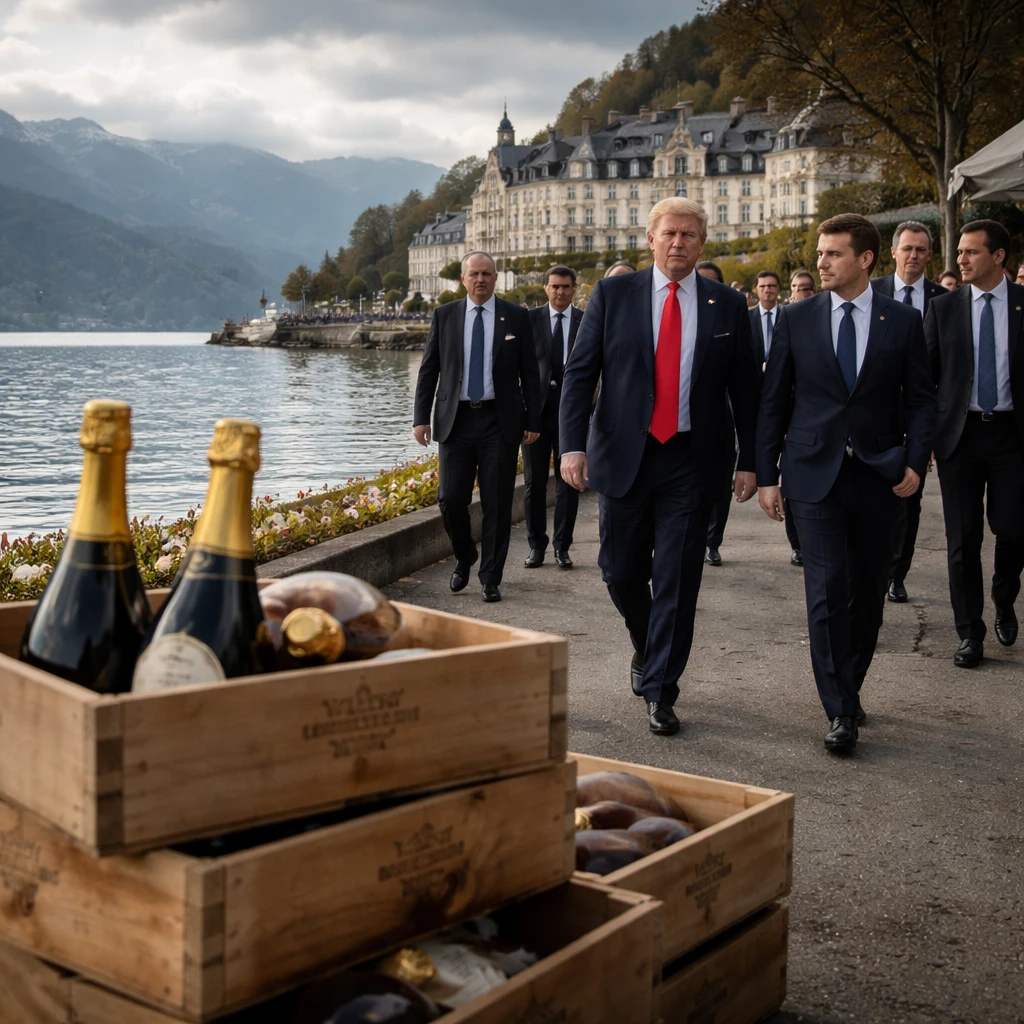
U.S. President Donald Trump has warned France that the United States could impose 100% tariffs on all French wines and champagnes unless Paris repeals a 3% digital services levy that targets American technology companies, according to an interview published by the New York Post on Monday.
Trump said he personally conveyed the demand to outgoing French President Emmanuel Macron, urging him to abandon what is commonly described as the GAFAM tax - a levy that applies to gross revenues earned in France by firms including Alphabet, Amazon, Meta and Apple. The president told the Post that if Paris refuses to drop the measure, Washington would have no option but to slap 100% duties on French wine imports, and that removing the levy would immediately remove the threat of those tariffs.
The exchange heightens tension ahead of the G7 summit, which runs through Wednesday in Évian-les-Bains, where trade is among the agenda items. The United States is a significant market for French wine: it accounts for about one-fifth of global French wine sales and is worth more than $2 billion a year.
The 100% tariff level invoked by Trump has precedent in U.S. trade deliberations. It was first proposed by the U.S. Trade Representative during a 2019 probe into the French levy. France has maintained the GAFAM tax since that same year; the French finance ministry reported that it generated roughly $700 million in 2025 alone.
Trump's statements also stand in contrast to assertions from the Élysée Palace. Last week, Macron's office said that the two countries had quietly resolved their disagreement over taxing Silicon Valley. A senior French source told reporters the dispute had effectively been settled among G7 partners, but a U.S. official subsequently rejected that characterization.
France's position is further complicated by shifting stances among its allies. Canada abandoned its own digital levy in 2025 after Washington walked away from trade talks, and Italy is reported to be considering a comparable retreat. By contrast, Britain has retained its digital services tax under its existing trade framework with the United States.
Domestically, pressure to raise the French levy has not disappeared. In October, France's National Assembly voted 296-58 to double the rate to 6%, although ministers later vetoed that measure. Earlier discussions among French lawmakers had contemplated a 15% rate before pulls back under industry pressure.
Following Trump's remarks, the White House reiterated to the Post a February 2025 presidential memo that said American firms would no longer "prop up failed foreign economies through extortive fines and taxes."
The ultimatum, made public as leaders converge in Évian-les-Bains, sets up a diplomatic and trade showdown with potential consequences across several sectors, including wine exporters, technology firms that operate in France, and the broader transatlantic trade and regulatory environment.
Further context within available reporting: The warning from the U.S. president revives a tariff strategy discussed by U.S. trade officials in 2019 and underscores the continued friction over national-level digital levies that seek revenue from large tech platforms. The dispute has seen differing responses from allied governments, with some rescinding their levies and others maintaining them under separate trade arrangements with the United States.