
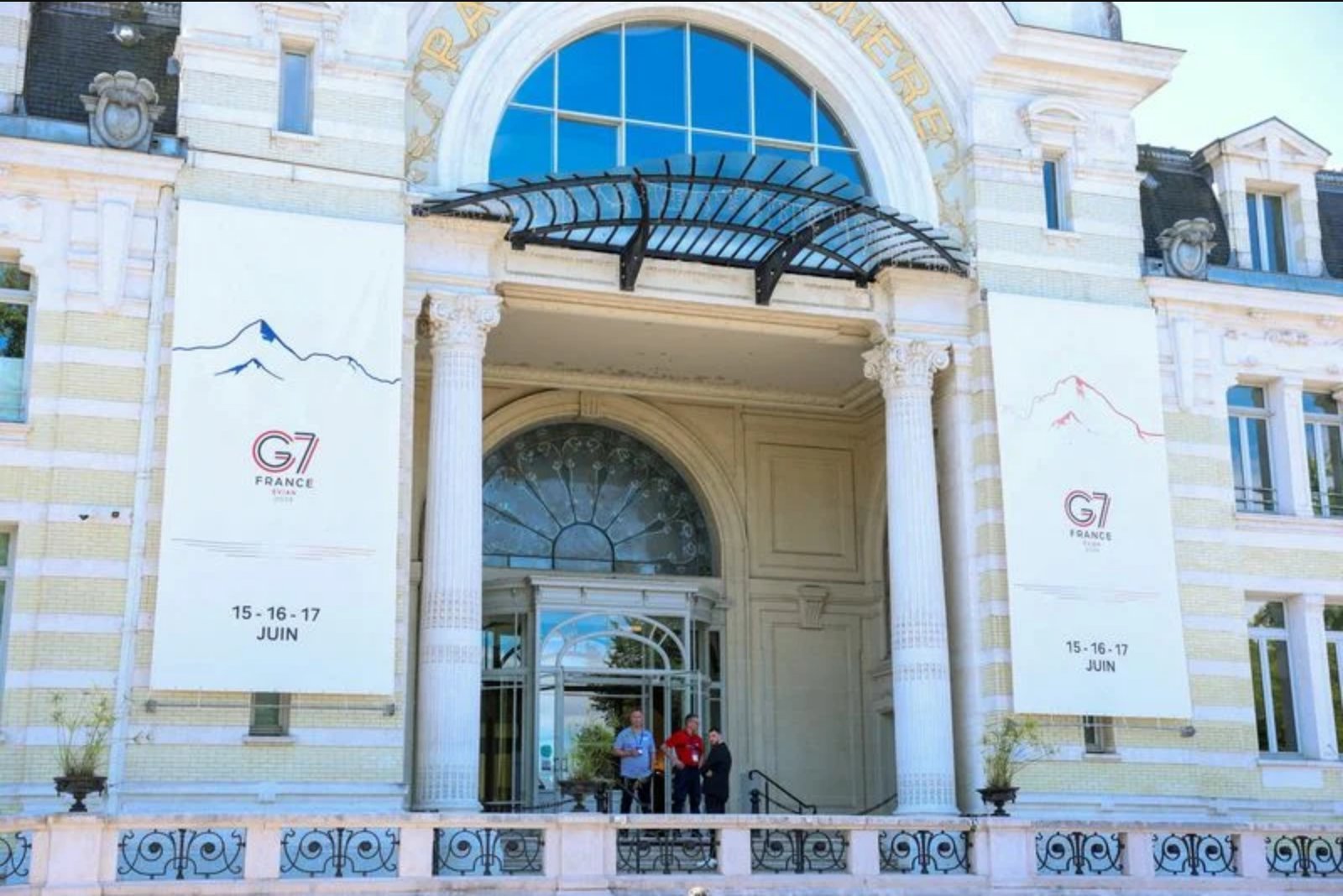
Leaders of the Group of Seven will meet at a French lakeside resort from June 15-17, arriving shortly after the United States and Iran said they had reached a preliminary pact to end their war. Delegations assemble in Evian-les-Bains to press for details on that understanding while also confronting persistent questions on the war in Ukraine, global economic imbalances and how to secure supplies of critical minerals away from the dominant supplier, China.
The U.S.-Iran understanding is expected to be a central topic of discussion. A memorandum of understanding is due to be formally signed on Friday in Switzerland, but leaders at the summit do not yet have full visibility on its precise terms. U.S. officials have said the Strait of Hormuz - an important route for global oil and gas shipments that Iran had effectively blocked for months - would reopen on Friday and that the United States had ordered an end to its blockade of Iranian ports.
In a statement, the secretariat of Iran's Supreme National Security Council declared that war and military operations on all fronts, including in Lebanon, would end permanently beginning Monday night. Iran's deputy foreign minister, Kazem Gharibabadi, said a broader agreement would be negotiated during a 60-day ceasefire period and that sanctions relief for Iran would be part of those discussions. Sources have indicated that Iran's nuclear program would be addressed in later talks.
G7 leaders will therefore be focused on extracting the details of the accord, and assessing the implications for regional stability and global markets. Energy markets and shipping routes have particular exposure given the Strait of Hormuz's role in oil and gas transit. The involvement of regional actors directly affected by the conflict - including the United Arab Emirates and mediators such as Qatar and Egypt - means the summit will also be a forum for those states to present their perspectives to the G7.
U.S. President Donald Trump is scheduled to arrive in Evian-les-Bains on Monday. French officials welcomed his presence after he left last year’s summit in Canada early. Many members of the G7 have been directly affected by the volatility stemming from the U.S. president's foreign policy actions, which the summit agenda frames as having disrupted the Middle East, global trade and diplomatic norms.
During the gathering, Trump will hold meetings with Middle Eastern leaders and take part in a working session with Ukrainian President Volodymyr Zelenskiy. That meeting comes as Russian advances in Ukraine have slowed and Kyiv presses allies for additional military funding. Mr. Zelenskiy's position has strengthened since last year when Mr. Trump told him in the Oval Office: "You don't have the cards" - a remark referenced in the context of evolving U.S.-Ukraine relations. Yet the summit dynamic suggests U.S. policy will balance support for Ukraine with a desire to finalize a settlement with Iran - a priority that has carried domestic political significance for the U.S. administration.
For French President Emmanuel Macron the summit represents a diplomatic centerpiece in the final year of his second term. Macron will greet Mr. Trump on Monday and has secured his agreement to attend a formal state dinner at the Palace of Versailles on Wednesday. Paris has used its G7 presidency to push an agenda focused on global macroeconomic imbalances - a theme that Paris frames as a shared responsibility, describing China as overproducing, the United States as overconsuming and Europe as underinvesting.
To broaden the conversation, France has invited Brazil, India, Kenya and South Korea to take part in summit discussions. Macron has publicly encouraged China to boost its domestic consumption as part of a broader rebalancing of global demand and supply dynamics.
Beyond geopolitics, leaders will seek consensus on securing supplies of critical minerals - materials essential for clean energy, advanced electronics and defense technologies - outside the current dominant supplier. Securing alternative sources and supply chains is a stated priority for the G7, and will be discussed alongside broader trade and investment topics.
As summit participants deliberate, several dimensions remain uncertain: the detailed provisions of the U.S.-Iran memorandum, the extent of sanctions relief that might be negotiated during the ceasefire period, and how those developments will influence Western military support for Ukraine. The convergence of these issues - security in the Middle East, the trajectory of the Ukraine conflict, and macroeconomic imbalances - sets a crowded agenda for the three-day meeting in Evian-les-Bains.
Summary
G7 leaders convene in Evian-les-Bains for a three-day summit immediately after Washington and Tehran announced a preliminary deal to halt their war. Delegates will press for the memorandum's details, consider the implications for Ukraine funding, and advance discussions on economic imbalances and critical minerals supply diversification.
Key details
- A memorandum of understanding between the United States and Iran is set to be signed on Friday in Switzerland; precise terms remain unclear.
- The Strait of Hormuz is expected to reopen on Friday after months of effective closure, and the United States has ordered an end to its blockade of Iranian ports.
- Iran reported that hostilities would end permanently starting Monday night, and an expanded agreement - including sanctions relief - is to be negotiated over a 60-day ceasefire.