
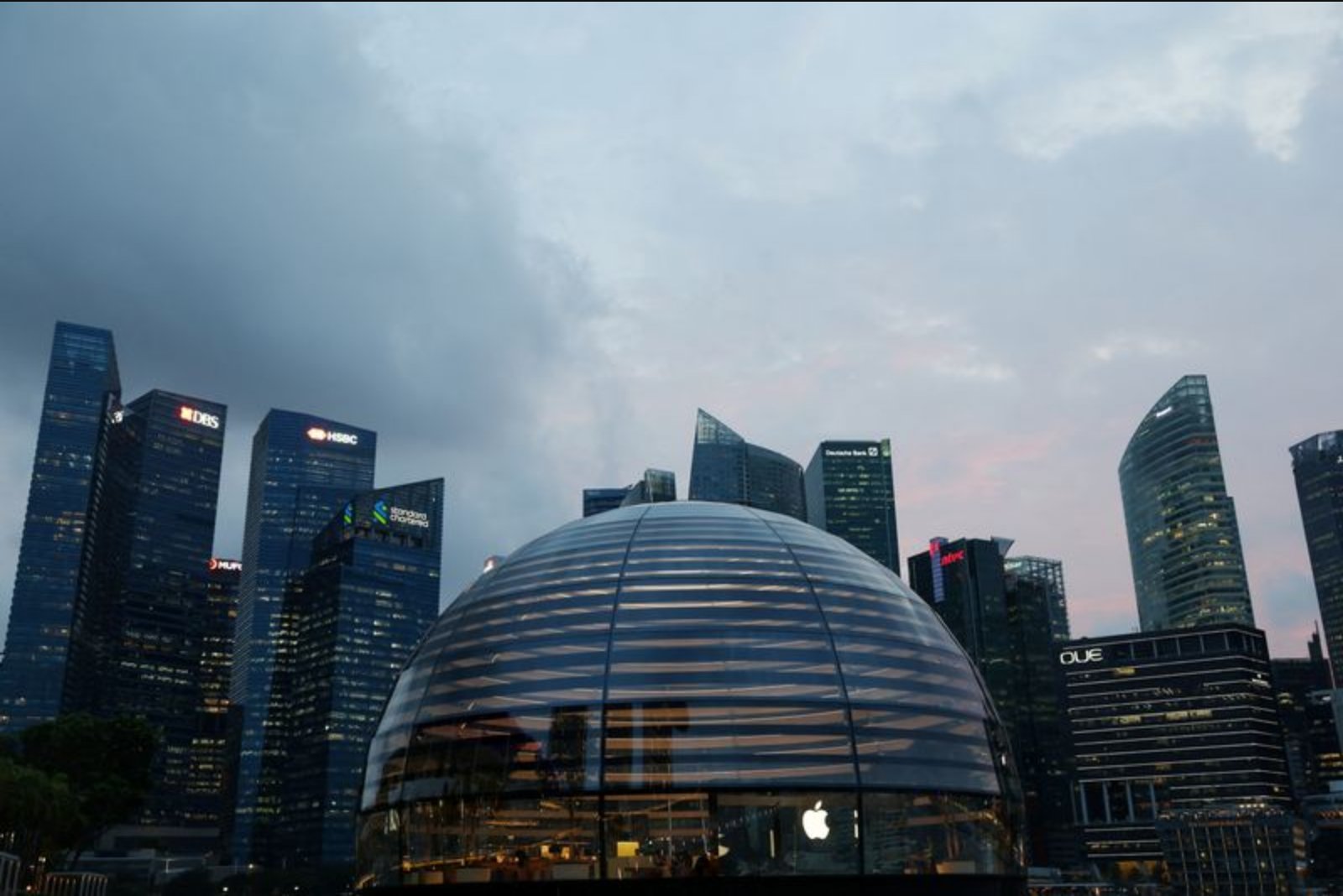
Singapore is evolving from an East-West gateway into a deliberate neutral ground for firms building artificial intelligence products, as companies from China and the United States look to escape mounting political and regulatory pressure in their home markets.
Investors and executives navigating the intensifying Sino-U.S. competition say setting up operations on the island delivers a reassuring signal to international clients that a company’s intellectual property resides outside the direct control of either Beijing or Washington. "Setting up in Singapore gives a lot of comfort," said Kerry Goh, chief executive of Kamet Capital, describing how clients interpret an island-based legal and operational footprint.
Goh recounted advising two former executives from Chinese tech company Alibaba to incorporate their AI video venture, Topview, in Singapore as part of a strategy to remove potential concerns about Chinese government oversight. Topview has received more than $8 million in Kamet investment since 2024, according to Goh. He said moving the operation out of China and clarifying that the product was not available in China increased the venture’s prospects of selling to clients in the United States.
The shift to Singapore comes as U.S.-China tensions over emerging technology - and in particular AI - have grown more public. The article notes that U.S. policy moves have affected the movement of talent and equipment, and that the U.S. has taken steps such as preventing Nvidia from selling its most advanced AI chips to China and restricting access to chipmaking tools.
At the same time, changes to U.S. visa rules for highly skilled workers have complicated staffing plans for companies that routinely transfer engineers to and from the United States. The resulting uncertainty has heightened the appeal of Singapore, where authorities have launched measures to attract AI talent and incentivize firms to register intellectual property locally.
Singapore’s Economic Development Board said its "ecosystem enablers" have attracted investment from companies of various sizes and nationalities. Industry participants describe two overlapping dynamics: Chinese-founded firms seeking to distance themselves from political preconceptions by appearing more Singaporean, and U.S. companies looking for engineers without the friction of U.S. visa processes.
Brad Gastwirth, global head of research at Circular Technology, summed up the trend by saying, "Singapore is increasingly becoming a neutral hub for AI companies from both the U.S. and China." He also pointed to the difficulties firms face when the visa process in the United States has become more unpredictable, with longer waiting times, stricter screening and higher fees.
Several AI firms with links to either China or the United States have established operations in Singapore. Examples cited include automation platform Workato, wealth management tool developer Addepar, note-taking device maker Plaud AI, and legal platform Harvey AI, which joined the local ecosystem in June. The article also notes the presence of major AI developers such as OpenAI, Meta-affiliated Superintelligence Labs and Alphabet-owned DeepMind.
Three people familiar with the matter said U.S. developer Anthropic - whose $30 billion fundraising round was led by Singapore’s sovereign wealth fund GIC - plans to open a Singapore office. Anthropic declined to comment.
Despite the appeal, observers say Singapore’s role as a neutral zone is fragile and could provoke countermeasures. National University of Singapore political scientist Chong Ja Ian warned that rising demands from the U.S. and Chinese governments to keep their technology stacks separate could prompt authorities to view Singapore as a "grey space" for technology transfers. That perception, Chong said, could lead one or both major governments to impose restrictions on activities involving Singapore.
Tan Yinglan, founding managing partner of Insignia Ventures Partners, set out conditions under which a Chinese founder’s relocation to Singapore would genuinely insulate a company from Chinese controls. According to Tan, such a move only works if the founder no longer holds a Chinese passport, does not employ engineers in China, and if the company’s revenue, data and headquarters are also not based in China.
The paper reports specific instances that illustrate the tensions. It cites a Financial Times account that China imposed a travel ban on founders of AI startup Manus after the company moved to Singapore and was acquired by Meta. A Washington Post report is cited saying that Chinese authorities told MiroMind not to send talent abroad after the startup established offices in Singapore, Japan and the United States.
When Reuters sought comment on MiroMind, parent company Shanda said only that it develops AI projects across countries. Shanda CEO Chen Tianqiao wrote on LinkedIn that going global was challenging for AI firms given how rapidly regulation, geopolitics and public scrutiny are changing.
The article notes that China’s Ministry of Commerce and the U.S. Department of Commerce did not respond to written requests for comment.
Practical benefits of Singapore’s approach are highlighted by corporate service providers and engineers who have relocated. Huang Lin, founder of Link-da, said entry to Singapore is "very friendly" and that employment passes can sometimes be approved within three days. Link-da has helped roughly 50 Chinese AI-related firms establish operations in Singapore since 2024, Huang said.
Indonesian AI engineer Vincent Tatan described Singapore as "very welcoming" after moving there from the United States. Tatan also recounted that a U.S. employer initiated, then cancelled, an application for permanent residency on his behalf, leaving him to question whether the fight and wait for U.S. residency was worth it.
As AI companies evaluate where to locate staff, data and headquarters, Singapore’s combination of policy tools, business-friendly administration and bilingual population is being tested as a deliberate alternative to operations rooted in China or reliant on U.S. immigration flows. Still, the article underscores that geopolitical friction and the protective actions of the major powers could yet complicate Singapore’s role as a neutral hub.