
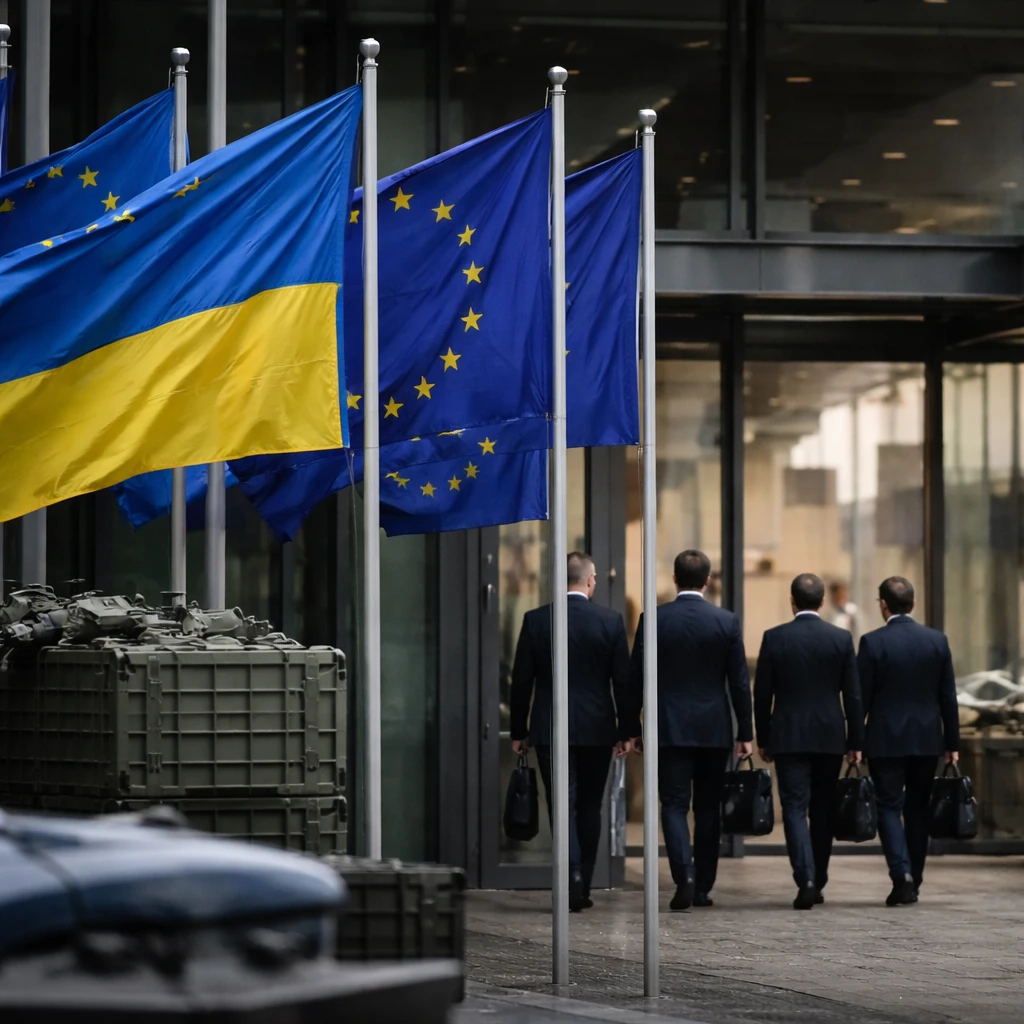
The responsibility for sustaining Ukraine's war effort has shifted decisively onto European institutions after the European Union this week finalized a €90 billion ($105 billion) loan package intended to keep Kyiv funded through the end of next year.
The package represents a substantive change in how the war is financed, coinciding with a narrowing of U.S. focus toward the Middle East and a pullback from the United States' previous role as Ukraine's principal external backer.
European leaders describe the loan as a vital lifeline for Ukraine, but officials in Brussels say the commitment may not match the full financial demands of a protracted conflict. Diplomats referenced by European officials estimate a further funding gap of about €19 billion for the coming year alone, leaving open the possibility that additional multi-billion euro programs will be required sooner than anticipated.
The decision to advance the loan package came after a political shift inside the bloc - the measure was cleared following the recent electoral defeat of Hungary's leadership - and was hailed by Kyiv's president. At the same time, President Volodymyr Zelensky has emphasized that Ukraine still requires certain U.S.-sourced capabilities that the EU cannot currently reproduce, specifically high-end aerial interceptors and battlefield intelligence, capabilities Brussels officials acknowledge are outside the bloc's present production capacity.
Two additional strains complicate the EU's ability to sustain long-term aid. First, energy price volatility linked to the conflict in Iran is adding financial and political pressure across the continent. Second, rising domestic political pressure from nationalist parties in France and Germany is making it more difficult to maintain unity on extended funding commitments.
Support for the loan package remains firm among several leading EU members, who frame the conflict as a direct security concern for Europe's borders. Nonetheless, officials caution that maintaining a consensus on continued assistance will be a delicate balancing act amid shifting energy markets and domestic political currents.
On the industrial side, Europe's defense sector is adjusting its approach. Companies and policymakers are moving toward joint production models with Ukraine, seeking to incorporate Kyiv's recent tactical drone experience and battlefield lessons into allied production and procurement plans. These efforts aim to leverage Ukraine's tactical expertise while addressing capability gaps, but they do not immediately replace the specialized systems Ukraine continues to request from the United States.
As the conflict extends into its fifth year, major questions remain about whether Europe can shoulder the primary financing burden over a prolonged period. With national elections scheduled in multiple EU member states, the ability of European capitals to shield defense spending from populist fatigue will be central to determining whether the current level of aid can be sustained through 2027 and beyond.
Key takeaways:
- The EU has approved a €90 billion ($105 billion) loan package to fund Ukraine through the end of next year.
- Diplomats estimate an additional €19 billion shortfall for next year, indicating possible further funding needs.
- Europe lacks certain U.S.-sourced military capabilities such as high-end aerial interceptors and battlefield intelligence, prompting continued Ukrainian appeals to Washington.