
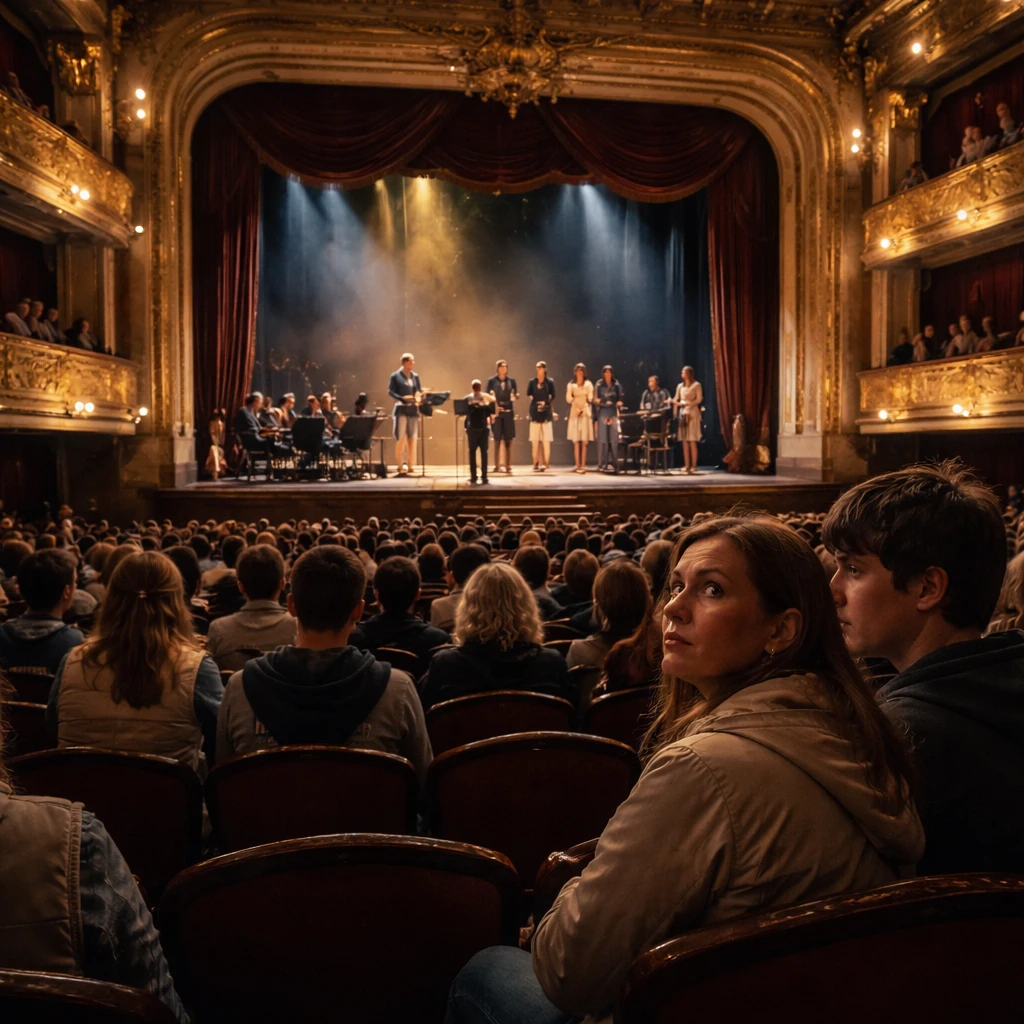
An opera by Ukrainian composer Maxim Kolomiiets that opened in Kyiv this week dramatizes the efforts of two mothers and a grandmother who risked their lives to travel roughly 3,000 miles (4,800 km) to occupied Crimea to recover children taken by Russian forces.
Titled "Mothers of Kherson" and co-commissioned by New York's Metropolitan Opera, the piece is grounded in the real accounts of women who departed a southern Ukrainian city after it was liberated in November 2022 and set out to bring their children home. The women circumvented a roughly 750-mile front line, moving via Poland, Belarus and Russia, to reach the camp in Crimea where the children were held.
Ukrainian officials say they have confirmed the abduction by Russia of around 20,000 children during the four-year-old war. A U.N. commission concluded in March that the deportation and enforced disappearance of Ukrainian children by Russia amounted to a crime against humanity. The Kremlin rejects that finding, saying it evacuated Ukrainian children for their safety. Charitable organization Save Ukraine reports that 1,343 children have been returned so far through rescue efforts it helps to organize.
Peter Gelb, general manager of the Metropolitan Opera, said he hoped that converting these accounts into art would help keep public attention on alleged war crimes and produce a lasting record. "It’s just an incredibly emotional story that these mothers would basically sacrifice everything, including their lives if necessary, to get their children back," Gelb, 73, said. He added that setting the story to music intensifies its impact. "It has the capability of doing something that watching the news can’t possibly do, or reading a newspaper, which is to elevate our souls," he said.
The premiere took place at Kyiv’s 19th-century national opera house on the day Ukraine observes remembrance for children killed in the conflict. The staging presented excerpts from the work, which remains incomplete. A full production is scheduled at the Polish National Opera in October, with a subsequent Metropolitan Opera premiere planned for April 2028.
Among those in the audience was Yulia Radzevilova, one of the mothers whose experience inspired the opera. She and her son Maxim, now 16, were able to return just over three years ago. Radzevilova, 39, said the trip to reclaim her child had been "very difficult and long," and that seeing the episode onstage brought back intense emotions and moved her to tears.
Her son Maxim was part of a group that was sent to Crimea in October 2022 under the guise of a two-week trip organized by a teacher for children to "rest" from the war. Maxim remained there for four months. When his mother sought his return, she was told to retrieve him in person. Maxim, who was 12 at the time, described the camp as feeling like a "prison," saying children were forbidden to speak Ukrainian, faced corporal punishment and were made to exercise each morning to the Russian national anthem. He recalled reaching out to his mother by Telegram, saying, "I wanted to go home. When I saw my mother, I was so happy."
Mykola Kuleba, founder of Save Ukraine, said he was surprised when Gelb contacted him after rescue missions in 2023 and that they later met in Washington to discuss turning the rescues into an operatic work. "An opera about kidnapped children - I’d never heard of such a thing," Kuleba said. He described the music at the premiere as "magical" and called attending the performance a "moment of healing," particularly as Kyiv continues to endure regular air raids.
Kuleba said Save Ukraine continues to identify new cases of abducted children, many of whose parents were killed, arrested or have disappeared. He said rescued children reported being barred from contact with Ukrainian culture and taught that the West was their enemy. "We will not stop. We’ll continue our rescue missions," he said.
Keri-Lynn Wilson, who conducted the Kyiv premiere, founded the Ukrainian Freedom Orchestra after the Russian invasion to showcase Ukrainian artistic talent internationally. A Canadian of Ukrainian descent, she said the opera would help draw attention to Ukraine’s suffering and its resilience. "Ukrainian culture and music are vital and alive and you can’t silence it," Wilson said. She is married to Gelb.
The opera’s public debut in Kyiv was both a cultural moment and a form of testimony, bringing to the stage the intimate details of long, dangerous journeys and the conditions reported by children who were held in camps. The production’s planned run in Poland and later at the Metropolitan Opera reflects collaboration between Ukrainian artists, international cultural institutions and humanitarian organizations involved in rescue efforts.
While the work remains unfinished, organizers and participants framed the artistic project as a way to record survivor testimony and to foster broader awareness about forced transfers of children and the responses of charities and cultural institutions. The premiere’s timing, on a day set aside to remember children killed in the conflict, underscored the opera’s connection to ongoing human rights concerns and to efforts to recover those still missing.
Contextual note: The stage work focuses on firsthand accounts and documented rescues as described by participants, organizers and charity representatives. It aims to translate those accounts into a sustained artistic statement without altering the underlying factual claims provided by those sources.