
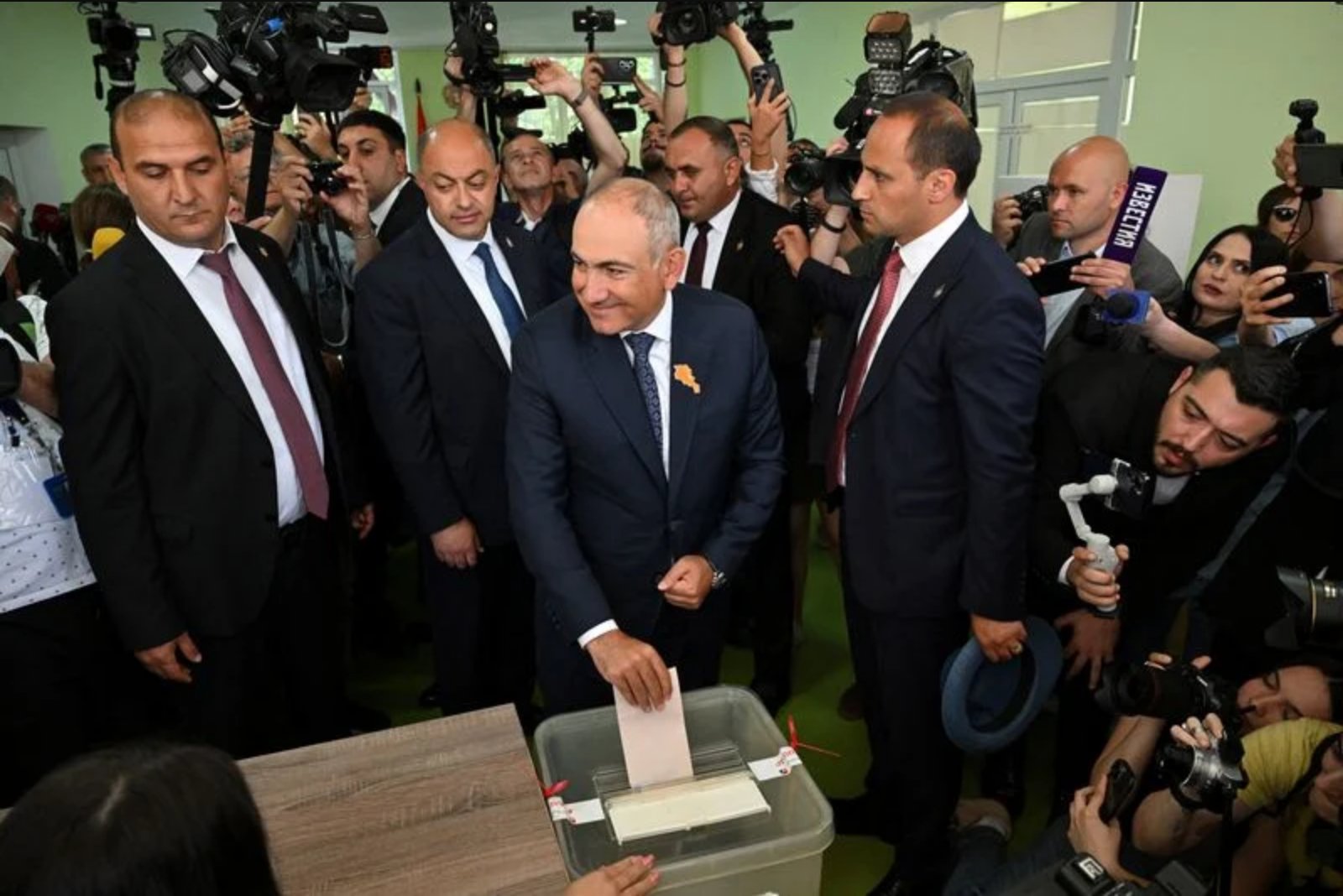
Armenia held a parliamentary election on Sunday that many inside the country and observers abroad framed as a verdict on the government’s peace efforts following a crushing military defeat by Azerbaijan three years earlier. Voters were confronted with competing visions: the ruling Civil Contract party led by Prime Minister Nikol Pashinyan, and a resurgent pro-Russian opposition grouping headed by Samvel Karapetyan.
Opinion polling published prior to voting showed Pashinyan’s Civil Contract topping preferences with support of up to 32% of respondents. The Strong Armenia party, a pro-Russian force established last year by Russian-Armenian billionaire Samvel Karapetyan, trailed in second place with up to 11% backing.
Pashinyan, who was a journalist and opposition activist before entering politics, has steered Armenia closer to Western partners since taking office in 2018, a course that has drawn Moscow’s displeasure in the run-up to the ballot. Supporters point to marked economic improvements since he assumed power: GDP per capita has doubled under his administration, a fact frequently cited by voters at campaign events.
At a rally in Yerevan’s central square on Friday, 39-year-old Karine Darbinyan expressed enthusiasm for the changes she has witnessed. "I really like how Armenia has been growing right before my eyes," she told the crowd, reflecting the sentiment of some voters who link economic progress to Pashinyan’s tenure.
The Karabakh exodus and campaign tensions
The 2023 war and its aftermath have been a dominant theme of the campaign. Critics of the prime minister and segments of the public have accused him of yielding to Azerbaijan in ways they deem unacceptable, particularly after the retaking of Nagorno-Karabakh by Azerbaijan and the subsequent flight of the region’s Armenian population.
Pashinyan has foregrounded his diplomatic approach in response, making the pursuit of a peace deal a central pillar of his campaign message. He has highlighted the agreement he signed at the White House last August with Azerbaijan as a key element of that strategy.
Opposition groups, many of which espouse a pro-Russian orientation, have rallied behind promises to reestablish closer ties to Moscow. At a Strong Armenia gathering in Yerevan last week, a woman who identified herself only as Gayane said she supports Samvel Karapetyan because she believes he can ensure "that our Armenia remains Armenian." Gayane described her roots as originating in Nagorno-Karabakh, a territory Armenians also refer to as Artsakh, and said that the population there fled during the chaotic one-day offensive by Azerbaijani forces in 2023. "We lost Artsakh, hoping it would remain with us," she said. "The current authorities have taken away that hope from us. And Samvel Karapetyan has now given us new hope that we can at least preserve our Armenia and our traditions."
Security, arrests and political friction
The campaign period has also been marked by a series of arrests targeting opposition figures, including some parliamentary candidates for the Strong Armenia party. Critics and human rights groups have accused Pashinyan of authoritarian tendencies, pointing to the imprisonment of many of his opponents in recent years. The government has countered these allegations by defending law enforcement actions, saying they target individuals accused of attempting to foment coups.
These developments unfolded as polling stations opened at 8 a.m. local time (0400 GMT) and were set to close at 8 p.m. The electorate for the vote comprised some 2.48 million registered voters in a country with an overall population of about 3 million.
Economic and geopolitical stakes
While the campaign rhetoric emphasized national identity and security, the election also carried economic undertones. Russia remains an important partner for Armenia as a supplier of energy and a buyer of Armenian exports, a link cited by pro-Russian politicians arguing for closer ties with Moscow.
The parliamentary outcome is likely to affect the trajectory of Armenia’s foreign alignment and, by extension, relationships that bear directly on energy supplies and export markets. Voters weighing economic progress under Pashinyan against concerns over territorial losses and cultural preservation were thus making choices that combined both domestic and geopolitical calculations.
As results were awaited, the vote stood as a measure of public confidence in Pashinyan’s strategy to secure a negotiated peace and a sign of how strongly pro-Russian sentiment resonates after the turmoil of the previous year.