
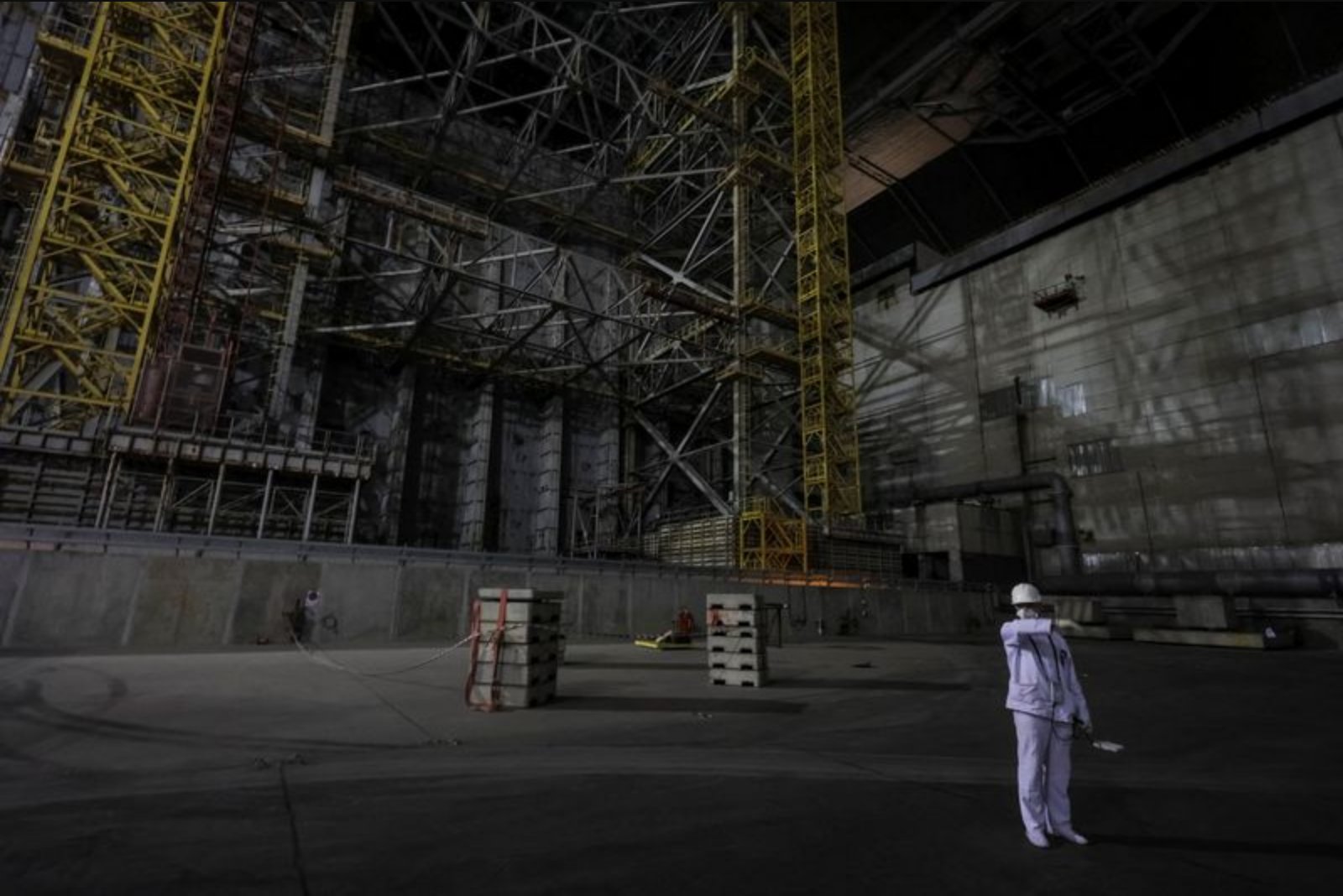
Denys Khomenko remembers the night a year ago when a strike drone struck the protective covering over the part of the Chornobyl nuclear plant that was damaged in the world's worst nuclear accident - narrowly averting another disaster. As deputy director for technical operations, Khomenko said keeping a steady composure is essential when managing the complex and hazardous tasks required to keep the site powered and secure while the damaged reactor is gradually dismantled.
"Emotions get in the way of logic, so you need to work calmly," he said during a recent visit to the plant, located inside a quiet, wooded exclusion zone roughly 100 km north of Kyiv.
The drone strike on February 14, 2025 punched a hole through the outer protective arc that sits over reactor four. Workers have since mounted a large panel to cover the breach, a repair that is small in scale compared with the enormous 256 metre-wide steel-and-concrete structure built to contain the reactor and the radioactive debris within. Additional repairs are required, but access is limited by lingering radiation that makes prolonged work in some areas unsafe.
Large portions of the exclusion zone now show radiation levels close to normal, but zones surrounding the destroyed reactor remain highly contaminated. Khomenko highlighted that highly skilled personnel, such as welders, can often only tolerate short exposures in these contaminated areas - sometimes minutes, sometimes a few hours. That constraint drives up the number of specialists needed to complete repairs and complicates scheduling and logistics, since such workers are not easily replaced.
Those operational limits underscore the acute hazards present at the facility more than four years into the conflict that has seen repeated strikes on Ukrainian infrastructure. The site remains an uncanny landscape where wild moose wander the approach road and the abandoned city of Prypiat sits reclaimed by the surrounding forest.
The damaged arc covers tons of radioactive material left by the April 26, 1986 explosion of reactor four, which spewed radioactive clouds across much of Europe. The new outer shelter, completed in 2016 at a cost of 2 billion euros and designed to have a 100-year lifespan, sustained damage to its membrane in the drone attack. Experts have warned repairs are necessary within the coming years to prevent permanent degradation.
Odile Renaud-Basso, president of the European Bank for Reconstruction and Development, said the primary concern is corrosion that could undermine the shelter's integrity and pose nuclear safety risks. The bank is working to raise funds for the required work and estimates the repairs will cost at least 500 million euros.
Inside the protective arc the original sarcophagus - a gray, rusted structure built immediately after the 1986 explosion - remains intact and officials report no radioactive leaks have been detected following the strike. The control room of reactor four is a dim space strewn with aging Soviet-era instruments.
Ukraine's prosecutors say the strike involved a Shahed drone - a platform Kyiv's forces do not use - and Moscow has denied responsibility. Russian officials have claimed Kyiv attacked the site to obtain more support from Western nations. Meanwhile, Ukraine's top state prosecutor reported that Russian unmanned aerial vehicles and missiles have been routed near the plant; radars, according to Ruslan Kravchenko, detected at least 92 Russian drones within a five-km radius of the shelter since June 2024.
The plant continues to operate with a workforce of roughly 2,250 employees who maintain power, security, and decommissioning operations. The facility was briefly occupied by Russian forces in the initial weeks of the 2022 invasion, an occupation that delayed plans to dismantle reactor four. Today, some workers live on-site in rotating shifts of 13 days, in part because the overland route through Belarus they once used has been cut off.
Khomenko warned that other areas of the site are also vulnerable, particularly a nuclear fuel storage location near reactor four. "It was not designed for the impact of aerial vehicles, planes, or anything else of that kind," he said, noting that many structures predate threats from modern aerial attack and therefore lack resilience to such impacts.
Repairing the damaged outer shelter and ensuring long-term containment will require substantial funding and a pool of qualified specialists able to work under tight exposure limits. The combination of elevated contamination around reactor four, limited access routes for staff, and the proximity of repeated drone flights has left managers and international financiers focused on both technical remedies and security measures.
For now, no radioactive release has been recorded, but the recent strike and its aftermath have crystallized a set of technical, workforce, and funding challenges that must be resolved to keep the site stable as it moves through a protracted decommissioning process.