
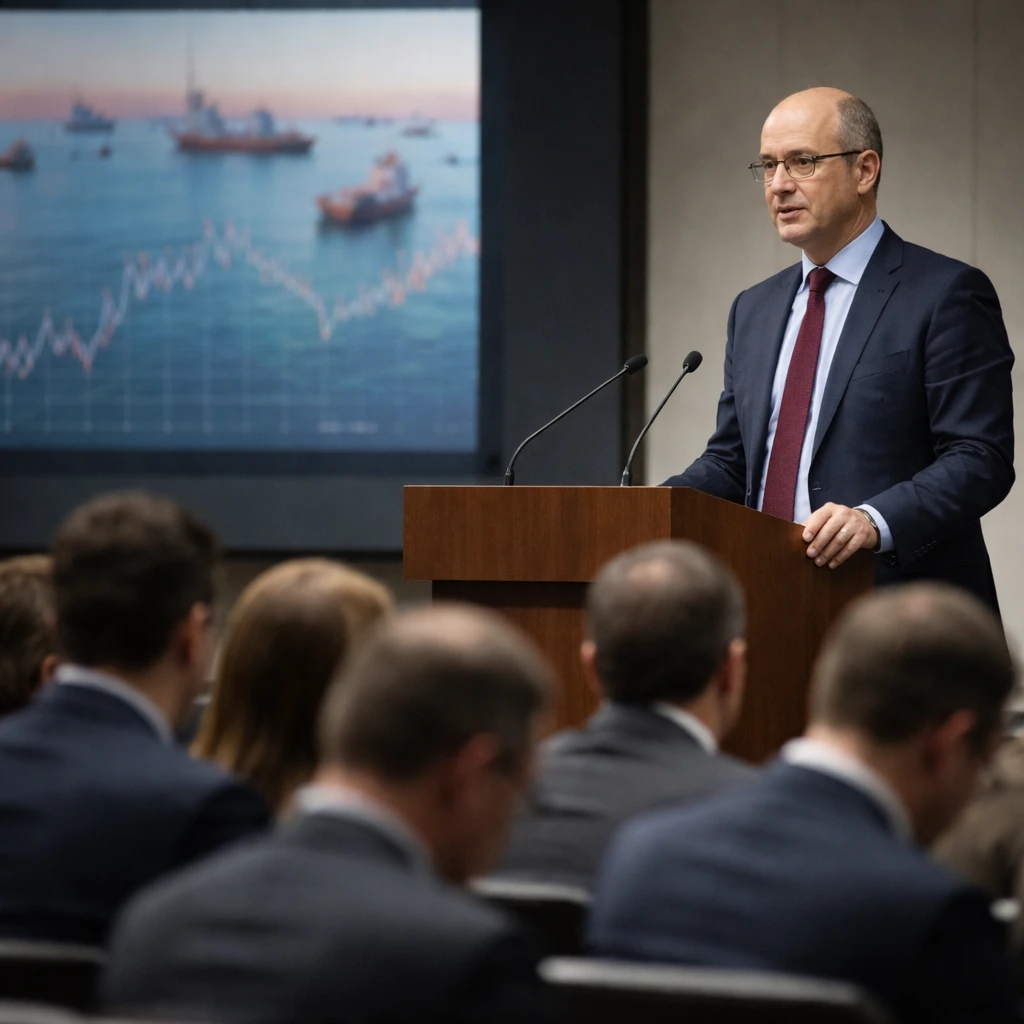
Reserve Bank of Australia Deputy Governor Andrew Hauser said on Monday that policymakers are not certain whether interest rates are set high enough to bring inflation back into the central bank's 2% to 3% target band. Hauser made the comments while speaking at an event in New York, and he drew attention to a recent geopolitical shock that requires careful observation.
Headline inflation stood at 3.7% in February, Hauser noted, and the RBA will need rates to reach a level that returns inflation to its target range. He cautioned that high confidence in having achieved the correct stance on interest rates is uncommon, and stressed the need to monitor developments closely. "I wouldn’t say we have high confidence that we’ve set interest rates at the right level because you never do have that high confidence. But we’re going to have to monitor this new shock pretty carefully," he said.
This year the RBA has raised its policy rate twice, taking the rate to 4.1%. Those moves have reversed two of the three rate cuts implemented last year. The central bank has warned that sharply higher fuel costs are likely to lift headline inflation to about 5% in the second quarter, a risk the RBA shares with other major central banks.
Global oil and gas prices rose sharply in March after fighting involving the U.S., Israel and Iran disrupted at least a fifth of world supplies, according to the bank's assessment. The RBA explicitly cited fuel-driven inflation as a key factor when it increased rates last month.
Beyond the immediate energy-driven pressures, the bank is also contending with what it described as a late-2025 resurgence in inflation domestically. That resurgence is attributed in the RBA’s assessment to local supply-side shocks combined with robust private demand.
Hauser’s remarks underline the dual challenge facing policymakers: calibrating interest rates to rein in inflation while tracking the broader economic impact of a disruption to fuel supplies caused by the Middle East conflict.
Key points
- RBA Deputy Governor Andrew Hauser says there is uncertainty whether current rates are sufficient to achieve the 2%-3% inflation target.
- The RBA has raised rates twice this year to 4.1%, reversing two of last year’s three cuts.
- Sharply higher fuel costs from a supply disruption tied to conflict involving Iran are expected to push headline inflation toward 5% in Q2; the bank also faces a late-2025 domestic inflation resurgence from supply shocks and strong private demand.
Impacted sectors: energy, consumer-facing sectors, financial markets.
Risks and uncertainties
- Uncertainty over whether current interest rates will be sufficient to return inflation to the 2%-3% target band - this affects monetary policy and financial markets.
- Fuel-driven inflation resulting from a disruption that removed at least a fifth of global oil and gas supplies - this impacts the energy sector and broad inflation readings.
- A domestic resurgence in inflation projected for late 2025, stemming from local supply-side shocks and robust private demand - this creates uncertainty for economic growth and consumer price stability.