
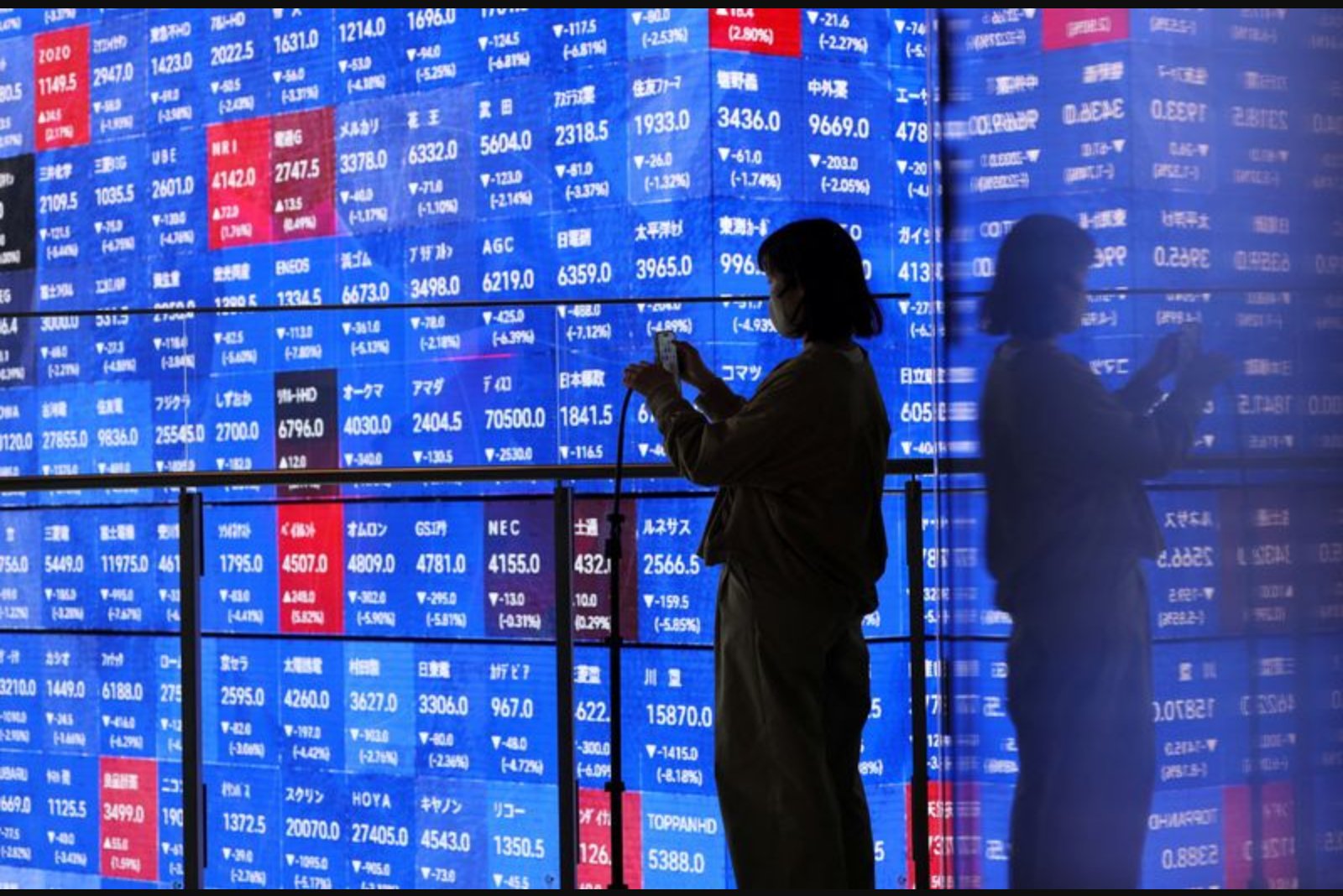
Asian share indices moved higher on Tuesday as hopes for resumed diplomacy between the United States and Iran supported risk appetite, while oil prices slid and the dollar weakened as investors reduced exposure to traditional safe-haven assets.
Officials and other sources indicated that discussions between Washington and Tehran had not been shut down after a recent breakdown in talks, with at least one U.S. official describing "forward motion" toward an agreement. At the same time, the U.S. enacted a blockade of Iranian ports in an effort to increase pressure on Tehran following the collapse of weekend negotiations.
MSCI’s broadest index of Asia-Pacific shares outside Japan rose about 1% in early Asian trading. Japan’s Nikkei and South Korea’s KOSPI each gained more than 2% as regional markets reacted to the improved diplomatic tone.
Sentiment in global equity futures followed suit. Nasdaq futures advanced 0.13% while S&P 500 futures were broadly unchanged after a strong session on Wall Street the prior night. In Europe, futures pointed higher as EUROSTOXX 50 contracts gained 0.63% and DAX futures added 0.77%.
"Markets are trading hope, not resolution," said Charu Chanana, Saxo’s chief investment strategist. "The failed weekend talks did not produce a deal, but they also did not close the door on diplomacy, and that is enough for equities to keep pushing higher for now."
In public remarks, U.S. President Donald Trump said Iran had "called this morning" and that "they’d like to work a deal." The assertion could not be immediately verified.
At the same time as diplomatic overtures, U.S. military forces began a blockade of Iran’s ports. The move was described as aimed at increasing pressure on Tehran; the U.S. also warned it would block Iranian vessels or any ships that paid certain tolls and said Iranian "fast-attack" vessels that approached the blockade would be eliminated.
"The U.S. has actually played that trump card. To me it’s important because they forced the onus back on Iran to open the Strait without the need to put those boots on the ground," said Tony Sycamore, a market analyst at IG. "It’s now forced the Iranians back to the drawing board."
Oil prices moved lower as markets priced in the increased chance of a diplomatic resolution outweighing near-term supply disruption risks. Brent crude futures fell 2.7% to $96.66 a barrel, while U.S. crude lost 3% to $96.13 a barrel.
Currency markets reflected a softer demand for safe-haven dollars as risk sentiment improved. The dollar slipped to a one-and-a-half-month low of 98.328 against a basket of currencies. That facilitated a modest gain for the euro, which traded 0.05% higher at $1.1764, while sterling climbed to a more than six-week high of $1.3514.
"The U.S. and Iran have started to walk down the path of coming up to an agreement," said Joseph Capurso, a strategist at Commonwealth Bank of Australia. He cautioned, however, that "the markets are still facing a global economic outlook that is deteriorating, and I think the risks are high that you get equity markets and credit markets and the like fall again, and that would push up the U.S. dollar against probably all currencies."
U.S. Treasury yields were largely steady, with the two-year yield last at 3.7722% and the 10-year benchmark yield at 4.2854%.
Analysts noted that the sharp rise in energy costs has increased inflationary pressures and prompted investors to revisit the likelihood that several major central banks may lean toward further rate increases, a turnaround from earlier expectations of cuts or extended pauses in tightening.
Precious metals and digital assets reflected the broader market moves. Spot gold was up 0.7% at $4,771.81 an ounce. Bitcoin rose about 1.5% to trade near $74,312.
Market participants said the combination of tentative diplomatic progress and the U.S. show of force created a complex signal: diplomatic channels remain open, boosting risk assets and easing energy market fears, yet military pressure and the potential for renewed tensions sustain uncertainty for commodities, currencies and policy outlooks.