
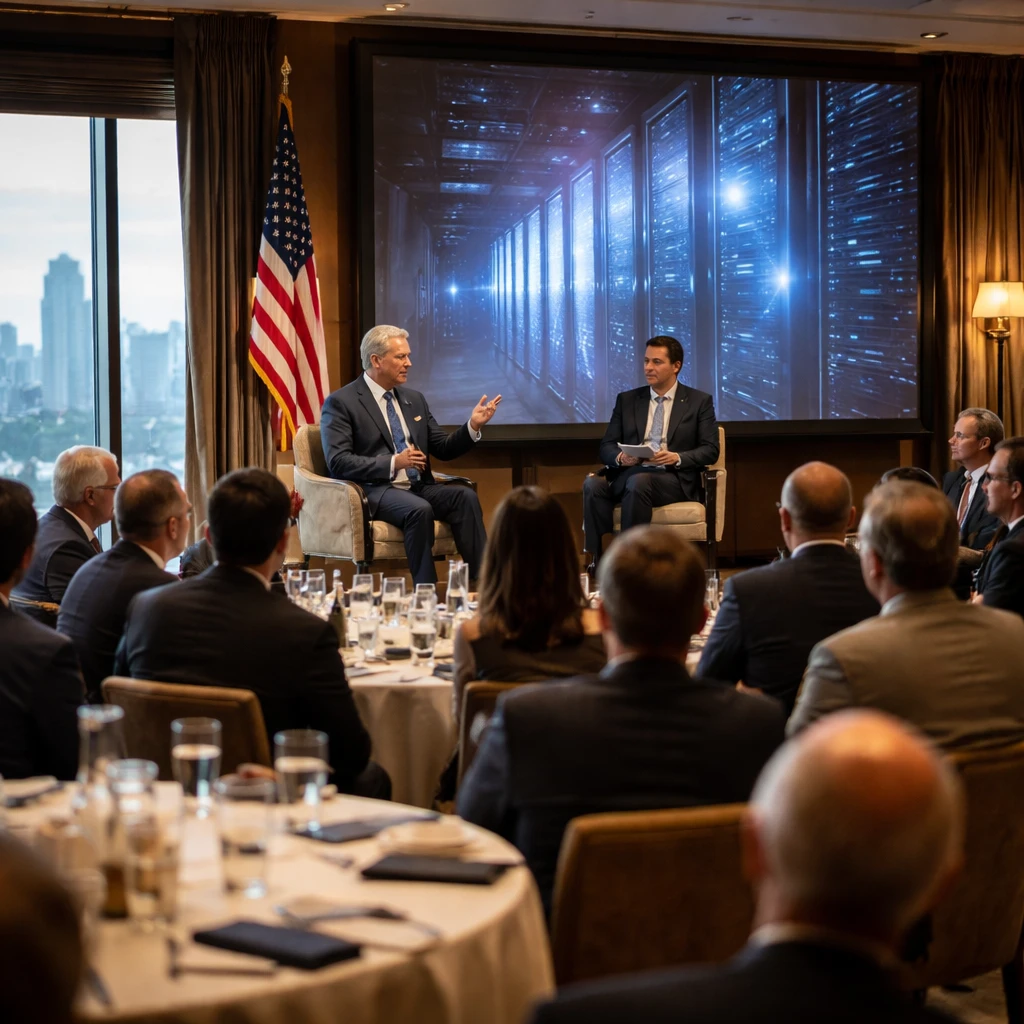
Treasury Secretary Scott Bessent framed the competition between the United States and China over artificial intelligence in stark terms on Wednesday, saying that an American loss in the race would "negate all our other efforts." Speaking at the Charlotte City Club on September 2, a day after the G20 Finance Ministers' meeting concluded in Asheville, Bessent said the United States currently maintains about a six-month lead over Beijing in AI compute capacity.
In a fireside conversation with Larry Kudlow, Bessent predicted that the U.S. share of global computing power will climb substantially over the coming years. "We are going to go up from about, call it, 60% in 2025. By 2028, the US will have 80 per cent of global computing power here, which is just extraordinary," he said, attributing the projected shift to the Trump administration's regulatory, tax and energy policies.
Compute and markets
Bessent's comments put compute capacity at the center of a broader economic and geopolitical contest. The most direct corporate reflection of that compute buildout is Nvidia (NASDAQ:NVDA), the leading supplier of AI training and inference processors used in data centers. Nvidia's data-center business generated approximately $39 billion in its most recent quarter, and investors will receive a formal gauge of that franchise when the company reports fiscal third-quarter results in November 2026.
However, the public financials do not provide a complete breakdown of how much data-center revenue comes specifically from U.S. hyperscalers, which limits the precision of a single-metric test of the compute-share thesis. Even so, the link is clear in Bessent's framing: policies that accelerate domestic data-center construction should lift demand for GPUs and related hardware, reinforcing revenue and margin trends that have positioned Nvidia as a proxy for U.S. AI capability.
Industry adoption beyond tech
To underline his point that AI's effects reach far beyond core technology firms, Bessent named four industrial companies whose chief executives joined the first private-sector session embedded in a G20 Finance Ministers' meeting: Medtronic (NYSE:MDT), Deere & Co. (NYSE:DE), 3M (NYSE:MMM) and Eli Lilly (NYSE:LLY). He described the gatherings as evidence of cross-sector ecosystems forming around machine intelligence.
"It was fascinating to see the ecosystems that are developing, the productivity, the higher level of precision manufacturing both across their supply chains and their customer bases," he told reporters at the G20 closing press conference, according to the Asheville Citizen-Times.
Bessent's point is that these are not early-stage experimenters. Rather, established industrial and pharmaceutical firms are embedding machine intelligence into manufacturing tolerances, drug development timelines and logistics networks. That framing shifts the investment question from a technology-sector multiple story to one about cross-market earnings potential.
G20 tensions and the competitive backdrop
The G20 meeting itself closed without a joint communiqué after China rejected the consensus, with the disagreement focused on non-market economic practices and export-distortion policies. That rupture added a sharper competitive subtext to Bessent's remarks - the U.S. effort to scale compute is unfolding amid deepening economic rivalry with Beijing.
"We want to set the guardrails, create incentives, and then let our private sector build. And that is where a nation's wealth is created," he said, per IANS wire.
Domestic priorities and market inclusion
Bessent also spoke about domestic recovery and market access. He highlighted recovery work following Helene in the Asheville region and the need for continued federal infrastructure assistance. FEMA has approved more than $7.5 billion in federal funding to North Carolina, including a recent additional tranche of $137 million, though officials say a significant portion of that money remains caught up in approval processes, according to the Carolina Journal.
On participation in equity markets, Bessent promoted the Trump Accounts program - a policy that seeds $1,000 investment accounts for children born during Trump's second term. He cited an estimate that 38% of U.S. families have no stock market exposure and argued the accounts can give previously sidelined households what he called "skin in the game." More than 7 million children are already enrolled, he said.
"American families, left on the sidelines of Wall Street for too long, will finally understand what a piece of the action feels like," he said in earlier remarks to the Financial Literacy and Education Commission, per Money.com.
Corporate uptake of the program has begun to accelerate. Goldman Sachs (NYSE:GS) and Delta Air Lines (NYSE:DAL) have both said they will match the $1,000 federal seed contribution for eligible employees, a development cited in media reporting.
Near-term policy markers to watch
Bessent outlined two near-term developments that could test the traction of his AI and market-inclusion theses. First, the IRS is expected to issue additional guidance on employer contributions to Trump Accounts, clarifying how companies - including the industrials and pharma firms he named - can structure matching programs. That clarity could broaden corporate participation and deepen retail equity ownership.
Second, the Commerce Department and the White House Office of Science and Technology Policy are planning a technology showcase in Chapel Hill, North Carolina, which Bessent flagged as part of the administration's effort to promote AI investment. Confirmation of the event's date would provide another formal policy marker for investors tracking the administration's compute-dominance agenda.
What to watch next
- November 2026 - Nvidia's fiscal third-quarter results will give investors updated visibility into the company's data-center revenue trend.
- IRS guidance rounds - further clarity on employer contributions to Trump Accounts could influence corporate matching programs.
- Commerce/OSTP showcase - formal confirmation of the Chapel Hill technology event would signal the next administration-backed AI investment milestone.