
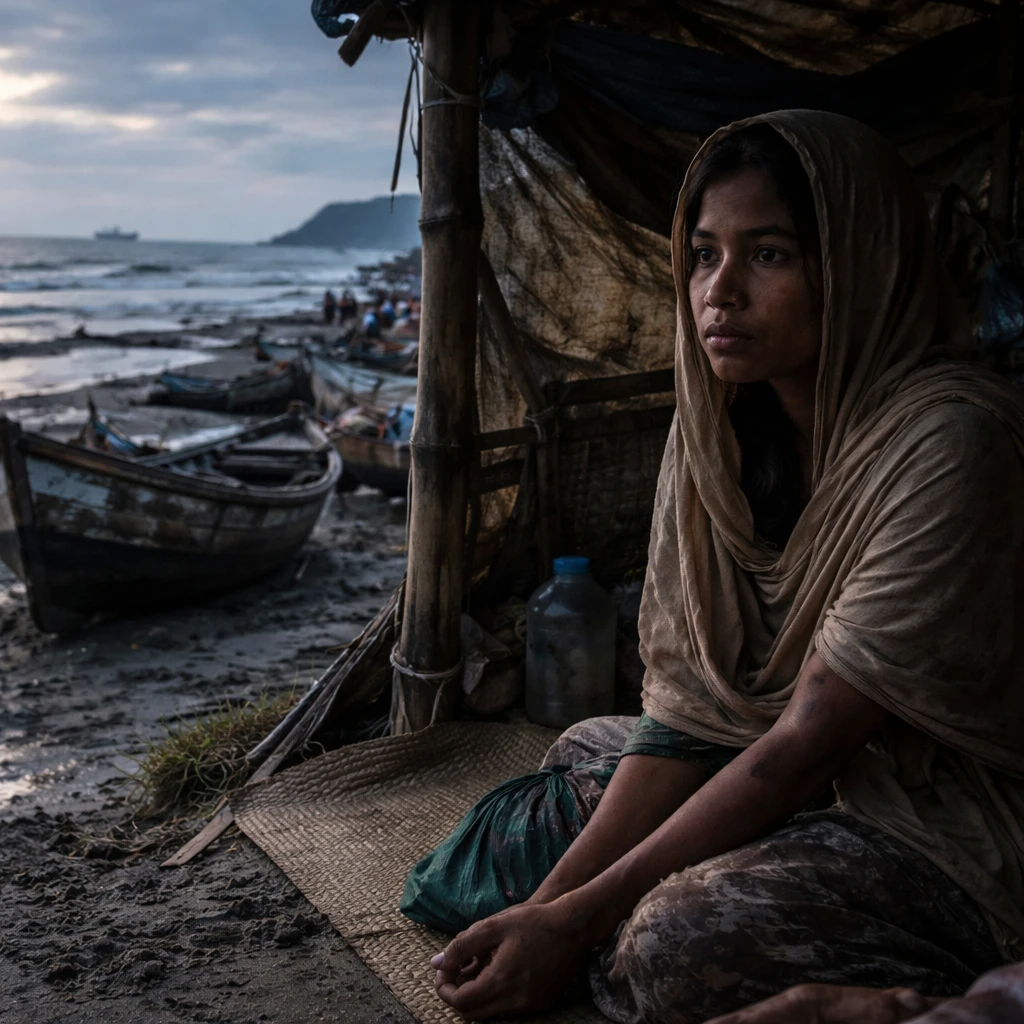
Rahila Begum is one of a handful of survivors from a recent maritime disaster in which an overcrowded wooden boat sank while attempting to reach Malaysia. She spent two days adrift in the Andaman Sea, clinging to a fragment of wood before being picked up by a passing Bangladeshi oil tanker and later transferred to the Coast Guard. She described the experience in stark terms as she recovered in her family’s makeshift shelter, wrapped in a blanket and nursing fever and body aches.
Begum’s story reflects a wider pattern among the Rohingya living in camps in southeastern Bangladesh. Each year thousands risk hunger and hazardous sea crossings aboard unseaworthy vessels in hopes of reaching countries such as Indonesia and Malaysia. While some complete the journey, hundreds die along the way from hunger or accidents at sea. The recent sinking, which left about 250 people missing and feared dead, has drawn attention to the growing scale of the exodus.
The drivers behind these journeys are largely tied to deteriorating conditions inside the camps. Cox’s Bazar, the coastal district that hosts nearly 1.2 million Rohingya, has become a place of prolonged confinement for many who fled persecution and fighting in Myanmar. In Bangladesh, they face legal and practical barriers: they are largely denied the right to work, receive only limited formal education, and depend on international assistance that has been contracting. For many, the combination of restricted opportunities and shrinking food support has eroded any viable sense of a future in the camps.
International agencies tracking the movements and maritime incidents say the situation has become more dangerous. The U.N. refugee agency, UNHCR, reported that nearly 900 Rohingya were recorded as missing or dead in the Andaman Sea and Bay of Bengal in 2025, making that year the deadliest on record for regional sea crossings. UNHCR also recorded more than 6,500 attempted crossings in that period. From January through mid-April of the current year, more than 2,800 attempts were reported, indicating that the flow has continued into the new year.
"The Rohingya population is very young and aspires to a better life, but that hope is increasingly turning into desperation," said Astrid Castelein, a UNHCR official. "That is why youths and families are deciding to take these dangerous boat journeys."
Authorities have reacted by increasing coastal patrols and intensifying surveillance of camps in an effort to disrupt trafficking networks that organize these crossings. A Bangladesh official, speaking on condition of anonymity, said the government has stepped up enforcement measures but conceded that the underlying scale of desperation makes complete prevention difficult.
Begum’s body still bears physical reminders of the sinking. Her arms and torso are marked by burns, which she says were caused when hot engine oil mixed with seawater spilled over passengers during the capsizing. She originally fled Myanmar in 2017 amid a military crackdown that prompted more than 730,000 Rohingya to seek refuge in Bangladesh. That exodus followed allegations of killings, mass rape and arson that a United Nations mission later described as "genocidal," a characterization Myanmar denies.
Personal circumstances also contributed to Begum’s decision to leave Myanmar. She said that after her marriage four years ago, life deteriorated: she was beaten because she could not have children and her husband refused to take her back. Those pressures, she said, left her feeling she had no option but to flee.
Recent changes to aid distribution in Cox’s Bazar have further sharpened food insecurity. The U.N. World Food Programme has revised its allocations, distributing monthly rations based on households’ estimated earning capacity. The amounts range from $12 per person for the most vulnerable to $7 for those assessed as food insecure, while families headed by children, women, or the elderly receive the highest support.
Not all households have benefited from the new system. Mohammed Rafiq, 50, a father of four, said his monthly allocation was reduced from $12 to $7 after a reassessment because he has an 18-year-old son. "But does he earn anything?" he asked. Rafiq said the funds stretch to basic staples such as rice and cooking oil but do not cover fish or meat, items his children desire. He summed up the living conditions bluntly: "We are living in inhumane conditions," he said, citing shortages of adequate food, shelter, freedom, education and work. "Even if my children leave by sea one day, I would not be surprised."
The shrinking safety net is a fertile environment for traffickers, who frequently exploit refugees’ desperation. Many of those involved in organizing crossings are themselves Rohingya. One 24-year-old who identified himself as Faisal said he had arranged travel for 20 people aboard the vessel that later capsized, including three women and two children, and that none of them survived. Faisal said he had ignored repeated calls from grieving family members seeking information. "They keep calling again and again ... sometimes I just switch off my phone," he said.
Faisal described his own path into the trade: he traveled to Malaysia in 2018 with traffickers’ assistance and later returned to the camps to become a facilitator. He was jailed in Bangladesh in 2020 for a year on a human trafficking charge, but he said his imprisonment did not stop him from resuming the activity after his release. That account has not been independently verified.
Traffickers and those seeking passage both understand the risks involved. Faisal noted that such journeys typically peak during calmer winter months, but the growing urgency among camp residents has led many to attempt crossings in less favorable conditions. "They come to us asking for a way out," he said. "They know the risks - some make it, some are arrested, some die."
The recent tragedy and the broader pattern of movement underscore a persistent humanitarian challenge: aid shortfalls and constrained livelihoods in the camps are directly reshaping migration choices, producing increased pressure on maritime routes and complicating enforcement efforts. As rationing policies adjust to constrained resources and as authorities intensify patrols, refugees continue to weigh the acute risks of sea travel against the daily risks of life in protracted displacement.