
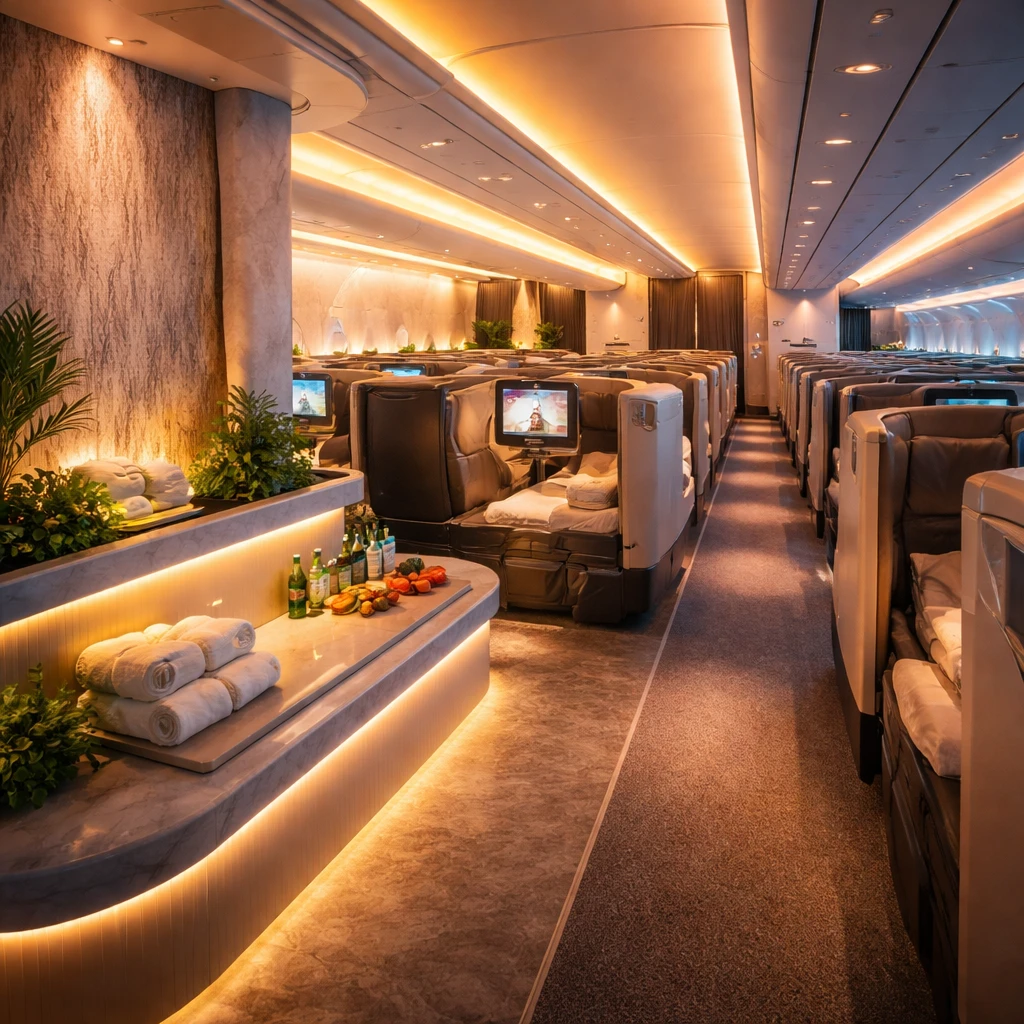
Qantas Airways is betting that careful application of sleep science, cabin ergonomics and tailored onboard services can make ultra-long non-stop flights tolerable - and commercially attractive. The Australian carrier has disclosed plans for a "wellness zone," increased legroom in selected rows, timed meal services and animated lighting systems on its non-stop Sydney-London flights, which it says are due to begin next October. Executives also plan to follow those services with non-stop Sydney-New York routes.
The initiative, known internally as Project Sunrise, has focused on the physiological challenge of crossing multiple time zones in a single journey. "It’s a major biological challenge crossing all these time zones - seven to nine for London and 14 to 16 for New York," said Peter Cistulli, professor of sleep medicine at the University of Sydney, who contributed to the airline’s scientific work. Qantas has presented detailed briefings on the scientific tests behind roughly 20-hour journeys as it seeks to persuade passengers to pay a premium to avoid a stopover.
Frequent Australian long-haul travellers surveyed by the airline and in conversations with the carrier identified seat comfort, the ability to move about the cabin and price as their top considerations when weighing ultra-long non-stop options. Qantas has responded by examining a wide range of factors since launching Project Sunrise nearly a decade ago. The carrier’s research covered nutrition, movement, ergonomics and, critically, light - which serves as a primary cue for the body clock.
According to Cistulli, trials that combined optimised meal timing - notably avoiding serving food immediately after takeoff - with lighting strategies that created a "protective sleep window" produced measurable improvements in passenger alertness compared with traditional service patterns. The airline says those results are central to its pitch that non-stop travel can reduce jet lag and improve the post-flight experience.
Cabin designer David Caon described his brief as much scientific as aesthetic. "When you have a passenger for essentially a whole day, it really does drive a whole set of new decisions," he said. Caon explored several novel ideas during the design process; while some concepts such as exercise bikes and yoga mats were tested, they did not make the final configuration. The wellness zone remains as a dedicated area illuminated with diffused, shimmering light intended to create a relaxing atmosphere. "I wanted to recreate the sense of lying by the swimming pool," Caon said.
Elsewhere in the cabin, custom mood lighting will shift to simulate sunrise or sunset, progressing from the front toward the rear of the aircraft. Qantas said it developed 14 distinct light "scenarios" inspired by Australian landscapes, and that programming those sequences required weeks of work. The combined effect of lighting, meal scheduling and ergonomics is designed to lessen the discomfort of flights that, on the specially modified A350-1000ULR jets, could be as long as 22 hours.
Beyond passenger comfort, the cabin design has a clear commercial objective. Qantas has configured the aircraft to be heavy on premium seating in order to extract the most revenue from flights constrained by weight limits, carrying only 238 passengers. The airline expects the direct flights to command a premium and has cited an anticipated revenue boost of around 20% compared with one-stop services based on evidence from its Perth-Europe operations. Most analysts note that Qantas’ existing 17-hour Perth-London flights provide a useful precedent for the Project Sunrise business case.
Operational constraints are evident in the plan. Because of strict weight restrictions on ultra-long sectors, Qantas may have to block seats to conserve fuel under some weather conditions. The airline also acknowledges other operational risks include costly diversions on very long routes.
Qantas has chosen a premium-heavy passenger mix because the airline must maximise revenue per flight given the small number of seats and the high operational cost of ultra-long sectors. In economy, the carrier said regular seat pitch will be 33 inches (84 cm), with some rows slightly tighter at 32 inches; those variations will be disclosed at booking. The carrier will offer an "Economy Plus" section with 34 inches of legroom. At the front of the cabin, Qantas will install enclosed first-class suites that include a fixed bed.
Passengers and frequent long-haul travellers who spoke about the plan emphasized comfort and value as decisive factors. Sam Davies, who works in drinks marketing, said he already uses the Perth direct services when travelling between Paris and Sydney and would consider the non-stop Sydney-London option. "There is something wonderful about waking up in Australia and not having to get off anywhere and go through security and kill three hours, so I am all up for it," he said. However, he noted that physical comfort would be critical: "I am six-foot-four (193 cm) so the economy seat is too small...I would have to ask for some more details on the seats."
Other travellers weighed time savings against price. Melbourne-based business executive Ian Morden said he values the extended work time such flights provide but questioned whether a four-hour reduction versus a one-stop routing would justify the fares Qantas expects from its business case. "A slight premium would be justifiable but...I probably wouldn’t choose it for a 20% premium on an already much more expensive business-class flight," he said.
London-based Nathalie Curtis, who travels frequently for work in the cultural sector, said she would opt for the flight if the in-flight measures delivered on Qantas’ claims. She added concerns about cabin upkeep on such long journeys. "If it allows you to move around, reduce jet lag with lighting adjustment and is hygienic and saves ... four hours then I would go for it and pay a 20% premium," she said.
Mark Levine, an Australian strategic adviser based in New York, highlighted the intangible convenience of direct services for people whose lives are split between continents. "The distance doesn’t change but the journey feels a little smaller," he said.
The Project Sunrise program links an engineering and scientific approach to a clear commercial objective: to turn Australia’s geographic remoteness into an asset by offering direct flights that can command higher fares. Qantas’ strategy rests on a combination of physiological testing, cabin design and a premium seat mix intended to make non-stop 20-hour journeys both tolerable for passengers and profitable for the airline.