
U.S. stock-index futures opened lower on Thursday as markets digested a mix of geopolitical signals and company results. Unease around whether fresh talks between the United States and Iran will materialize tempered appetite for risk even after President Donald Trump announced an extension of a ceasefire earlier in the week.
Futures set a cautious tone
By 03:32 ET (07:32 GMT), futures linked to the major U.S. indexes showed noticeable declines. The Dow futures contract traded about 277 points, or 0.6%, lower; S&P 500 futures were down roughly 30 points, or 0.4%; and Nasdaq 100 futures had slipped about 104 points, or 0.4%.
Those moves followed a rally on Wednesday when the main U.S. equity gauges inched toward new record highs. Market participants welcomed the temporary extension of the U.S.-Iran ceasefire and drew confidence from corporate earnings that, so far, have exceeded expectations. Bloomberg data cited in market commentary indicated that nearly 80% of S&P 500 companies that reported first-quarter earnings had topped analysts' estimates.
Some strategists argued that the torrent of headlines tied to the conflict may be losing its capacity to move markets as investors re-focus on fundamentals, including a wave of corporate reports and sustained investment in artificial-intelligence infrastructure. Michael Brown, Senior Research Strategist at Pepperstone, wrote that the predominant market view remained centered on a trajectory toward de-escalation. He added that public statements by both sides were largely aimed at securing negotiating leverage rather than preparing for renewed kinetic action. "So long as that remains the direction of travel, risk appetite is likely to remain underpinned," he said.
Outlook for U.S.-Iran talks stays unclear
Traders were searching for signs that substantive negotiations could resume between Washington and Tehran. President Trump told U.S. media that renewed discussions were "possible" as soon as Friday, and he said in a social media post that a ceasefire had been extended at Pakistan's request. Pakistan has been positioned by officials as a mediator in the exchanges. According to the president's post, the truce would remain in place "until such time as" Iran presents a "unified proposal" for peace.
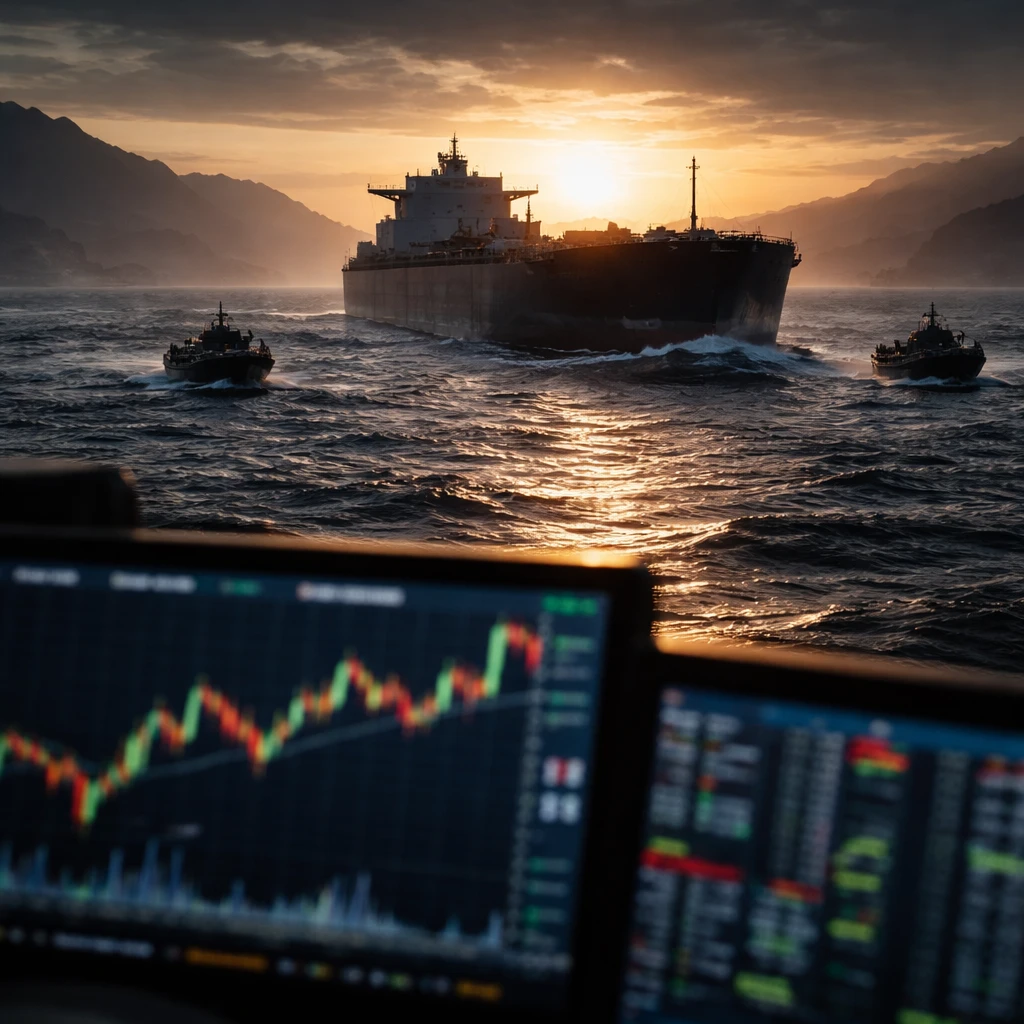
Yet the prospects for future talks were complicated by a sharp escalatory action shortly after the president's announcement. Iranian forces attacked three vessels and seized two ships near the Strait of Hormuz, a move that Tehran said was in response to an American blockade of Iranian ports. That incident undercut hopes that the ceasefire extension would immediately translate into a sustained reduction in hostilities.
Oil prices climb above $100 on Strait of Hormuz risks
Supply fears tied to the Strait of Hormuz pushed global benchmark oil back above $100 a barrel. The narrow maritime corridor remains a critical conduit for oil flows, handling roughly one-fifth of the world's crude shipments. The potential for further interruptions there has been central to recent volatility in energy markets.
Analysts at ING highlighted two contrasting dynamics: on one hand, the United States appeared eager to resume negotiations quickly; on the other hand, there was no clear plan for reopening the Strait of Hormuz. ING warned that if hopes for a diplomatic resolution recede, the reality of sustained supply disruption could drive prices higher. They added that, without progress, markets might become increasingly desensitized to the persistent headlines that have shaped price action.
Although oil has eased from an early spike that followed the outbreak of hostilities in late February, current crude levels remain notably above those seen before the conflict began. Market participants have flagged that a renewed or prolonged energy shock could exert upward pressure on inflation readings and weigh on global growth.
Tesla trims post-earnings gains after CEO tempers robotics, autonomy expectations
Tesla released quarterly results that beat expectations on both revenue and earnings metrics, driven in part by better-than-feared performance in its core automotive business. The initial reaction in extended trading was positive, but gains were pared after CEO Elon Musk answered analysts' questions and offered a more cautious take on the company's pivot into robotics and unsupervised autonomous driving.
Shares were last down 1.8% in after-hours trade, reversing from an earlier rise of over 4%.
On the post-earnings call, Musk said he could not predict what Tesla's production rate for its Optimus robot will be in 2026. He noted the technical and operational friction involved in converting production capacity, citing the company's recent discontinuation of the Model S and Model X earlier this year. Musk said transitioning those production lines to make robots presented challenges and made it "literally impossible to predict" initial output, adding that production was likely to be "quite slow at first."
He also signaled a "cautious approach" toward Tesla's plans for unsupervised autonomous driving and robotaxi services, warning that revenue from those businesses would "not be super material" this year.
Corporate calendar and tech-sector focus
Market watchers noted several significant earnings reports on the docket ahead of the open and after the close on Thursday. Card issuer American Express and aerospace contractor Lockheed Martin were scheduled to report before the market opened, while chipmaker Intel was set to issue results after the close. Investors have been parsing these releases for signals about consumer spending, defense-sector dynamics, and the health of demand for semiconductors.
U.S. business activity data in focus
On the economic front, traders awaited U.S. purchasing managers' index (PMI) readings for April to assess how domestic firms are managing price pressures tied to the conflict and other cost dynamics. In March, the PMI fell to 50.3 from 51.9 the month before, marking the weakest reading since September 2023. S&P Global's Chief Business Economist, Chris Williamson, commented at the time that the figures suggested "the U.S. economy buckling under the strain of rising prices and intensifying uncertainty, as the war in the Middle East exacerbates existing concerns regarding other policy decisions in recent months, notably with respect to tariffs."
The PMI trajectory and corporate earnings together were being monitored for clues about the durability of consumer demand, the pace of business investment, and the potential for inflation to re-accelerate if energy prices remain elevated.
Market implications
The combination of geopolitics, energy-market stress, and mixed company-level news left markets in a reactive posture. Investors appeared to be balancing the prospect of renewed diplomacy against the practical risks posed by disruptions to oil flows and the execution risks embedded in corporate transitions, such as Tesla's move into robotics and autonomous systems.
With nearly 80% of S&P 500 firms that have reported beating expectations, the earnings season has offered some support for equities, even as headlines out of the Middle East continue to inject volatility into commodity and risk-asset markets. The path forward is likely to be shaped by whether negotiations progress, whether shipping lanes are reopened in a durable way, and how corporate leadership teams manage transitions and set realistic near-term expectations for nascent businesses.