
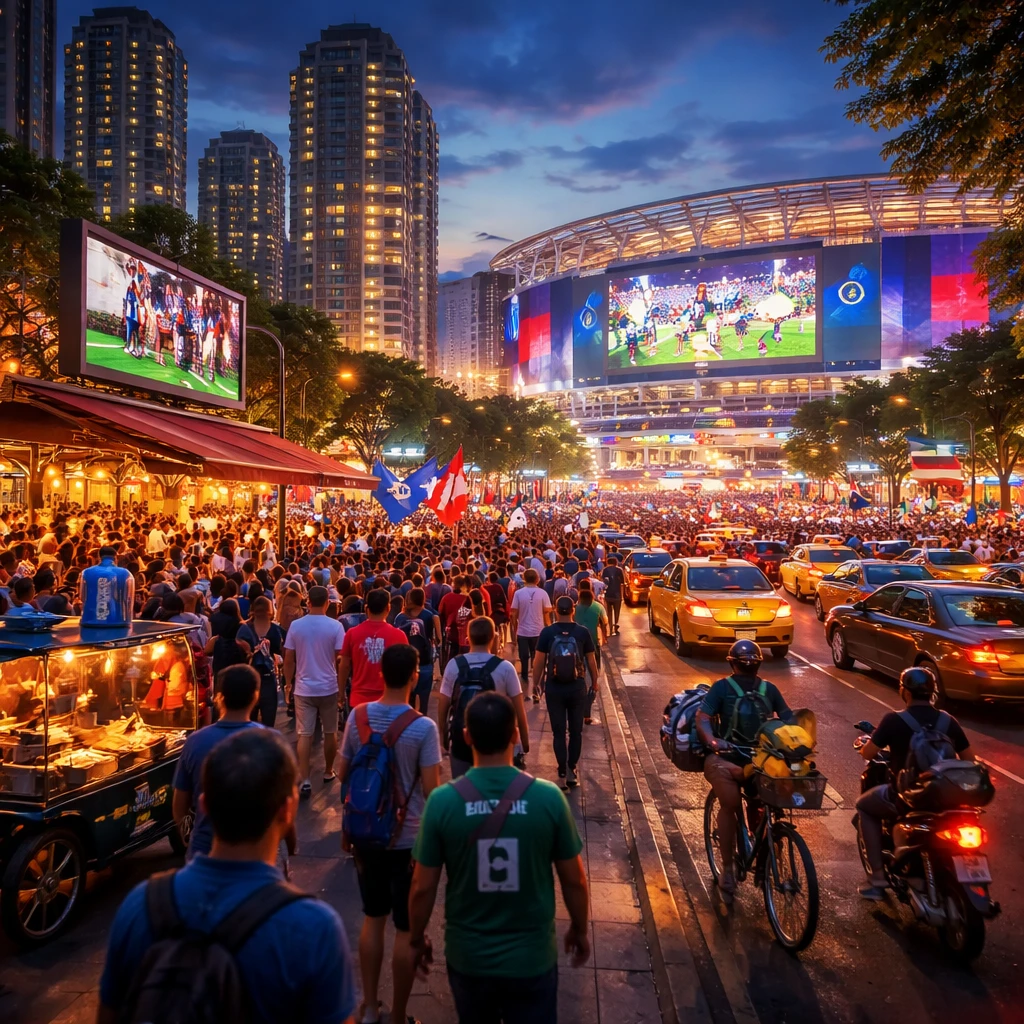
Deutsche Bank has assessed the economic footprint of the 2026 FIFA men’s World Cup and concluded the event will produce a limited boost to U.S. economic output - roughly 0.05% of U.S. GDP. At the same time, the bank compiled a list of companies and sectors it believes stand to gain from the tournament .
The tournament is scheduled to begin on June 11 and will run 39 days with 104 matches contested by 48 teams - 16 more teams and 40 more matches than the 2022 edition. FIFA has estimated the event could contribute as much as $17.2 billion to U.S. GDP.
Hotels and lodging
Deutsche Bank identified full-service hotel real estate investment trusts as the segment likely to capture the largest near-term revenue upside, modeling a 50 to 75 basis point lift to RevPAR across its hotel REIT coverage. Within that group, the broker assigned "buy" ratings to DiamondRock Hospitality, Host Hotels, Park Hotels and Ryman Hospitality, while Sunstone Hotel Investors received a "hold" rating.
The bank quantified exposure to World Cup city revenue across several REITs: DiamondRock carries the largest share of exposure at 34%, followed by Sunstone at 23%, Host Hotels and Park Hotels at 21% each, and Ryman at 14%.
For lodging corporate C-corps, Deutsche Bank highlighted the potential benefit accruing to luxury chains in particular, naming Hyatt, Hilton and Marriott as the brands expected to see the greatest lift.
Foodservice and quick-serve restaurants
The bank used Super Bowl data as a proxy for event-driven lodging and restaurant behavior, noting that luxury RevPAR rose about 212% in Phoenix during Super Bowl week and about 416% in New Orleans, while economy chains saw lifts of about 66% and 127% respectively. Applying that kind of event premium, Deutsche Bank flagged a range of restaurant operators and chains that could benefit from tournament-driven demand.
Deutsche Bank pointed to Uber, Lyft and Airbnb as additional beneficiaries through increased rideshare demand and alternative lodging usage. Within casual-dining and quick-serve categories, Sweetgreen was cited as having the greatest unit exposure to host stadiums at 49%, followed by Shake Shack at 34%, The Cheesecake Factory at 29% and Jack in the Box at 28%.
The bank also noted that global brand recognition will matter for attracting international visitors, singling out Shake Shack, McDonald s and Starbucks as well positioned in that regard.
On delivery-focused businesses, Deutsche Bank highlighted Domino s, where delivery accounts for about 55% of U.S. sales, calling it a relative winner and noting the chain has already launched a World Cup promotion. Wingstop, with roughly 30% of U.S. sales coming from delivery, was also mentioned as a beneficiary.
Industry provider Technomic estimates the World Cup will drive an incremental $1.9 billion in U.S. foodservice sales, which the report equates to roughly a 0.2% lift for the year overall and a concentrated increase of 2% to 3% in June and July.
Media and advertising
Broadcast and digital distribution rights are another obvious area of upside. Fox Corp. holds English-language broadcast rights and Comcast s Telemundo holds Spanish-language rights. Deutsche Bank cited Sportico s projection of $850 million in U.S. World Cup advertising revenue for 2026, compared with a historical range of $200 million to $400 million. Google s YouTube was identified as a digital distribution partner for highlights.
Sports betting and gaming
On sports wagering, Deutsche Bank laid out a range of handle scenarios for the U.S. market tied to the World Cup: a base-case handle of $3.3 billion, a bull case of $4.1 billion and a bear case of $2.5 billion. The bank estimated operator shares within its base case, with FanDuel leading at an estimated $1.3 billion of handle, DraftKings at $1.1 billion, BetMGM at $250 million, Caesars at $120 million and TheScoreBet at $83 million.
Takeaways
Deutsche Bank s analysis frames the 2026 World Cup as a major, but targeted, commercial opportunity: the overall macro impact on U.S. GDP is modest, yet specific companies and sectors - notably full-service hotel REITs, luxury hotel chains, certain restaurant chains, media rights holders and sportsbook operators - are positioned to capture disproportionate gains tied to elevated travel, lodging, dining, advertising and wagering demand during the event window.
Note on methodology
The bank used event proxies such as Super Bowl performance and industry estimates from sources cited to inform its revenue and handle projections. Where the underlying reporting provides ranges or estimates, Deutsche Bank presented base, bull and bear scenarios to reflect uncertainty in consumer behavior and market responses.