
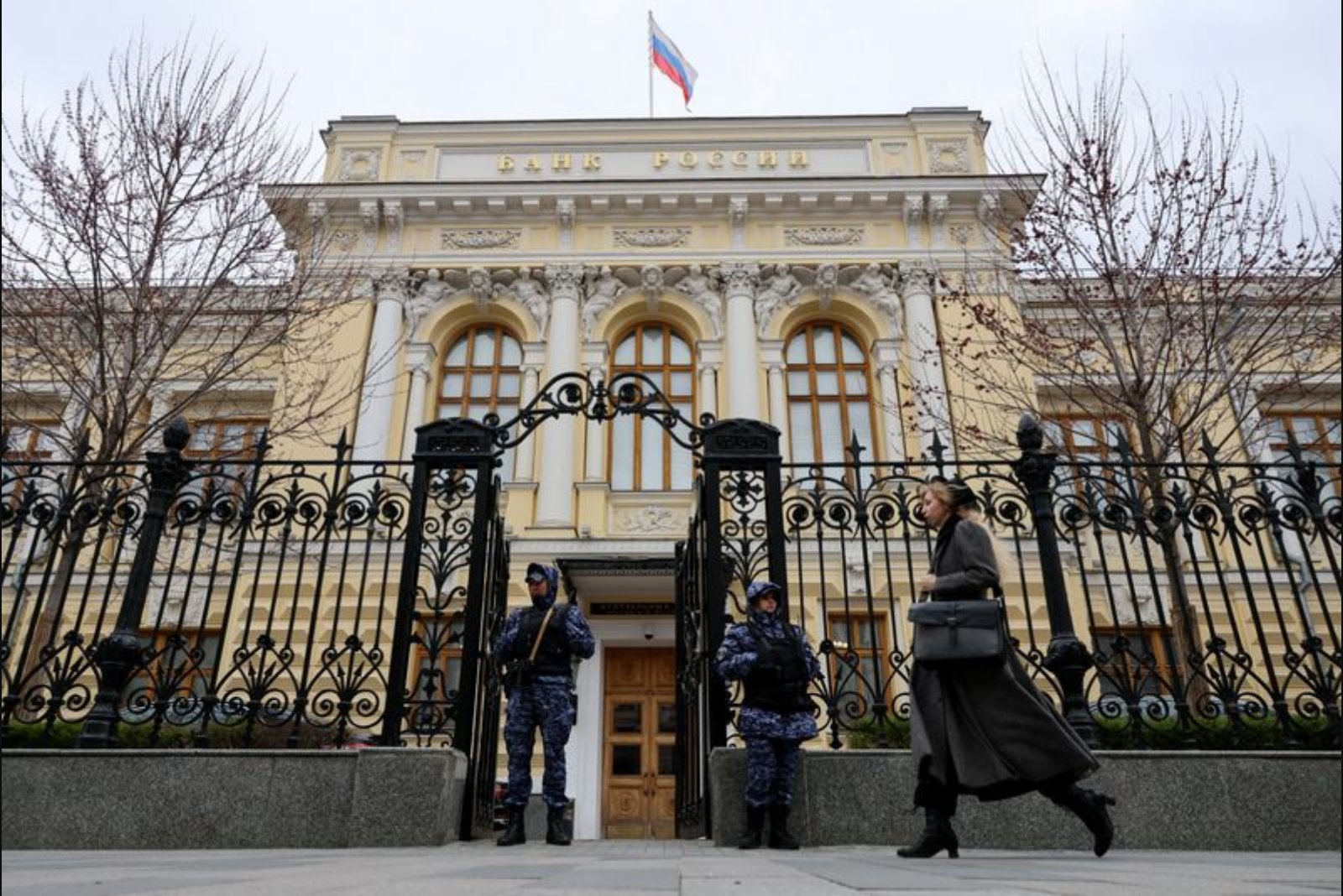
The Bank of Russia on Friday trimmed its key rate by 50 basis points to 14.5% - a move that matched market expectations but fell short of the faster easing some businesses have been pressing for as the economy contracted.
Officials flagged multiple sources of uncertainty that shaped their cautious stance. Governor Elvira Nabiullina pointed to the conflict in Iran and the blockade of the Strait of Hormuz, noting that the situation has driven up prices for Russian export commodities even as domestic oil output has been reduced by Ukrainian drone attacks on ports and refineries.
"If the conflict drags on, the adverse effects for the Russian economy will be strengthening. The implications caused by a global rise in costs might turn out to be more serious than the benefits from larger exports and a stronger rouble," Nabiullina said, underlining the downside risks from the external shock. "The situation in the Middle East remains a factor of uncertainty," she added.
Reflecting the impact of stronger commodity prices on budgetary calculations, the central bank lifted its average oil price forecast for 2026 by 45% to $65 per barrel and said that the higher assumed oil price will contribute to stronger growth later this year.
Domestic developments also factored heavily into the policy decision. The bank attributed the country's contraction in the first two months of the year - a decline of 1.8% - to a set of one-off factors. Officials pointed specifically to a value-added tax increase implemented at the start of the year that weighed on many small and medium-sized firms, as well as unusually heavy snowfalls and frosts that forced downtime for construction and other activity in the opening months.
"The abnormal frosts and snowfalls at the beginning of this year led to forced downtime in the first quarter, and therefore, construction companies will make efforts to catch up in the next quarter," Nabiullina said, suggesting some of the weakness should be temporary.
Given the central bank's assessment that the downturn was largely driven by transient shocks, it left its growth forecast for 2026 unchanged, maintaining a range of 0.5% to 1.5%.
First deputy governor Alexei Zabotkin said the full first-quarter GDP figures, which are scheduled for release in May, should look "for the better" than the January-February numbers, implying a moderation in the early-year decline once March data are included.
On inflation and the path of future rate cuts, Nabiullina set out clear pre-conditions for accelerated easing. The bank will consider faster reductions in the key rate only if inflation declines below the 4% target from the current 5.9% and if unemployment begins to rise. "It took humanity 50 years to return to the Moon. We will also return to 4% inflation, I am sure of it, and I am confident that it will happen much faster," she said.
Political pressure has increased following the early-year contraction. President Vladimir Putin reportedly reprimanded senior officials the prior week over the economic decline and urged the development of new measures to spur growth. Private-sector firms have been vocal about the cost of current monetary settings: businesses see 12% as the policy rate level at which economic expansion can resume, and several large companies, including steelmaker Severstal and aluminium producer Rusal, have reported quarterly losses or profit declines and have attributed those outcomes in part to the tight monetary stance.
Nabiullina emphasized that boosting productivity will be central to returning to sustainable growth and framed the central bank's role as that of a financial markets regulator that should help channel capital toward more productive sectors of the economy.
The central bank also warned that fiscal choices will influence monetary policy. It said that any shift toward faster spending and a higher structural budget deficit would compel it to maintain higher interest rates for longer. "In case of higher expenditures accompanied by growth in the structural budget deficit, tighter monetary policy will be required than that under the baseline scenario," the bank said.
As an additional signal on the expected path of policy, the Bank of Russia raised its estimate for the average key rate over the year to a range of 14% to 14.5% from a prior range of 13.5% to 14.5%. Market economists interpreted that move as a tougher signal on the likely duration of restrictive policy. "They are giving us a more stringent signal on the key rate," said Sofya Donets, chief economist at T-Bank.
Summary
The Bank of Russia lowered its policy rate by 50 basis points to 14.5% but signalled a cautious approach to future easing given external risks from the Iran war and domestic one-off shocks. The bank raised its 2026 oil price assumption to $65 per barrel and left its 2026 growth forecast unchanged in light of temporary factors that depressed early-year activity.
Key points
- The central bank cut the key rate to 14.5% but moderated expectations for faster easing.
- Higher oil price assumptions - raised to $65 per barrel for 2026 - are expected to support growth later in the year.
- One-off domestic factors - a VAT rise and severe winter weather - contributed to a 1.8% contraction in the first two months and informed the decision to keep the 2026 growth forecast at 0.5%-1.5%.
Risks and uncertainties
- Escalation or prolongation of the Middle East conflict and the Strait of Hormuz blockade could increase global costs and undermine domestic gains from commodity price support - this affects energy and export-oriented sectors.
- Further domestic disruptions to production or extended supply-side shocks would risk deeper near-term contraction and weigh on sectors such as construction and small and medium-sized enterprises that were hit by VAT changes and severe winter weather.
- Any fiscal shift toward accelerated spending and a larger structural deficit could force the central bank to keep interest rates higher for longer, impacting borrowing-sensitive sectors including manufacturing and capital-intensive industries.