
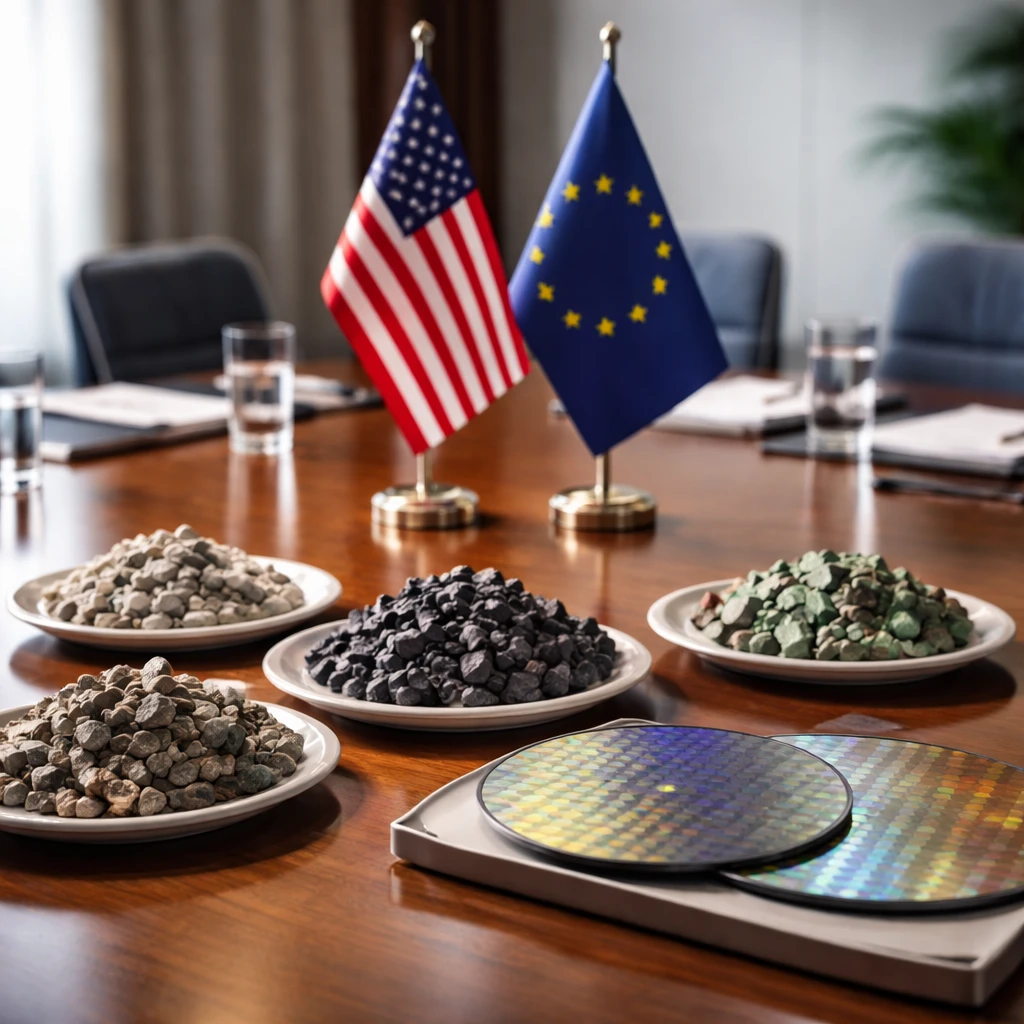
The United States and the European Union announced an action plan on Friday to align trade policy around critical minerals supply chains, including an intent to explore a binding plurilateral agreement.
The initiative forms part of efforts by the Trump administration to engage Western allies on the supply of materials central to advanced manufacturing. Officials highlighted concerns about concentrated processing capacity abroad, particularly in China, which currently controls a large share of the processing of minerals used to produce semiconductors, electric vehicles and advanced weapons.
Plan objectives and forums
U.S. Trade Representative Jamieson Greer, who was scheduled to meet on Friday with EU Commissioner Maros Sefcovic, said the United States and the EU are united in their goal of addressing “the non-market policies and practices that have distorted critical minerals supply chains.” The two sides intend to examine how trade measures could be used to strengthen domestic critical minerals industries and the downstream sectors that matter for industrial competitiveness.
Policy tools under consideration
Among the measures Washington and Brussels will look at are trade tools such as border-adjusted price floors. Greer noted these and other trade measures as potential mechanisms to bolster domestic processing capacity and to support sectors that depend on reliable mineral supply chains.
Strategic context
The action plan comes against a backdrop in which China has used its dominant position in mineral processing as economic leverage. The document and statements from officials cite episodes in which China curtailed exports, depressed prices and, in doing so, limited other countries’ ability to diversify sources of critical materials.
The formal exploration of a plurilateral agreement and trade measures signals a coordinated approach by the United States and the EU to address vulnerabilities in the supply of inputs vital to semiconductors, electric vehicles and defence-related manufacturing.
Summary of key facts
- The U.S. and EU released an action plan on Friday to coordinate trade policies on critical minerals supply chains.
- The plan includes exploring a binding plurilateral agreement and looking at trade measures such as border-adjusted price floors.
- China currently controls much of the processing for minerals used in semiconductors, electric vehicles and advanced weapons; officials say it has at times used that position as leverage.