
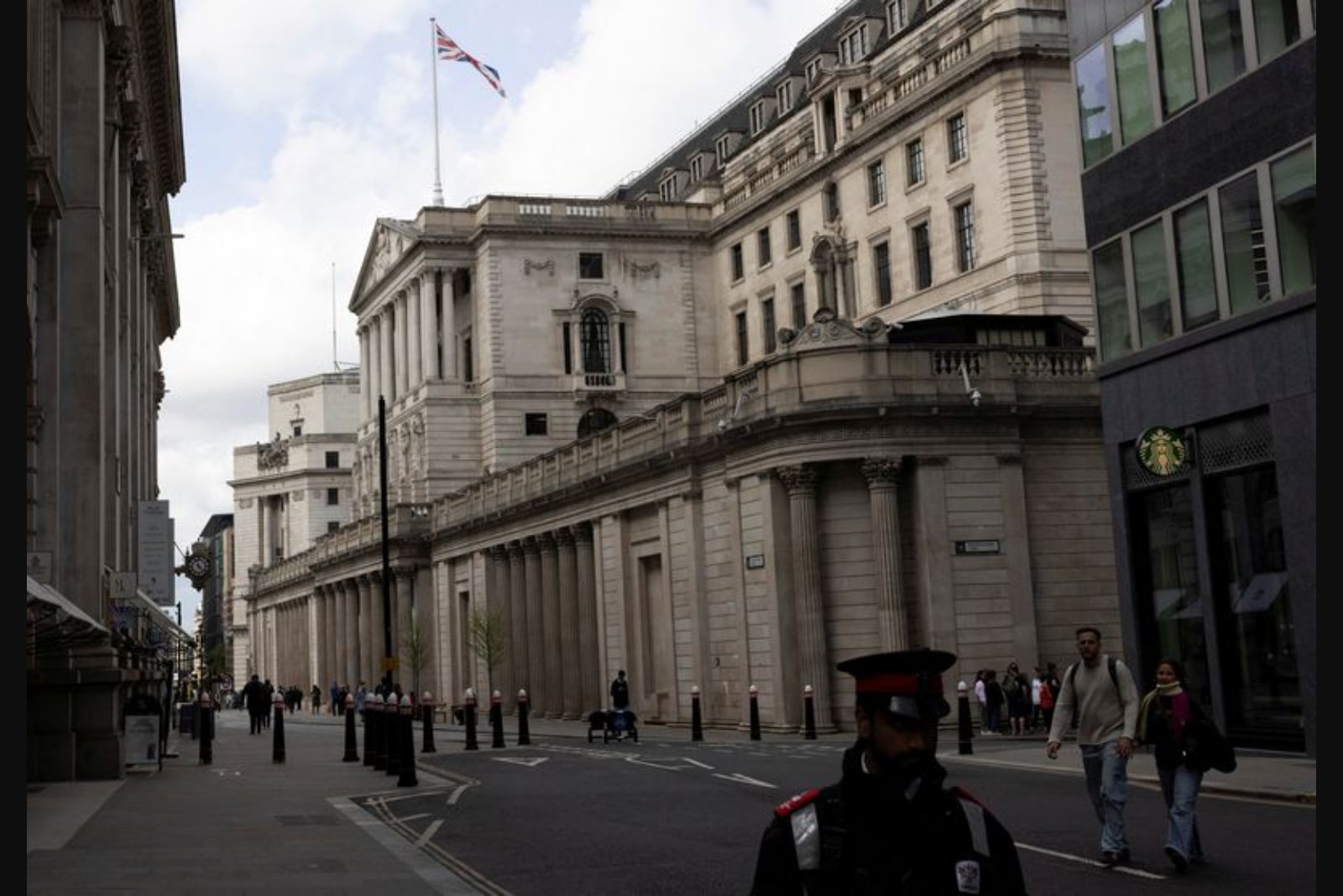
LONDON, April 27 - The Bank of England will keep interest rates unchanged this week as it seeks to measure the accumulating economic impact of the Iran war on Britain, while investors watch for any signals the central bank is leaning toward raising rates.
The central bank paused after its March decision to hold borrowing costs while it assessed the likely inflationary and growth effects of the conflict. With uncertainty still high, another no-change outcome is expected when the Monetary Policy Committee announces its decision on Thursday. Investors, however, are betting on rate increases later in the year.
By late last week, market participants had priced in a quarter-point rise in July, a further quarter-point move in September and a small chance of an additional increase before year-end, despite Governor Andrew Bailey warning that such moves would be premature.
Votes and expectations
At the March meeting the MPC voted unanimously to leave Bank Rate unchanged in a 9-0 decision. Economists polled last week by Reuters mostly forecast an 8-1 vote this week to keep Bank Rate at 3.75%, reflecting a modest shift in committee positioning since March. Unlike investors, the economists surveyed largely do not anticipate rate hikes this year.
Some analysts, however, expect a minority of MPC members - perhaps as many as three - to push for Bank Rate to be raised to 4.0% to guard against a rise in headline inflation driving higher wage demands and businesses lifting prices.
Why Britain is seen as vulnerable
Investors view the UK economy as particularly exposed to the surge in energy costs caused by the Iran war because of the country's reliance on natural gas. Recent data showed a jump in firms' input costs and a record pace at which companies raised their expectations for price increases over the next 12 months.
Earlier this month the International Monetary Fund projected British inflation - which has been the highest in the Group of Seven for much of the past four years - would peak at 4% this year. Memories remain fresh of headline inflation surpassing 11% in 2022, making policymakers attuned to upside risks.
MPC debate and the evidence
The committee faces a tension between members uneasy about lingering inflationary pressure that predated the war and others who emphasise the risk of a further weakening in hiring and a hit to business and consumer confidence. In that vein, BoE Chief Economist Huw Pill warned on April 17: "If you’re waiting and seeing and you don’t see, then you’ve just waited." Pill and other members concerned about persistent price pressures are likely to point to the rise in service price growth in March and signs of strong price pressures within companies.
By contrast, more dovish members may highlight weakening labour market indicators and the potential for a deterioration in economic activity, arguing there is still time to monitor incoming data before taking policy action.
Guidance, forecasts and outlook
Given the uncertain duration of the conflict and the unclear extent to which higher energy prices will feed through into broad inflation, the MPC may opt to restate the message it delivered in March that it stands "ready to act." The central bank is also scheduled to publish its first comprehensive forecast update since the conflict began, which is likely to show higher near-term inflation and weaker growth in 2026 and 2027.
Market observers will also parse the tone of the press conference that Governor Bailey and other MPC members are due to hold at 1130 GMT, half an hour after the interest rate decision is announced.
Thomas Pugh, chief UK economist at accountancy firm RSM, cautioned that a hawkish-sounding message on Thursday would not necessarily translate into immediate rate rises. "The economic data is likely to take a downturn over the next few months, which could shift the emphasis back to concerns about the economy before the next meeting," Pugh said.
Edward Allenby, senior UK economist at Oxford Economics, said he would place greater weight on how MPC members position themselves around the different scenarios the BoE is expected to produce alongside suggested paths for interest rates. "Our baseline forecast assumes Bank Rate will remain on hold for the rest of the year," Allenby said in a note to clients. "The committee will have more information about how the energy shock is feeding through to the economy by the end-July meeting," he added.
Implications for markets and firms
Investors' expectation of future rate rises means market pricing will remain sensitive to any sign the MPC shifts toward tightening policy. Companies facing higher input costs and rising expectations for future price increases could pass on those costs to customers, potentially sustaining inflationary pressures. At the same time, a weakening in hiring or consumer confidence could blunt the case for imminent tightening.
For now, the central bank appears poised to balance those competing forces by holding rates while clarifying the range of possible economic outcomes in its updated forecasts and signalling its readiness to respond if the data warrant it.
Summary of next steps
- The Monetary Policy Committee will announce its decision on Thursday and hold a press conference at 1130 GMT, thirty minutes later.
- The BoE will publish a fresh set of forecasts that incorporate the economic effects of the Iran war, likely showing higher inflation and weaker growth in 2026 and 2027.
- Markets will continue to watch incoming data through to the end-July meeting to judge how energy price pass-through is influencing the inflation outlook.