
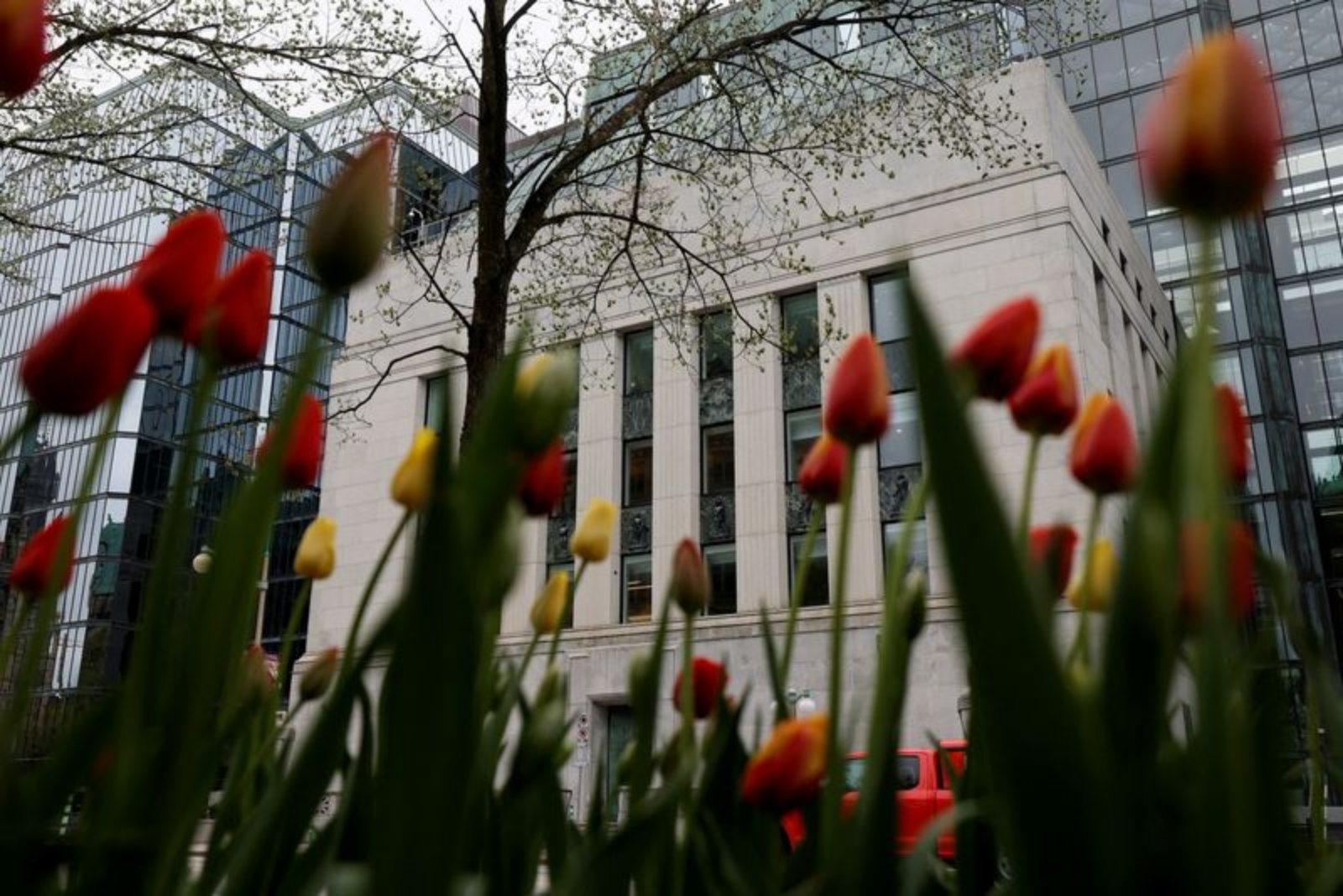
The Bank of Canada is widely expected to leave its policy rate untouched next week and to maintain that stance through the remainder of the year, according to a Reuters poll of economists conducted April 21-24. All 41 respondents anticipated the central bank would hold the overnight rate at 2.25% on April 29, and a large majority predicted no rate increases in 2024.
Financial markets still assign some probability to a hike in the fourth quarter, but most economists in the poll said such a move would only be justified if the recent surge in energy prices translated into a broad, persistent rise in inflation. A subdued economy and a labour market showing slack were cited as countervailing forces against any imminent tightening.
Inflation, while pushed higher by fuel costs, remained inside the Bank of Canada’s 1% to 3% target band in March, at 2.4%. Governor Tiff Macklem last week signalled that the central bank was not alarmed by a climb in short-term inflation expectations, saying such an increase should not be a cause for immediate concern.
Canada’s status as a net exporter of energy provides the economy with some buffer against rising global oil prices, softening the impact on national income even as consumers face higher pump prices. Nevertheless, economists in the poll upgraded near-term inflation forecasts: medians show expected averages of 2.9%, 2.7% and 2.5% for the current and upcoming quarters - roughly 50 basis points above the projections published in January.
Those upward revisions have shifted expectations for a subset of forecasters. Of the 34 economists who provided longer-horizon views, 14 now foresee at least one Bank of Canada rate increase by the end of March next year, reflecting sensitivity to the path of energy-driven inflation.
On the immediate policy call, respondents were steadfast. Thirty-three of the 41 economists said they expected the overnight rate to remain unchanged for the rest of the year. In March’s poll, 76% of respondents anticipated the central bank would hold rates in 2026, indicating little change to prevailing views of policy persistence.
"Because of softening core inflation, it does give the Bank of Canada a lot more room to be flexible and patient," said Claire Fan, a senior economist at RBC. "They can wait for actual concrete signs of risk of inflation climbing higher, broadening and persisting...as opposed to rushing to make a decision."
Trade developments quickly moved up the list of risks facing the Canadian economy. Negotiations this summer over the free trade agreement with the United States and Mexico - the USMCA - have raised concern among economists and officials. Janice Charette, Canada’s chief trade negotiator to the U.S., said she did not expect all issues to be resolved ahead of the July 1 deadline but asserted that failure to complete every element by that date would not mean the agreement’s collapse.
Douglas Porter, chief economist at BMO Capital Markets, warned that once energy price pressures recede the spotlight would shift to trade, which he expects to weigh on growth. "After energy prices settle down the focus is going to turn entirely to...where the USMCA is headed. And frankly, I’m a bit concerned on that front. I am concerned trade is going to continue to be a drag on the Canadian economy," he said.
Poll medians showed Canadian gross domestic product growth moderating to 1.2% in 2026, down from 1.7% in 2025. Economists said the combination of slowing growth and rising inflation creates a difficult mix - though not, in their view, a full-blown stagflation scenario. Porter noted that stagflation typically requires a prolonged period of near-zero growth coupled with high inflation and rising unemployment, a trio not fully evident in the current forecasts.
The unemployment outlook was slightly revised in the April poll: the 2026 unemployment rate median was trimmed to 6.6% from 6.7% in January’s survey. RBC’s Fan described the labour market’s recovery as likely to be uneven. She pointed to job losses concentrated in sectors exposed to U.S. demand and suggested that as domestic demand strengthens later in the year it should help offset trade-related weakness and support a choppier improvement in employment.
Overall, the Reuters poll depicts a central bank with room to be cautious. Economists see the Bank of Canada maintaining its current policy stance unless inflation pressures linked to energy prices broaden and persist, while trade uncertainty and soft growth loom as constraints on policy tightening.
Poll details: April 21-24 poll of 41 economists; unanimous expectation of a 2.25% overnight rate on April 29; 33 of 41 predict no rate change for the year; inflation at 2.4% in March; inflation forecasts raised to medians of 2.9%, 2.7% and 2.5% for the current and upcoming quarters; 14 of 34 foresee at least one rate increase by end-March next year; GDP medians: 1.7% in 2025 and 1.2% in 2026; unemployment 6.6% in 2026 (median).