
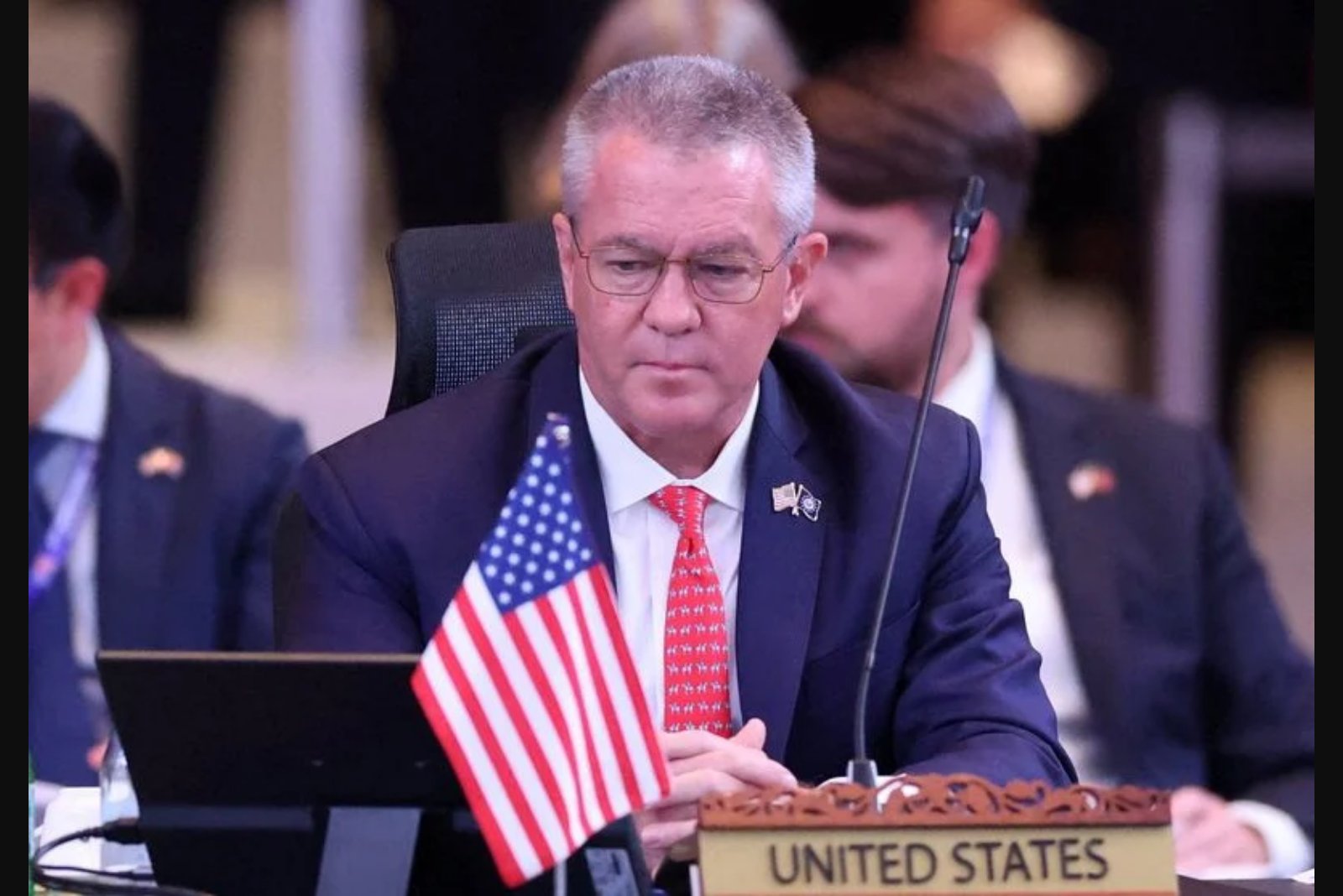
On June 25, the U.S. State Department’s senior diplomat for East Asia told a congressional subcommittee that a pending notification to Congress for an arms sale to Taiwan is not conditioned on talks with China, countering comments by the U.S. president that had suggested otherwise.
President Donald Trump has previously described the $14 billion weapons package for Taiwan as a potential "bargaining chip" and said he was holding it in "abeyance," adding that it depended on China. Those remarks created uncertainty and prompted concern in Taiwan, where officials saw them as inconsistent with established U.S. policy on arms transfers to the island.
Asked at a House Foreign Affairs Committee subcommittee hearing to confirm whether the decision to proceed with the sale was contingent on discussions with Beijing, Assistant Secretary of State for East Asian and Pacific Affairs Michael DeSombre replied, "Correct."
DeSombre, a nominee of the president to his current post, reiterated that U.S. policy remains anchored by the Six Assurances - a framework that directs Washington not to negotiate Taiwan arms sales with Beijing. He said meetings with Chinese counterparts routinely include questions about Taiwan and arms transfers, but that those exchanges do not represent a departure from the assurances.
"I think we can assure you that whenever we meet with China, they raise the questions of Taiwan and Taiwan arms sales," DeSombre said. "So, it’s something that is always discussed with them, but that is not in any way a deviation from the Six Assurances."
DeSombre did not provide a timetable for the administration's review of the $14 billion package, noting only that the proposal remained under consideration by the president.
China claims Taiwan as its own territory and has consistently opposed U.S. weapons sales to the island, viewing such transfers as interference in its internal affairs. In response to the president's remarks after his meeting with Chinese leader Xi Jinping, Taiwan's President Lai Ching-te said the island would not be sacrificed or traded.
Although the United States does not maintain formal diplomatic relations with Taiwan, it remains Taiwan's principal international supporter and its largest supplier of military equipment. U.S. law obliges Washington to provide Taiwan with the means to defend itself. The current uncertainty follows a December decision by the administration to approve an $11 billion arms sales package, the largest such package to date.
The assistant secretary's public remarks sought to clarify that conversations with Beijing occur as part of routine diplomacy but that the United States' commitment to not bargaining away arms sales to Taiwan endures. The timing for any congressional notification on the $14 billion package, however, remains unspecified.
Summary
The U.S. assistant secretary for East Asia said a pending $14 billion arms notification to Congress for Taiwan is not dependent on talks with China. He affirmed that the Six Assurances continue to guide U.S. policy and noted that while Taiwan-related issues come up in talks with Beijing, such discussions do not change the longstanding policy. The administration is still reviewing the package and has offered no decision timeline.