
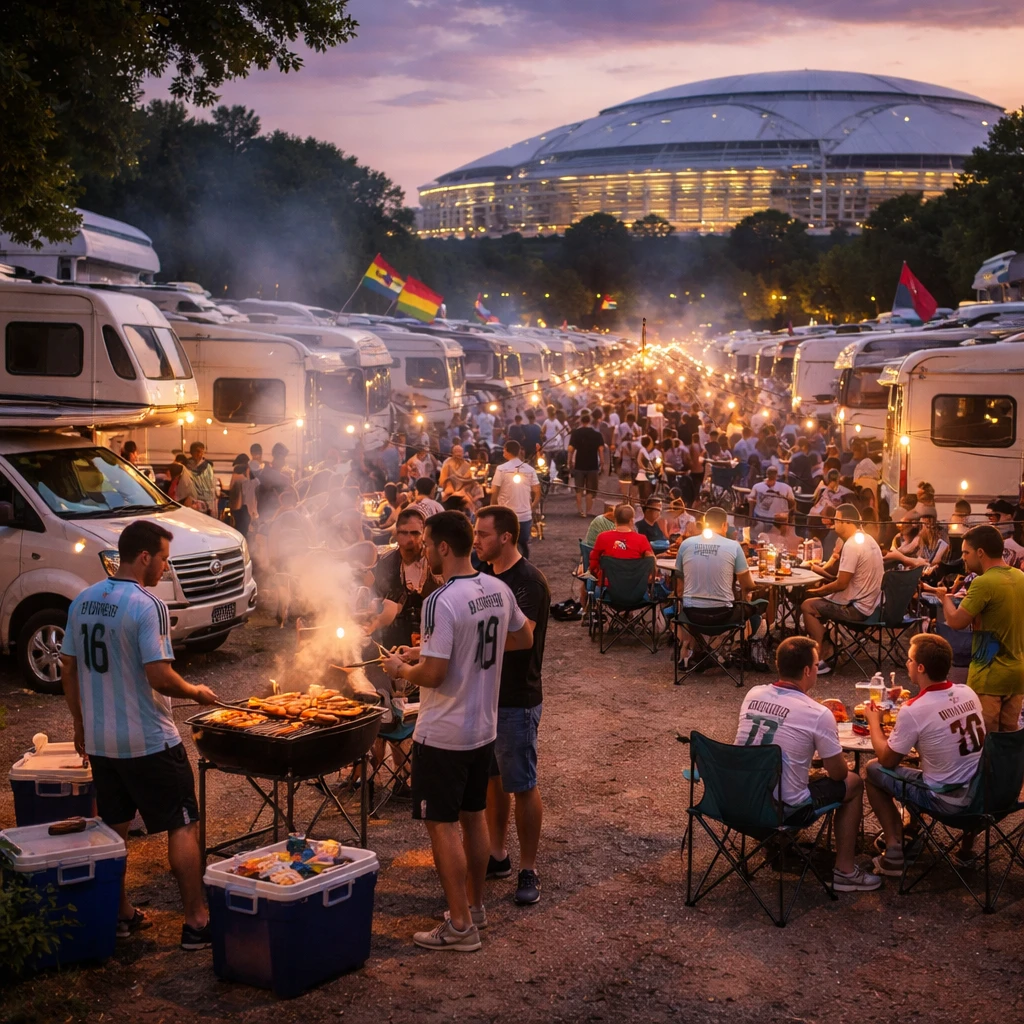
ARLINGTON, TX - With barbecue smoke drifting between rows of camper vans and Argentina flags fluttering above rooftop air conditioners, supporters attending the World Cup are finding that the most in-demand space in the Dallas area may be outside the stadium rather than inside it. A short drive from Dallas Stadium in Arlington, fans from Argentina, Germany and England have congregated at the Dallas/Arlington KOA Holiday, converting the campground into an impromptu World Cup village as elevated accommodation prices drive travelers toward lower-cost options.
The campground's general manager, Nona Gomez, said demand surged during the tournament and that nearly all of the facility's 159 RV sites were occupied for several marquee matches.
"For the England game, it was pretty packed," Gomez said. "For Argentina and Austria, we had 24 sites left. We also had a lot of walk-ins from people who didn’t have reservations."
For many fans, the decision to travel in a motorhome is as much a financial calculation as a travel preference. Argentine supporter Santiago Meneses, who is touring with five friends in a motorhome, said the combination of ticket and accommodation prices made the choice almost mandatory.
"Prices are incredibly high, both for tickets and accommodation," he said. "In previous World Cups, the costs were at least 50% lower. We thought this was a good opportunity to cut costs and have a different kind of adventure."
The campground has evolved into a communal setting where strangers share beers, compare itineraries and fire up grills late into the evening before heading to matches. German supporter Leroy Behrens, traveling through the southern United States with his father, said the social atmosphere provides a cultural exchange absent from standard hotel stays.
"We get more culture than just staying in hotels because we meet so many nice people from the U.S. and around the world," Behrens said.
The economics in play are straightforward. RV pitches work out to roughly $57 to $76 per person per night, according to campground estimates, while hotel rooms near Arlington have escalated well into the hundreds of dollars for marquee fixtures, with rates rising further for the tournament’s later stages. The campground's proximity to the stadium also helps fans avoid steep post-match ride-share fees; the stadium is only a short drive away.
Life on the road, however, has trade-offs. Meneses joked that the communal bathrooms can become crowded at peak times, and Behrens said squeezing three people into a camper in the Texas heat is not luxurious. Still, both fans said they would not change their choice.
"We couldn’t miss Messi’s last World Cup, whatever the cost," Meneses said.
Behrens also used his experience to comment on the broader affordability of the sport for average supporters, noting the growing expense of attending top-level matches.
"Football is for the fans and not for the rich people," he said. "It’s hard to see that most people can’t come to the stadium because it’s too expensive."
The KOA Holiday in Arlington illustrates how elevated pricing for major sporting events can alter travel behavior and hospitality demand, pushing some supporters toward alternative lodging and community-oriented experiences while concentrating costs elsewhere in the local market.