
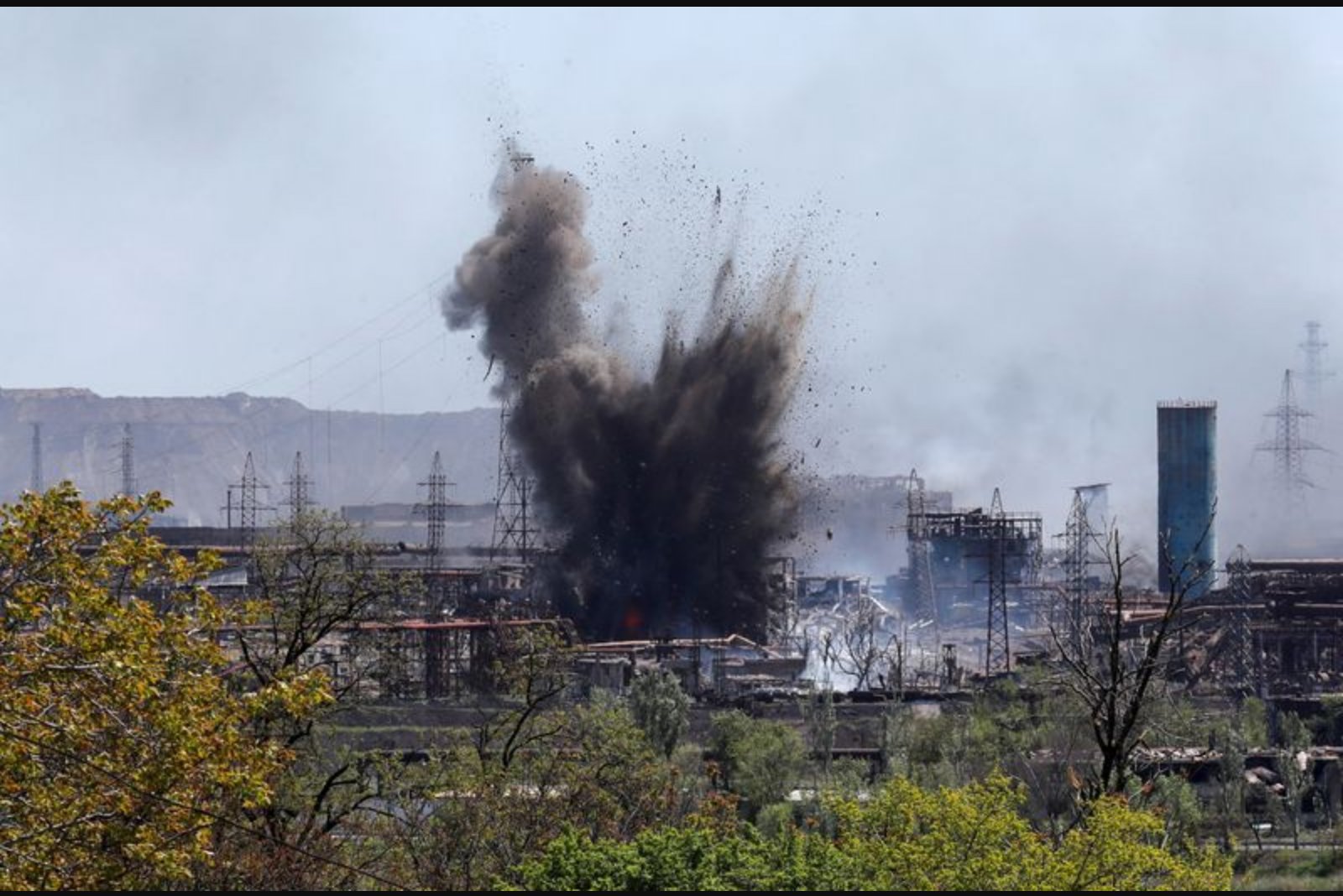
Four years after the Azov Regiment relinquished the last holdout of Mariupol to Russian forces in May 2022, the unit has been rebuilt and now is carrying out operations aimed at degrading Moscow’s control of the city and its supply lines. What was once a beleaguered regiment has expanded into a larger corps, and its First Corps has been staging drone strikes over strategic areas of Mariupol’s seaport and road network.
In a recent operation, drones operated by First Corps Azov struck multiple targets across Mariupol’s strategic port: electrical substations, repair facilities and a sanctioned ship. Kyiv’s military reported the attack caused a blackout at the port. Video footage posted by the corps of the operation included material whose locations were later confirmed as part of the sequence.
Leaders of the corps frame these actions as part of a wider Ukrainian campaign of mid-range strikes intended to hit Russian military logistics well behind the front lines. The aim, they say, is to disrupt Moscow’s ability to sustain its forces and thereby diminish the overall tempo of the Russian offensive.
Col. Arsen Dmytryk, who serves as chief of staff of First Corps Azov, acknowledged that driving Russian forces out of Mariupol will be a prolonged effort. "If it takes 20 years, we will spend 20 years planning, waiting, preparing," he said, adding that when the opportunity to retake the city arrives, the unit must be ready. Dmytryk, 32, was among those captured during the fall of Mariupol and was later released. He said he believes the corps will ultimately return to the city.
The recent port strike was conducted in coordination with Ukraine’s drone forces and the SBU security service. It occurred a short distance from the ruins of the Azovstal Iron and Steel Works, the site where Azov fighters and other Ukrainian defenders made their final stand during Moscow’s three-month siege of Mariupol in 2022.
The attack follows months of deliberate targeting of key roadways across territory Russian forces now occupy in the eastern Donetsk region, including routes in and around Mariupol. Corps footage published over recent months documents a campaign against supply lines: an April 16 video shows drones tracking long highways and open fields around Donetsk before engaging heavy army transport; a May 8 post features aerial views over central Mariupol and the damaged Azovstal complex.
"Azov is already patrolling its home city of Mariupol. From the skies - for now," a corps post said, reflecting a strategy of aerial surveillance and strikes while ground recapture remains a longer-term goal. Today’s Mariupol, whose pre-war population exceeded 400,000, hosts new infrastructure projects that are part of efforts by occupying authorities to embed administrative and economic control over the city.
Officials installed by the occupying authorities have characterized the city’s transformation as visible progress, portraying construction and port expansion as economic activity. They have downplayed the effects of the corps’ strike campaign and said repair teams are frequently restoring damaged infrastructure. Those officials also say they are increasing electronic warfare measures and adding mobile firing units to counter drone threats.
From the perspective of Ukrainian operators, a central objective of the corps’ mid-range campaign is to choke off critical cargo flows, most notably fuel shipments, that travel from Russia through transit hubs such as Mariupol and Donetsk city. A drone officer with the corps said fuel tankers and other supply vehicles are difficult to conceal on open roads, making them vulnerable to aerial attack. Routes targeted include the M14 corridor linking Mariupol with the Russian city of Rostov, the H20 running north from Mariupol toward Donetsk, and a ring road around Donetsk itself.
Ukraine’s broader strike effort also includes stepped-up attacks on logistics across the Russian-held "land bridge" in southern Ukraine that links Russia to Crimea. Those operations have contributed to fuel shortages on the peninsula, according to Ukrainian statements made public in recent weeks.
Robert Brovdi, described by Ukrainian officials as the country’s top drone commander, pledged that mounting strikes on the P-280 highway would be used to press an effort to "isolate Crimea in the near future."
Analysts and military commentators describe the effects of Azov’s strikes as cumulative rather than decisive in isolation. The sustained interdiction of supply corridors forces Russian logistics to reroute through longer, often less efficient paths and to rely on night movement, both of which degrade the capacity to sustain concentrated offensive operations. Over time, such pressure can reduce the pace at which an adversary can generate offensive tempo on the battlefield.
On the Eastern front, Russian forces are contesting control of cities such as Kostiantynivka, a key southern anchor of a fortified belt in Donetsk that Moscow has demanded Kyiv surrender. At the same time, Russia has its own drone teams attacking Ukrainian battlefield logistics. The overall pace of Russian advances has slowed in recent months, while Ukrainian units have staged local counterattacks to regain ground in certain sectors.
Observers note that Kyiv’s mid-range strike campaign could serve as a means to test the conditions for larger offensive actions by Ukrainian forces, possibly creating windows for ground operations by formations like Azov in the future.
Technological adaptation has been a hallmark of the corps’ evolution. One of its principal assets is the Hornet drone, which was developed by a U.S. defence-technology firm associated with a well-known technology executive. Corps operators have modified the Hornet by integrating Starlink internet terminals to extend the platform’s roughly 100 km nominal range, demonstrating the unit’s technical improvisation and capacity to enhance existing systems for longer-range missions.
Defence analysts credit Azov operators with significant contributions to improvements in the Hornet system. The corps has used these and other platforms to mount repeated strikes on the arterial roads serving Mariupol, with the stated goal of hastening an end to active fighting that, in commanders’ hopes, would make possible a comprehensive prisoner exchange and the release of more than 700 of its fighters currently held in Russian detention.
Securing prisoner swaps figures prominently in Kyiv’s negotiating posture, and frequent public demonstrations calling to "Free Azov" continue in Kyiv and other major Ukrainian cities—an indication of the unit’s influential status in Ukrainian society. Corps commander Denys Prokopenko said on a social platform last month that freeing his fellow combatants is a "personal priority and a matter of honour."
In Russia, the unit remains portrayed negatively because of aspects of its origins as a nationalist volunteer formation. But the unit now operates formally under the National Guard and is widely regarded within Ukrainian defence circles as a leading formation for drone operations and other advanced tactics. Defence analysts note that the corps now comprises multiple brigades, a dedicated drone regiment and special-purpose units, with total strength the unit describes as numbering in the tens of thousands.
Reflecting on the unit’s trajectory, Dmytryk said that despite Russian aims to "destroy" them while in captivity, those efforts have had the unintended effect of scaling up and consolidating Azov into a more capable force. "When we were in captivity, the Muscovites told us that they wanted to destroy, destroy, destroy us," he said. "But somehow their 'destruction' keeps scaling up Azov instead."
The corps’ campaign illustrates a broader dynamic on the current battlefield: improved unmanned systems, civilian satellite communications and decentralized command techniques are enabling forces to strike deeper into occupied territory and to target elements of logistics and infrastructure that underpin an opponent’s combat power. The Azov corps leaders emphasize patience and preparation as they continue to build capabilities, while continuing to press operations aimed at eroding the logistical foundations of Russian military presence in and around Mariupol.
As operations continue, both sides are adjusting tactics: Ukrainian forces are intensifying mid-range interdiction to force Russian logistics into less favorable patterns, while Russian-installed authorities claim to be expanding countermeasures including electronic warfare, repair and emergency-response efforts, and mobile defensive units. The interplay of these measures will shape the operational environment in the months ahead, with implications for supply chains, fuel availability and the security of transport nodes in the occupied south.