
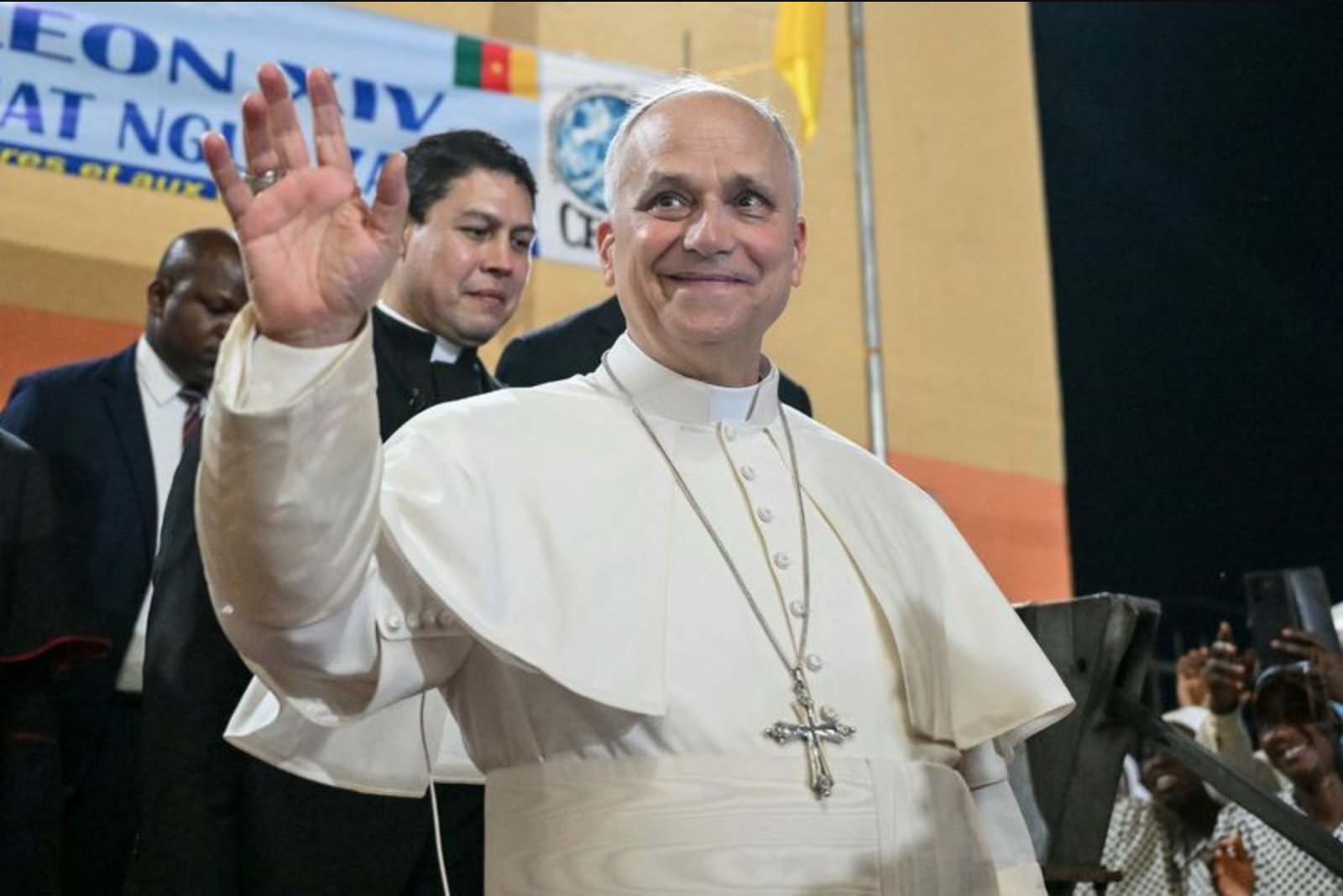
YAOUNDE, April 15 - Pope Leo used a forceful address in Cameroon's capital on Wednesday to call on the country's leaders to confront corruption and resist what he described as the whims of the rich and powerful. The remarks were delivered in the presence of President Paul Biya, who has led Cameroon since 1982, and other senior officials including Prime Minister Joseph Dion Ngute.
Arriving in Yaounde after a stop in Algeria, the pope urged a frank examination of conscience and a decisive shift toward fairness and accountability. "It is time to examine our conscience and take a bold leap forward," he said shortly after stepping off his flight. He directly linked the persistence of corruption to a loss of credibility in authority, warning that unchecked greed distorts governance and robs leaders of legitimacy.
"In order for peace and justice to prevail, the chains of corruption - which disfigure authority and strip it of its credibility - must be broken," he said, adding that hearts must be freed from an "idolatrous thirst for profit." The language was unusually direct for a pontifical overseas visit and framed corruption as a central obstacle to both justice and social trust.
Biya listened to the remarks without visible reaction. His government rejects allegations of corruption and human rights abuses, and argues that his long tenure provides stability that helps Cameroon avoid the types of conflict seen in nearby countries.
In the course of his 10-day tour of four African countries, the pope has also become more outspoken on multiple international issues. He has recently addressed the war in Iran, among other concerns, and the trip has drawn criticism from external political figures - including renewed public criticism from U.S. President Donald Trump during the tour. The pope said on Monday he would continue to speak out on the conflict regardless of those critiques. On his flight into Cameroon he did not address the criticism directly, instead urging respect between peoples and highlighting the value of dialogue across communities.
The pope also explicitly called for an end to the simmering Anglophone conflict in Cameroon, which the address noted has claimed thousands of lives over the last decade. The violence has taken place mainly in the country's two English-speaking regions, where separatist groups have clashed with government forces. A local separatist alliance announced a three-day safe travel passage to allow civilians and visitors to move freely during the pope's visit.
Referencing other security challenges in the country, the pope also mentioned conflicts involving militant groups such as Boko Haram in Cameroon's north. He highlighted the human cost of fighting, lamenting the deprivation of education and future prospects for young people caught in prolonged insecurity. "Enough of war, with all the pain it causes through death, destruction and exile!" he said.
Addressing governance and citizen engagement, the pope told President Biya and other officials that public service requires listening to people and valuing their capacity to contribute to solutions. He urged protection of basic rights while stressing that security operations must be balanced by respect for human rights. "Security is a priority, but it must always be exercised with respect for human rights," he said. "Authentic peace arises when ... the law serves as a secure safeguard against the whims of the rich and powerful."
President Biya, now 93 and in power for more than four decades, presides over a deeply entrenched patronage system, the speech noted. As he ran for an eighth term in 2025, the pope's remarks about listening to citizens and protecting rights come against a backdrop of internal political dynamics. The article referenced a widely circulated social media post by Biya's daughter, Brenda, who urged voters to consider another candidate on the grounds that her father "has made too many people suffer"; she later deleted that post.
The pope's visit drew large crowds in Yaounde. Thousands of people, many wearing colourful fabrics, lined the route from the airport to the presidential palace, dancing and singing under bright afternoon sun. Billboards displayed images of the pope and President Biya with bilingual welcome messages portraying Cameroon as a "Land of Hope." The pope, aged 70, was described as relatively young for a pontiff and in good health.
The itinerary is ambitious: the pontiff is undertaking what was characterised as one of the most complicated tours for a pope in recent decades. The journey spans roughly 18,000 km over 18 flights and will take him to 11 cities and towns across three countries in addition to Cameroon, including planned visits to Angola and Equatorial Guinea. On Thursday he will travel to Bamenda, the country's largest English-speaking city, to celebrate Mass and to participate in a "meeting for peace" at a cathedral. A Mass expected to draw around 600,000 people is scheduled for Friday in Douala, the coastal commercial hub.
Local actors are preparing for the pope's engagements while managing security concerns and seeking to facilitate movement for civilians and visitors alike. The temporary safe passage announced by separatist groups aims to reduce the risk of confrontation during the visit, though the broader conflict and other security threats remain unresolved.
Summary
Pope Leo used a direct speech in Yaounde to call on Cameroonian leaders to tackle corruption, respect human rights and pursue peace in English-speaking regions torn by separatist violence. Delivered before President Paul Biya, the address also referenced threats from militant groups in the north and urged leaders to listen to citizens as part of rebuilding trust. The papal tour has generated outside criticism and local measures to protect civilian movement during the visit.
Key Points
- The pope publicly urged Cameroon to break the "chains of corruption" and resist the influence of wealthy interests, linking governance failures to weakened authority and justice.
- He called for an end to the Anglophone conflict that has killed thousands and highlighted other security threats including attacks by militant groups in the north, stressing the impact on education and young people's futures.
- The visit is part of an extensive African tour covering multiple countries and cities, and it has prompted both local guarantees of safe passage by separatist forces and international criticism of the pontiff.
Risks and Uncertainties
- Persistent corruption and entrenched patronage could undermine public confidence and complicate efforts to deliver reforms - a concern for governance and institutions.
- Ongoing Anglophone violence and the presence of militant groups in the north present security risks that disrupt education, civilian life and broader social stability.
- Human rights concerns tied to security operations create uncertainty about how stability will be pursued and whether measures will respect legal safeguards.
Tags: Cameroon, Pope, Conflict, Governance, Security