
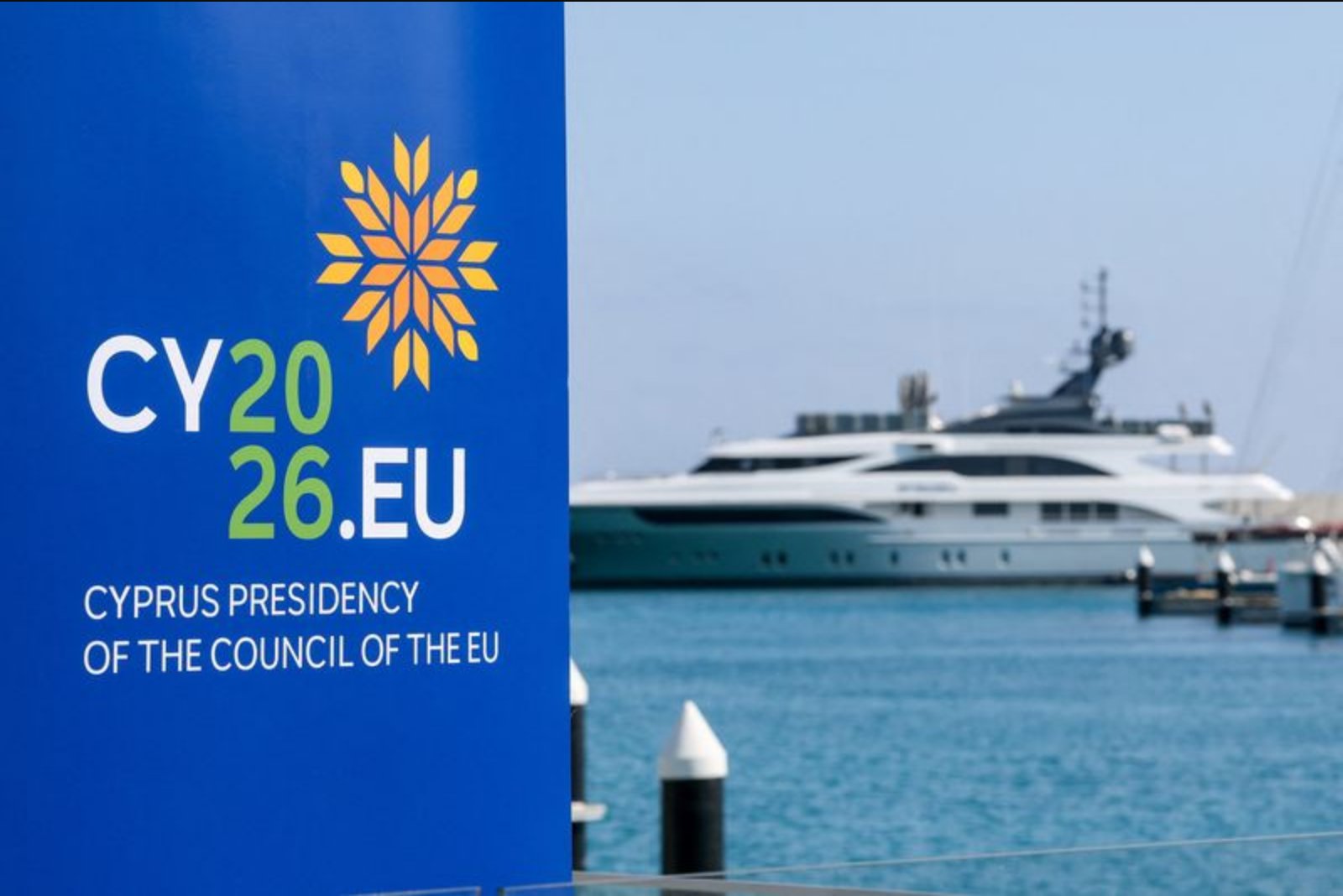
European Union leaders are set to examine the bloc’s mutual assistance provision at a summit in Cyprus on Thursday as questions over U.S. support for NATO and ambiguity around the clause’s implementation have elevated the issue on the EU agenda.
The mutual assistance clause, embedded in the Treaty on the European Union as Article 42.7, requires EU countries to come to the aid of a member state that is the victim of armed aggression. Officials say that, although the clause establishes an obligation of aid and assistance, there are limited practical rules detailing how such assistance should be provided.
Tensions in transatlantic relations have contributed to a new sense of urgency about clarifying the clause. U.S. President Donald Trump’s high-profile criticism of allied governments - including comments questioning NATO’s support for possible U.S. action in the Iran conflict and earlier remarks about seizing Greenland from Denmark - have prompted some in the EU to press for clearer internal arrangements in case of security contingencies.
"I think Greenland has shown it’s necessary to have that discussion," said one EU diplomat, reflecting concern that recent exchanges with Washington have exposed gaps in the EU’s contingency planning.
Cyprus, which currently holds the rotating EU Council presidency, has been particularly active in advocating a more concrete reading of Article 42.7. The push comes after a drone struck a British air base on the island last month during the Iran war, an incident that underscored the limits of relying solely on NATO or bilateral guarantees in some circumstances.
At the summit in Cyprus, EU foreign policy chief Kaja Kallas is expected to brief member state leaders on the kinds of assistance that could be offered under the clause, an EU official said. In parallel, senior diplomats are organizing scenario-based tabletop exercises in the coming weeks to test how the clause might be executed in defined situations, the EU diplomat added.
Juraj Majcin, a policy analyst at the European Policy Centre in Brussels, said the lack of pre-prepared options hampered rapid responses in the past. "What was missing was having some specific scenarios and options already prepared in case a situation comes when some countries will request assistance," he said. "There will be some thought put into what our union can facilitate, and how can this be streamlined."
Legal basis and past use
Article 42.7 of the Treaty on the European Union states that "if a Member State is the victim of armed aggression on its territory, the other Member States shall have towards it an obligation of aid and assistance by all means in their power." The treaty also makes clear that this obligation "shall not prejudice the specific character of the security and defence policy of certain Member States" and that any action must be consistent with commitments to NATO.
The clause has been activated only once, by France after the 2015 terrorist attacks in Paris. At that time, member states contributed to EU and international missions and operations, which allowed France to redeploy some of its forces.
Diverging positions and NATO’s role
Views within the EU differ on how far to develop Article 42.7. Cyprus wants more clarity because it is not a NATO member and therefore cannot rely on NATO’s mutual defence guarantee in the same way some other EU states can. Other member states are wary of taking steps that could be interpreted as distancing Europe from NATO or as preparing an alternative to NATO’s Article 5 mutual defence clause.
"We should avoid any interpretations saying this is a contingency if NATO explodes and (the) U.S. leaves," said a second EU diplomat, underlining the sensitivity of the debate and the desire among some capitals to avoid signaling a break with the transatlantic alliance.
NATO’s Article 5, which specifies that an attack on one ally is an attack on all, continues to be seen by many as Europe’s ultimate security guarantee. The clause obliges allies to take actions they judge necessary to assist a member under attack, including potentially the use of military force. NATO’s standing military structures and planning, backed by the United States as a major military power, are commonly referenced by officials as the backbone of European defence.
Latvia’s Foreign Minister Baiba Braze said her country "sees NATO as the cornerstone of collective defence." She emphasized that any activation or further development of Article 42.7 should complement NATO rather than contradict it. "The possible activation and further development of Article 42.7 should go hand in hand with NATO, seeking synergies, and would in no way be regarded as a sign of distrust in NATO or as weakening the Alliance," she said.
Latvia also argued for preserving flexibility when applying Article 42.7, allowing a threatened member state to determine the type of assistance it requires in the event of armed aggression or hybrid threats.
EU leaders in Cyprus will therefore confront both a legal and a political task: to translate the broad obligation of aid and assistance into a set of practical options and procedures while avoiding steps that could be read as undermining NATO. The scheduled briefings and tabletop exercises are meant to surface concrete scenarios and policy choices that member states can adopt if and when the clause is invoked.