
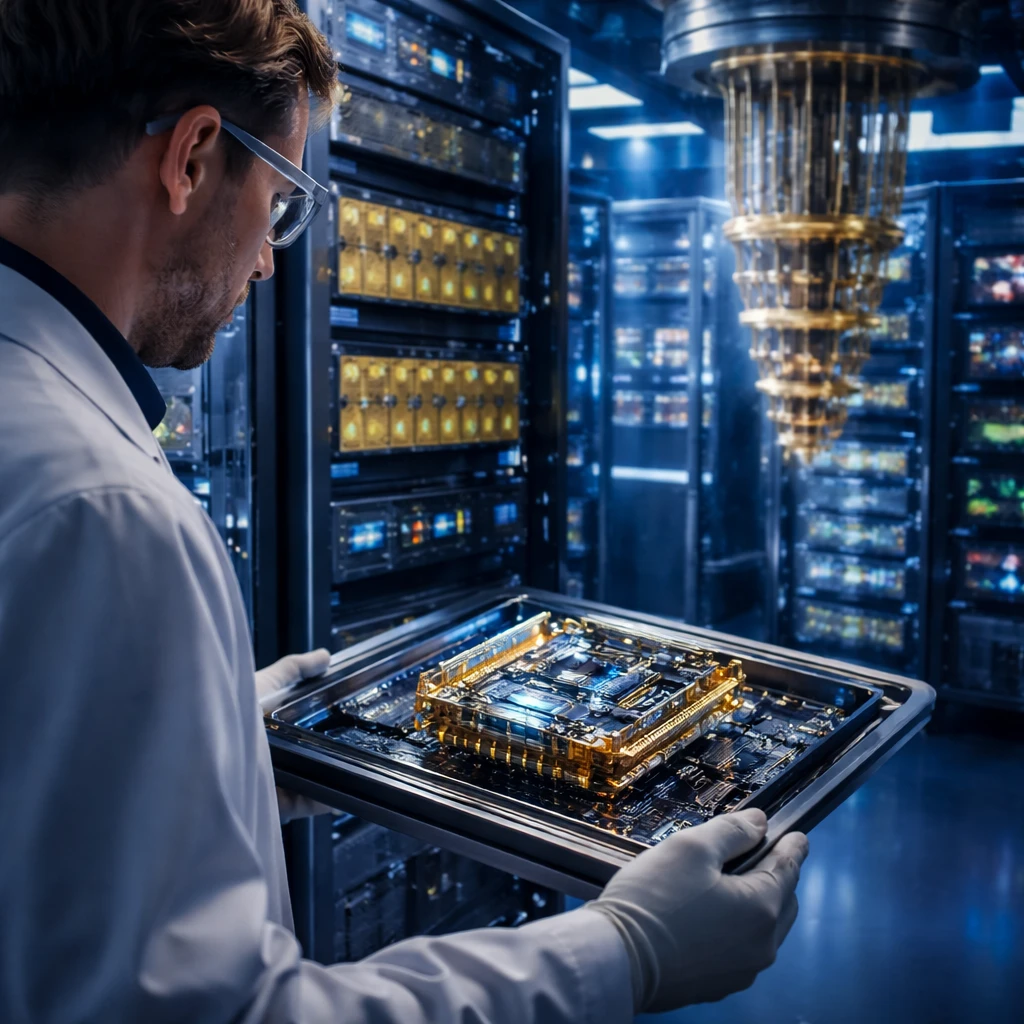
Premarket trading on Wednesday showed a broad uptick among companies focused on quantum computing following Nvidia's announcement of a new family of open-source quantum AI models.
By 05:44 ET, D-Wave Quantum had jumped more than 8% in premarket trade, while IonQ advanced 6.2%. Infleqtion, Rigetti Computing and Quantum Computing all registered increases in the range of 3.9% to 5.5% during the same early session.
Nvidia introduced the new model suite under the name NVIDIA Ising - a reference to a mathematical model used to describe complex physical systems. The company positioned the models as tools for researchers and enterprises working to develop quantum processors capable of running practical applications.
According to Nvidia, the Ising models are aimed specifically at two of the most significant technical barriers in the field: error correction and processor calibration. Nvidia said the models can deliver up to 2.5x faster performance and up to 3x higher accuracy in the decoding process that is required for quantum error correction.
"AI is essential to making quantum computing practical," said Jensen Huang, founder and CEO of NVIDIA. "With Ising, AI becomes the control plane - the operating system of quantum machines - transforming fragile qubits to scalable and reliable quantum-GPU systems."
Nvidia also cited an estimate from analyst firm Resonance that projects the global quantum computing market to exceed $11 billion by 2030, while noting that much of that expansion depends on continued engineering advances in error correction and scalability.
The prospect of quantum computing rests on its potential to solve problems in areas such as physics, chemistry and cybersecurity that lie beyond the reach of conventional machines. Yet the industry continues to confront a core technical challenge: building reliable systems. Current quantum systems remain prone to errors, and achieving the levels of reliability and scale needed for widespread practical use depends on breakthroughs in the specific areas Nvidia's models target.
The market reaction observed in premarket trading reflects investor sensitivity to developments that could advance error correction and calibration. For participants tracking volume and price reactions across related equipment and software providers, Nvidia's announcement provides a concrete technology narrative tied to measurable performance claims, even as the broader challenge of producing dependable quantum hardware remains.
Readout: Nvidia's NVIDIA Ising models promise improved decoding speed and accuracy for quantum error correction; early-morning trading showed gains across multiple quantum computing firms, while the industry still faces reliability and scalability hurdles.