
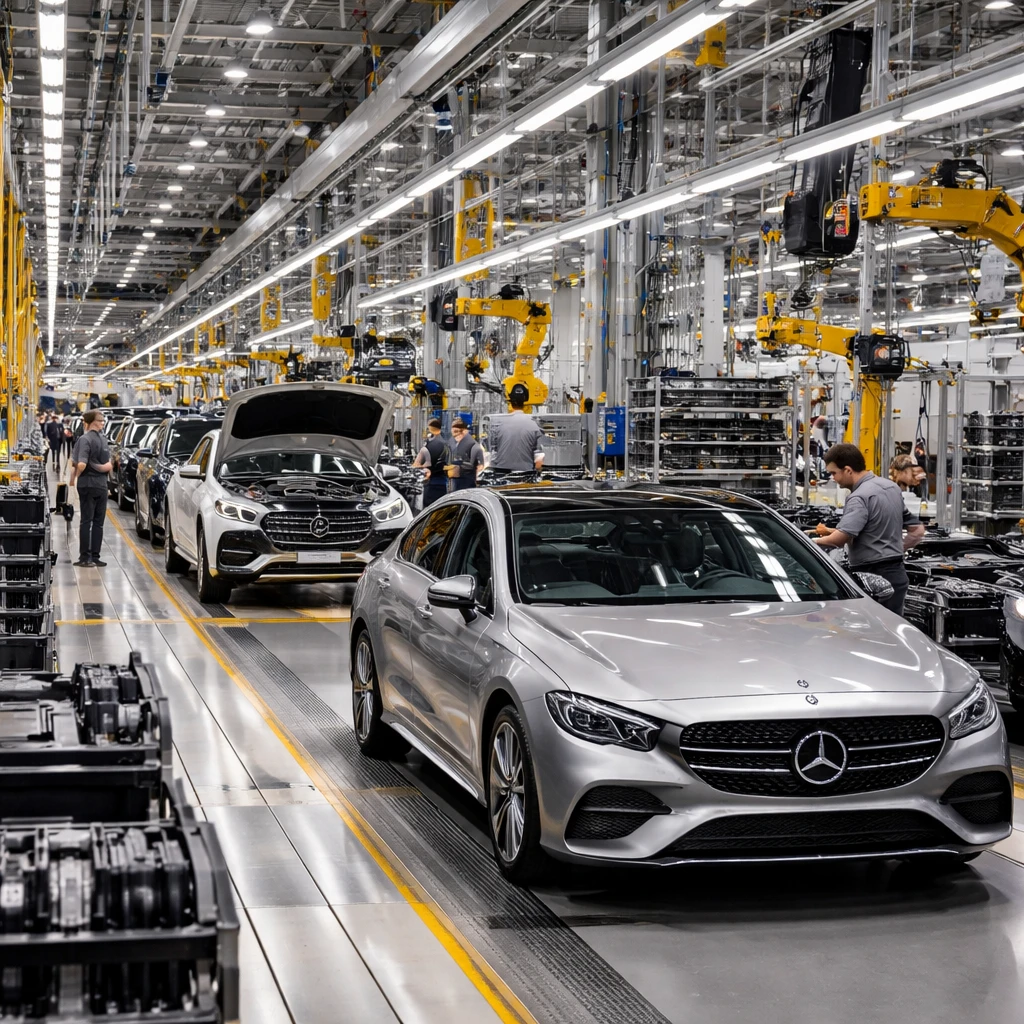
Mercedes-Benz reported a marked retreat in first-quarter operating profit on Wednesday even as the automaker marginally outperformed analysts' consensus. The Stuttgart-based premium carmaker said earnings before interest and tax (EBIT) were 1.9 billion euros, a 17% decline from the prior-year quarter that nevertheless exceeded the average analyst forecast of 1.6 billion euros, according to a Visible Alpha poll.
First-quarter revenue came in at 31.6 billion euros, slightly below the analyst expectation of 31.8 billion euros. Management highlighted multiple headwinds that have pressured margins and sales, including steep tariffs, weakness in China and the costs and complexities tied to a transition toward electric vehicles.
The adjusted return on sales for Mercedes' core cars division fell to 4.1% in the quarter, a figure that sits within the company's full-year target range of 3% to 5% but is down from 7.3% in the same quarter a year earlier. The decline underscores narrower margins as Mercedes navigates shifting market demand and higher operating pressures.
Chief Financial Officer Harald Wilhelm said the company remains "on track" to achieve its guidance for 2026 group EBIT to be "significantly above" last year’s 5.8-billion-euro result. Wilhelm pointed to demand for new products and healthy order books as factors that should support improved momentum in the second half of the year.
"Strong demand for our new products and healthy order books position us well for improved momentum in the second half of the year," Wilhelm said.
CEO Ola Kaellenius has implemented broad job cuts and cost-reduction measures as part of efforts to protect earnings while the company introduces a steady stream of new models. Mercedes plans to launch 40 new models between 2025 and 2027, a slate that includes an all-electric CLA sedan positioned in its entry-level segment and an updated S-class range aimed at maintaining its luxury position in China.
On margins, the finance chief reiterated a disciplined approach to expenditure and a cautious ambition to return to double-digit margins in the longer term, targeting a mid-term operating margin of 8% to 10%.
The company also included a currency conversion reference in its release: $1 = 0.8543 euros.
The quarterly update additionally featured promotional content aimed at investors, noting a question about investing $2,000 in Mercedes (ticker MBGn) and describing a ProPicks AI tool that evaluates stocks across numerous financial metrics to generate strategy ideas. The release cited the tool's approach and referenced past winners identified by the AI, while inviting readers to explore whether MBGn appears in ProPicks AI strategies or if alternative opportunities exist in the same sector.
Overall, Mercedes' results reflect a company balancing short-term margin compression and market headwinds with a product-led response and cost discipline designed to restore profitability.