
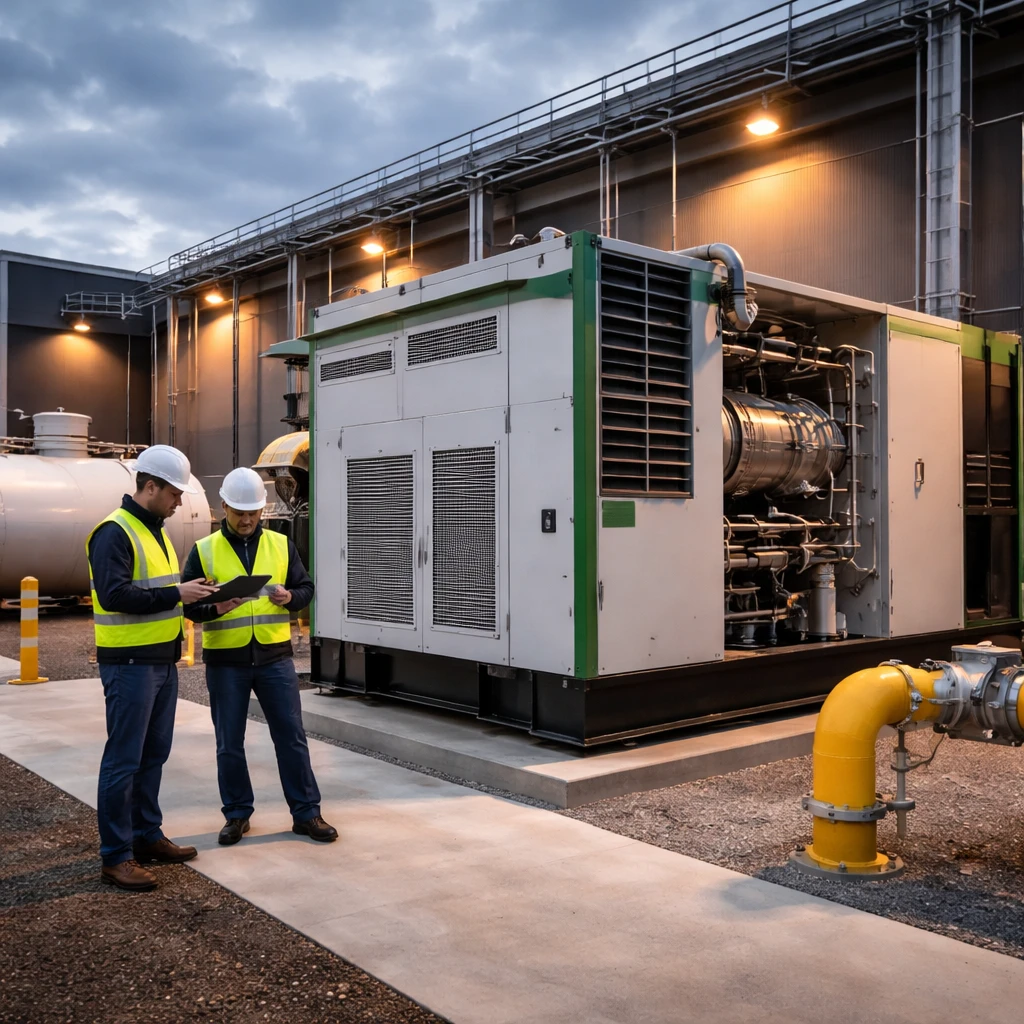
Hyliion has made fuel logistics the responsibility of its customers for KARNO generator deployments, advising buyers to arrange their own pipeline natural gas or on-site diesel storage rather than relying on the company to supply fuel. The guidance, outlined by Chief Executive Thomas Healy in an interview following Hyliion's second-quarter results, frames a central piece of on-site power economics as a buyer-managed item as the company seeks to win data center business.
"Customers are responsible for supplying the fuel used to operate the KARNO Power Module," Healy said, noting that many data center operators would likely tap pipeline natural gas where available while others might rely on diesel stored at the site. Healy also highlighted the KARNO module's capacity to run on more than 20 fuel sources, which he said provides customers with flexibility and potential redundancy.
The comments accompanied a quarterly update in which Hyliion raised its full-year revenue outlook by 50% to about $15 million and reported a net loss of $13.9 million. The company also disclosed a $41.7 million contract with the U.S. Navy, its largest military award to date.
Hyliion confirmed that commercialization of the 200-kilowatt KARNO module has shifted into 2027. Healy attributed the revised commercialization timing to the schedule for early deployments and "growing military opportunities," while also describing continued progress on the larger, 800-kW module intended for the Navy.
"We continue to make strong progress on the 800 kW power module for the U.S. Navy, while also conducting on-site testing of 200 kW commercial systems that we plan to deploy to additional customers later this year, including data center customers preparing to evaluate KARNO technology," Healy said.
Healy pointed to a gap between current production capacity and customer demand. Hyliion's existing installed fleet of printers supports roughly 15 megawatts of annual production, while the appetite from at least one data center customer reached about 400 megawatts a year. To address that discrepancy, the company said it plans to roughly triple printer throughput and now expects to commence ramping its additive-manufacturing investment in 2027, a year earlier than previously planned.
Healy described the path to higher throughput as a combination of upgrades to the current printer fleet and the introduction of next-generation printers with greater output. "As we expand manufacturing capacity, we expect to begin addressing the significant backlog of customer interest in our products," he said.
On demand indicators, Hyliion cited roughly 750 KARNO Cores tied to non-binding letters of intent, with more than half originating from data center providers. The company emphasized that conversion of those LOIs into firm orders will hinge on customers testing units in their own facilities.
"Following commercialization and successful customer validation, we expect these early deployments to provide the basis for customers to move toward firm orders," Healy said.
Hyliion is charging customers for early units, but the company will not recognize the associated revenue until after commercialization is achieved.
The company's recent financial and operational updates present a mixed picture: an upgraded revenue outlook and a material Navy contract on one hand, and continued net losses, a deferred commercialization timetable for the commercial 200-kW product, and production constraints relative to some customer needs on the other. For prospective data center buyers and military customers, the arrangement that places fuel sourcing and storage on the purchaser alters the on-site deployment economics and planning responsibilities.