
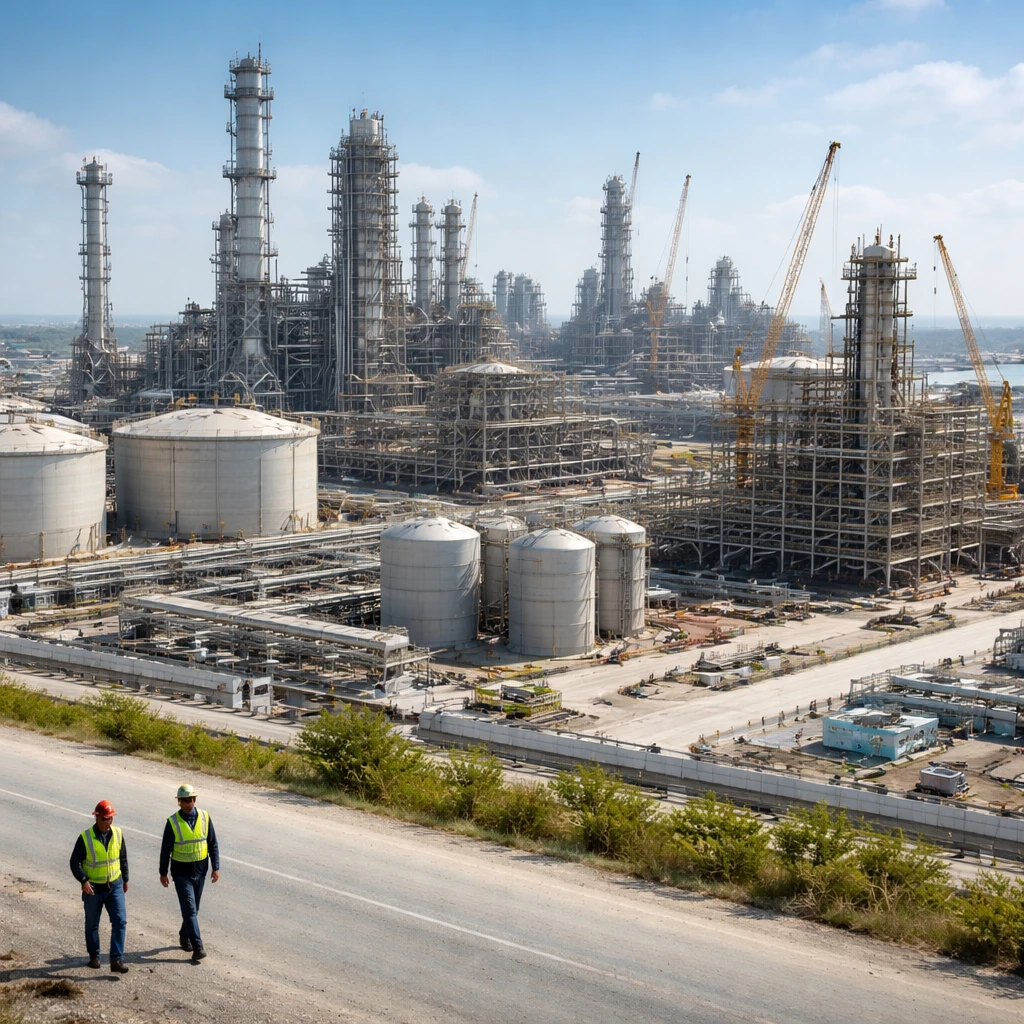
Nigeria's Dangote oil refinery has entered an agreement with U.S. industrial firm Honeywell to apply Honeywell's process technology to increase manufacture of petrochemical feedstocks used in plastics and detergents, the companies said. The collaboration expands the scope of the $20 billion Lekki complex beyond fuel production and is intended to reduce reliance on imports for industrial and consumer inputs.
Under the deal, Dangote will employ Honeywell UOP's Oleflex technology to add 750,000 metric tons per year of propylene output at the Lekki refinery. Propylene is a primary building block for polypropylene and other plastics that serve packaging, consumer goods, and industrial purposes. In addition, the refinery complex will use Honeywell technologies to produce 400,000 metric tons per year of linear alkylbenzene, or LAB, which is a core ingredient in detergents and cleaning formulations.
Dangote said the planned LAB plant, once fully commissioned, is expected to be among the largest in the world by nameplate capacity. The companies did not disclose financial terms of the agreement.
The petrochemical expansion is described as part of Dangote's broader objective to create an integrated petrochemicals business anchored on Africa's largest refinery. By producing industrial and consumer chemical inputs domestically, the project aims to position Nigeria as a regional manufacturing hub while meeting local demand for plastics and detergent feedstocks.
Dangote's wider Lekki complex already includes a $2 billion petrochemical plant adjacent to the main refinery. That petrochemical unit, which has an 830,000 metric tonne capacity, began producing polypropylene in March 2025 in 25 kg bags for local markets. Dangote and Honeywell have a history of cooperation on the refinery project itself, which currently has a crude processing capacity of 650,000 barrels per day.
Using Honeywell process technology, Dangote plans to expand the refinery's throughput to 1.4 million barrels per day by 2028. Dangote has stated that reaching that level of throughput would make the Lekki facility the world's largest refinery by crude processing capacity. Financial details and implementation timelines beyond the production capacities cited were not provided in the announcement.
Summary
Dangote will utilize Honeywell UOP Oleflex and other Honeywell technologies to raise annual propylene output by 750,000 metric tons and produce 400,000 metric tons of LAB at the Lekki complex, broadening the site's product slate to support plastics and detergents while advancing Dangote's integrated petrochemicals ambitions.
Key points
- Technology: Honeywell UOP's Oleflex technology will be used to produce 750,000 metric tons per year of propylene.
- New products: The refinery will also produce 400,000 metric tons per year of LAB for detergents.
- Capacity and strategy: The expansion is part of Dangote's plan to build an integrated petrochemicals business around its refinery, which is targeted to reach 1.4 million bpd capacity by 2028.
Risks and uncertainties
- Financial terms undisclosed - the companies did not release monetary details of the Honeywell-Dangote agreement, leaving the investment scale and financing structure unclear.
- Timing and commissioning - while production capacities are stated, the announcement did not provide full implementation timelines beyond the stated operational milestones, introducing execution uncertainty.
- Market absorption - increasing domestic output of propylene, polypropylene and LAB will require demand uptake in local and regional markets to displace imports as intended.