
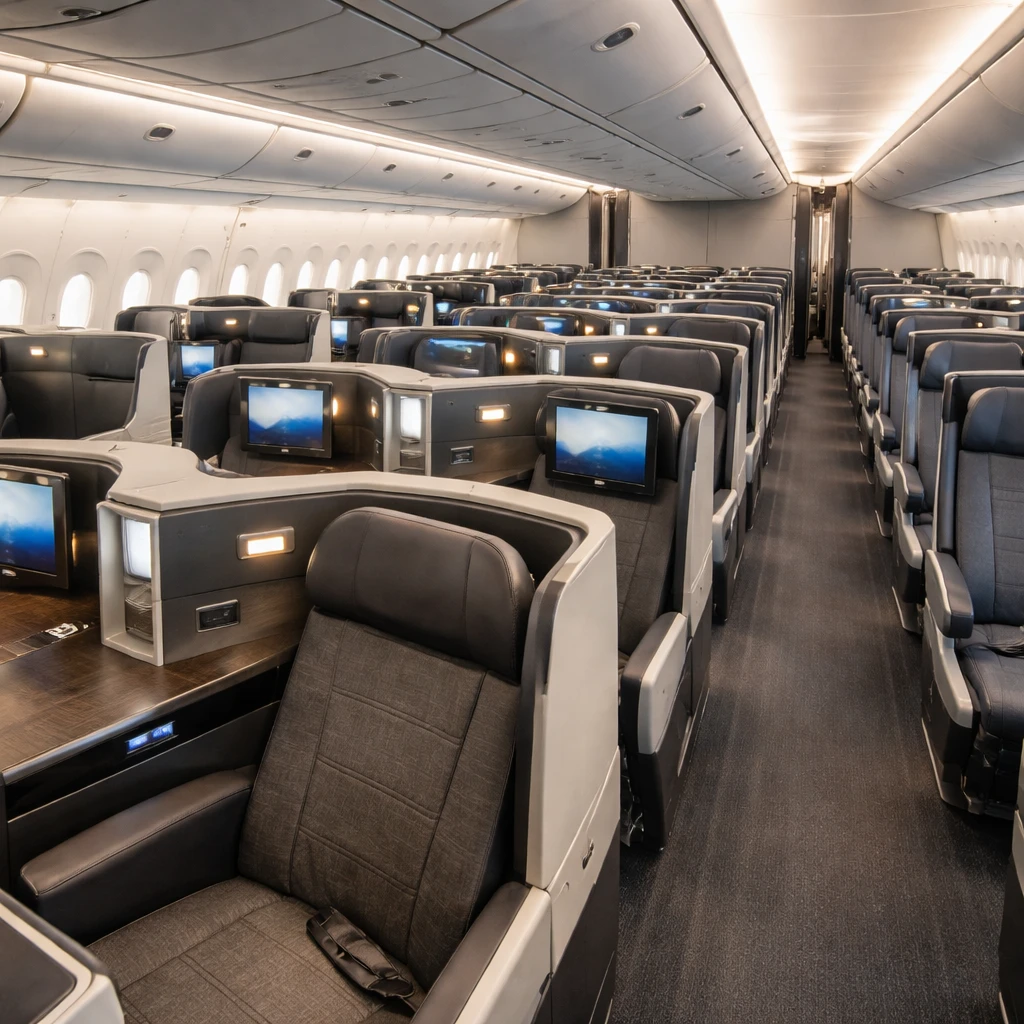
American Airlines is reconfiguring its fleet of Boeing 777-300ERs to concentrate more capacity in higher-yield cabins, moving away from a distinct international first-class product on that aircraft and reallocating space to business class and premium economy.
The carrier said the first of the retrofitted 777-300ERs will begin commercial operations from New York to Buenos Aires on Wednesday. The work is being done across American's entire 777-300ER fleet, which numbers 20 aircraft, and the airline expects the program to be finished sometime in 2027.
The revamped interior will raise the count of premium seats on each 777-300ER to 144, up from the current 116. That translates to the premium share of seats increasing to roughly 44% of the cabin from about 38% today. Under the new layout, the premium seating mix will include 70 Flagship Suite business-class seats equipped with privacy doors, 44 Premium Economy seats and 30 Main Cabin Extra seats, American's extra-legroom economy option.
By contrast, the 777-300ERs in their present configuration carry 52 business-class seats and eight Flagship First seats, the airline's top-tier international first-class offering. As part of the retrofit, American will remove Flagship First from the 777-300ER. The airline will no longer sell the Flagship First product on 777-300ER flights for travel beginning November 19.
Among the large U.S. network carriers, American remains the only one that continues to offer a separate international first-class cabin. Delta Air Lines combined its international first- and business-class cabins beginning in late 1998, while United Airlines stopped selling international first class in 2018 as it reconfigured its long-haul fleet around Polaris business class.
American first announced in 2022 that it would phase out international first class on some types because customer demand for the product was weak. The move to reconfigure the 777-300ERs extends that strategic shift, reallocating the space toward seats that the airline says customers are more willing to pay for.
The retrofit forms part of American's broader effort to boost revenue from premium travel. In the second quarter, premium travelers accounted for nearly half of the airline's ticketed revenue while representing about 30% of its seats, according to the airline's own reporting. The company has also said that premium seating on its narrowbody fleet will rise to approximately 40% in coming years from roughly 25% now.
This reallocation of capacity reflects a larger trend across U.S. carriers toward expanding higher-end products. Revenue from premium offerings has been growing faster than more price-sensitive segments at several major airlines as wealthier customers continue to spend while more budget-conscious travelers retrench.
Carriers historically known for lower fares are also reacting. Southwest Airlines is evaluating services and products more commonly associated with network carriers, including airport lounges, transoceanic flying and more premium seating. Frontier has introduced first-class-style seats, and JetBlue has expanded its premium offerings to include airport lounges.
American's 777-300ERs serve long-haul routes such as London, Tokyo, Sao Paulo, Buenos Aires and Sydney. Along with the seating reconfiguration, the retrofitted jets will feature upgraded inflight entertainment systems, and members of American's AAdvantage loyalty program will receive access to complimentary high-speed Wi-Fi on these aircraft.
Context and implications
The change increases premium capacity on key long-haul routes and aligns American's product offering on the 777-300ER with demand signals the airline has reported internally. The elimination of a separate first-class cabin on the type further standardizes the carrier's long-haul premium products and follows similar moves by other major U.S. carriers.
The upgrades are being phased fleetwide over multiple years, with completion expected sometime in 2027, leaving timing and execution as key variables to watch as the airline implements the program.