
Overview
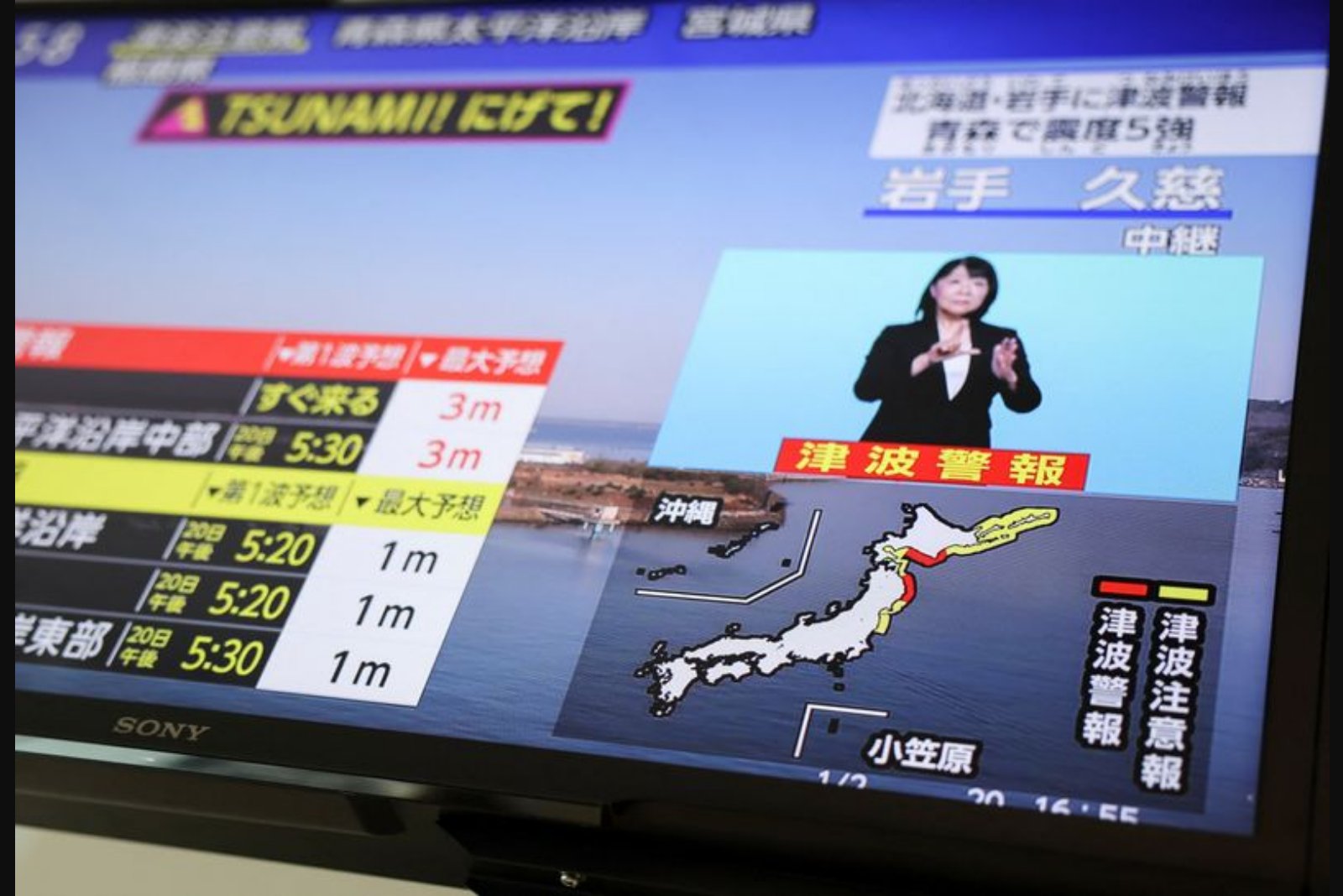
An earthquake measuring magnitude 7.5 hit off the northeastern coast of Japan on Monday, according to the Japan Meteorological Agency (JMA). The agency placed the epicentre in the Pacific Ocean and said the quake occurred at a depth of 10 km. Officials issued tsunami warnings for coastal locations where waves of up to 3 metres (9.84 ft) were expected.
Government response and public alerts
Prime Minister Sanae Takaichi told reporters the government had established an emergency task force and urged residents in the affected regions to move to safety. Broadcaster NHK aired footage showing vessels departing Hachinohe port in Hokkaido ahead of the expected waves, and displayed a 'Tsunami! Evacuate!' alert on screen to warn coastal communities.
Local impact and transport disruption
Rail services were affected: Kyodo news agency reported that bullet train operations in Aomori, at the northern tip of Honshu island, were suspended following the tremors. The JMA rated the shaking as an 'upper 5' on Japan's seismic intensity scale, a level described as strong enough to make movement difficult for people and able to cause collapse of unreinforced concrete-block walls in many cases.
Energy sector checks
While there are no nuclear power plants currently in operation in Hokkaido and the Tohoku regions, Hokkaido Electric Power Co and Tohoku Electric Power Co maintain a number of facilities that have been shut down. Tohoku Electric said it was assessing the impact of both the earthquake and the tsunami threat on its Onagawa nuclear power plant.
Seismic context noted by authorities
Japanese authorities reiterated the country's high seismic activity. Officials noted that Japan lies within the Pacific Basin's zone of volcanoes and oceanic trenches and accounts for roughly 20% of the world's earthquakes of magnitude 6.0 or greater. They also noted the frequency of tremors across the country.
Key points
- The quake measured 7.5 magnitude with an epicentre in the Pacific Ocean and a depth of 10 km - immediate tsunami warnings called for coastal areas.
- Evacuation orders and an emergency government task force were deployed; maritime activity at Hachinohe port and bullet train services in Aomori were disrupted.
- Energy operators are conducting inspections, including checks at the Onagawa nuclear plant; no reactors are currently operating in Hokkaido and Tohoku but several plants remain shut down.
Risks and uncertainties
- Tsunami risk - Coastal communities face potential inundation from waves up to 3 metres, posing immediate danger to ports, fishing vessels and shoreline infrastructure.
- Infrastructure and transport disruption - Strong shaking rated 'upper 5' raises the risk of structural damage to non-reinforced walls and continued interruption to rail and local services.
- Energy sector assessments - Although no nuclear reactors are active in Hokkaido and Tohoku, power companies are evaluating possible impacts at shutdown facilities and the Onagawa plant, creating short-term uncertainty for regional energy operations.
Market and sector considerations
Transport, maritime operations and regional energy utilities are the sectors most directly affected by the immediate impacts described. Authorities and operators are conducting inspections and issuing precautionary measures while emergency responses continue.
Investment note
Should you invest $2,000 in 9506 right now? ProPicks AI evaluates 9506 alongside thousands of other companies every month using more than 100 financial metrics. The system uses AI to identify stock ideas by assessing fundamentals, momentum and valuation without bias. The AI cited notable past winners including Super Micro Computer (+185%) and AppLovin (+157%). Investors can check whether 9506 appears in any ProPicks AI strategies or if there are alternative opportunities in the same sector.