
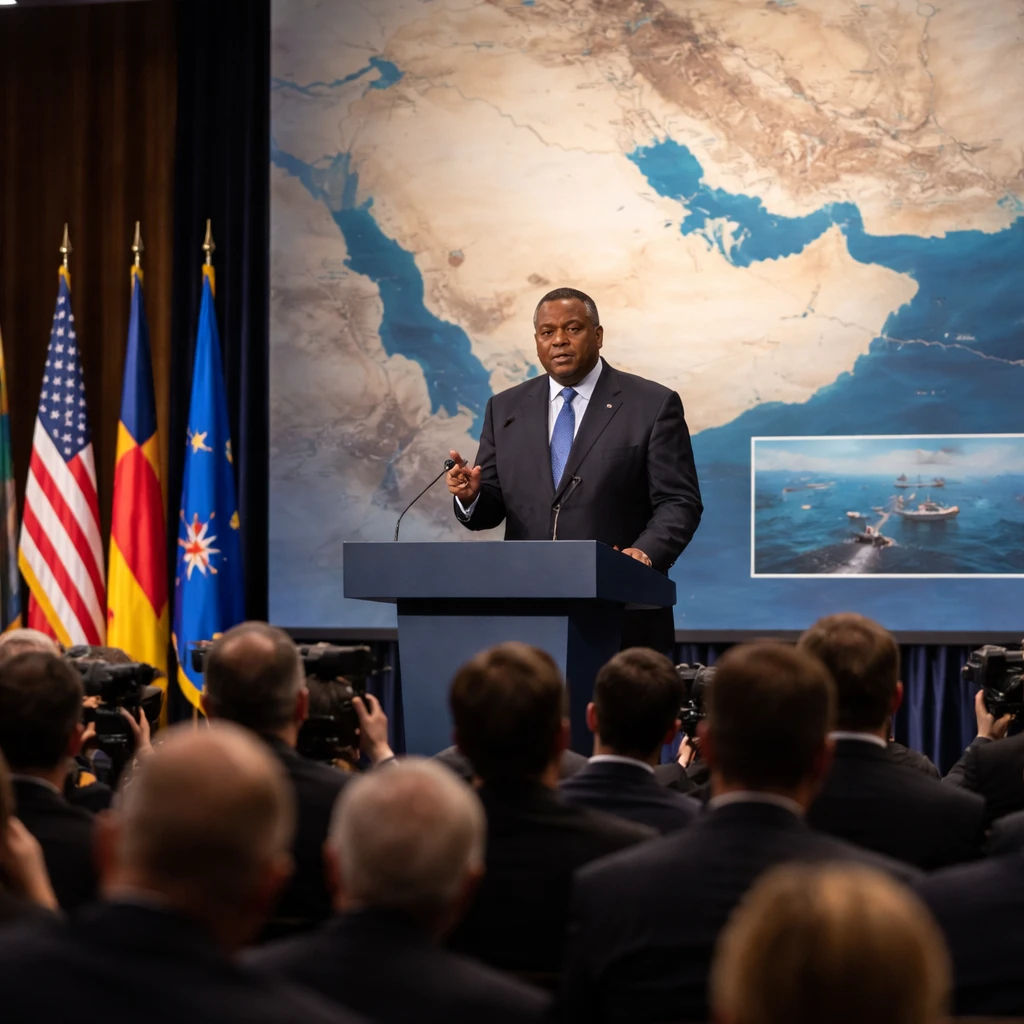
Former U.S. Defense Secretary Lloyd Austin said the U.S. Navy can carry out operations to reopen the Strait of Hormuz, but he warned that maintaining uninterrupted access would not be sustainable without help from other countries.
Speaking at the HSBC Gulf Cooperation Council Exchanges Conference in London, Austin framed the issue as both a military capability and a diplomatic challenge. "Certainly, the United States Navy could open the Strait of Hormuz," he told Bloomberg’s London Bureau Chief Ruth David. "Holding it open for a long period of time would be pretty costly and so we’d like to see an international effort, if that’s the case."
Austin stressed that freedom of navigation through the strait matters to the entire world, not only to the United States. He made the remarks in his current capacity as a national security consultant.
The former defense chief pointed to the fighting connected to Israel’s strikes against Hezbollah in Lebanon as a significant barrier to diplomatic progress aimed at resolving tensions in the region. Those strikes prompted direct clashes between Iran and Israel, complicating negotiations and heightening the risk of maritime disruption.
"We would like to see this ceasefire hold, so that we can get negotiations completed and then we can get the strait open again," Austin said. "It’s important to not only the United States but the entire global economy. And so, the sooner we can do that, the better."
The recent exchange of fire between Iran and Israel also put pressure on U.S.-led diplomatic efforts. According to Austin, Iran and Israel later agreed to reduce strikes against each other after the violence threatened to derail talks between Washington and Tehran and after President Donald Trump called for de-escalation.
Addressing another potential flashpoint, Austin said he does not believe Chinese President Xi Jinping seeks to seize Taiwan by force. He cautioned, however, that any armed conflict in the Taiwan Strait would inflict a far greater economic shock worldwide than the current disruptions associated with the Strait of Hormuz.
The comments tie military options to wider diplomatic and economic considerations, with Austin underlining the need for allied burden-sharing if prolonged operations to secure key maritime routes are required.
Summary: Lloyd Austin stated the U.S. Navy could open the Strait of Hormuz but that long-term security of the waterway would require international participation. He identified Israel’s attacks on Hezbollah and resulting Iran-Israel clashes as factors undermining diplomacy, and warned that conflict in the Taiwan Strait would have larger global economic consequences.