
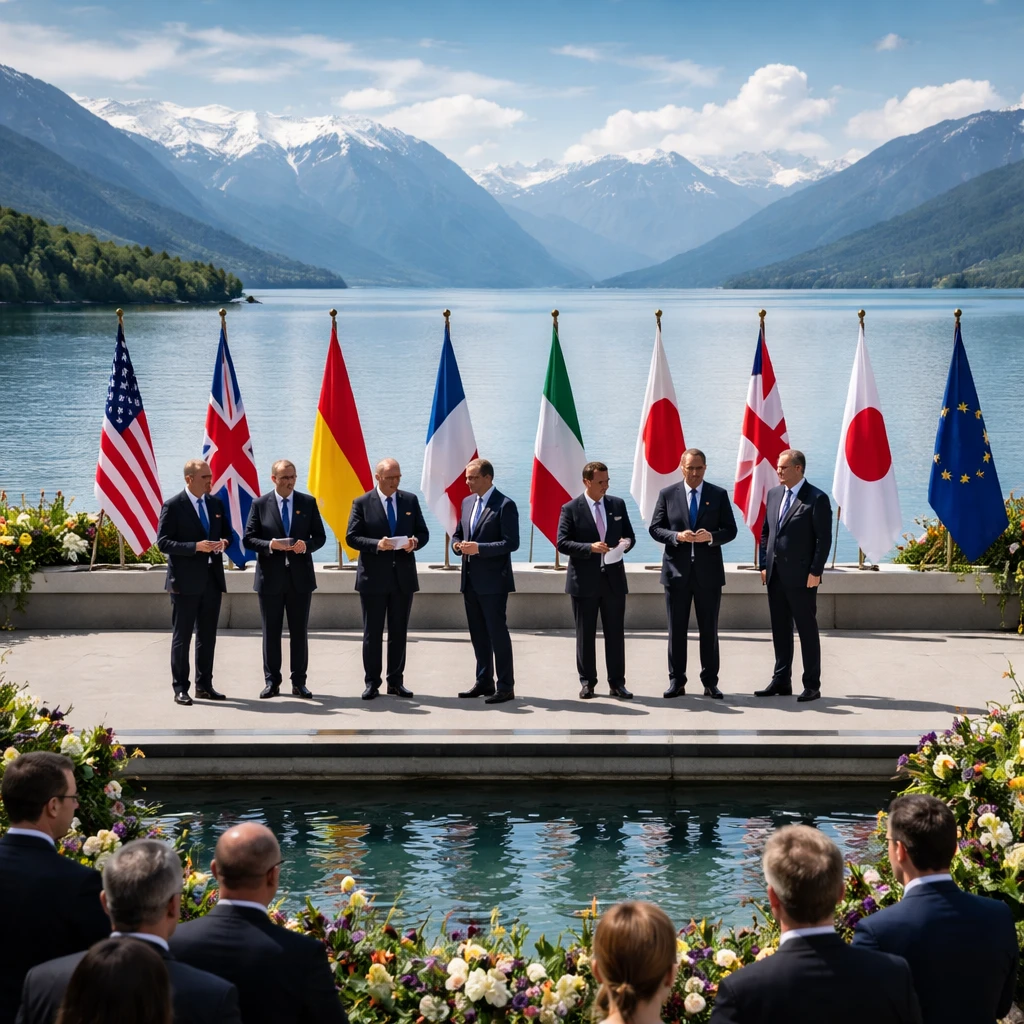
G7 leaders convening in the French town of Evian-les-Bains publicly urged a ceasefire in Lebanon on Wednesday while welcoming a preliminary agreement reached between the United States and Iran.
U.S. President Donald Trump spent the summit sessions briefing counterparts from Britain, Canada, France, Germany, Italy and Japan on the outlines of the accord, which is scheduled to be formally signed on Friday during a ceremony in Switzerland. Summit participants received details of the framework in incremental disclosures throughout the meeting, though a complete text has not been released.
The core of the arrangement is a 14-point framework that centers on a permanent ceasefire, including provisions intended to halt hostilities in Lebanon, where Israeli forces aligned with the United States have been engaged against Hezbollah militants backed by Iran. A Hezbollah spokesperson said the group does not believe Iran will accept an arrangement that does not include an end to what it described as Israeli occupation of Lebanese territory.
President Trump, meanwhile, criticized Israel's conduct during the recent fighting, saying he was "not happy" with the way the country conducted itself.
Key elements of the interim framework
Media reports circulating during the summit indicate the deal contains several political and economic provisions intended to produce immediate de-escalation and to set conditions for further negotiation.
- The lifting of an American naval blockade and the unblocking of the Strait of Hormuz are included among the interim measures, according to the reporting.
- The framework is described as paving the way for subsequent negotiations on Iran's nuclear program, with formal talks expected to commence after the signing ceremony.
- One described provision calls for immediate waivers on Iranian oil and petrochemical exports once the agreement is signed, together with other financial inducements such as the unfreezing of Iranian assets and a regional reconstruction program valued at roughly $300 billion.
- Tehran would, under the accord's terms, agree not to pursue a nuclear weapon and to neutralize nuclear material.
- At the same time, the financial relief appears conditioned on Iran meeting U.S. demands to eliminate its enriched uranium stockpile and curtail broader nuclear ambitions.
Analysts briefing summit participants cautioned that the document in circulation remains a high-level memorandum of understanding rather than a definitive settlement, underscoring that several details are still fluid ahead of the formal signing.
Market and security implications
Oil markets reacted to the prospect of restored supplies. By 03:54 ET, Brent crude futures had fallen by 0.8% to $78.35 a barrel, continuing a multi-day decline as traders priced in the likely return of exports following the anticipated reopening of the Strait of Hormuz. The contract slipped below $80 for the first time since March on Tuesday, though prices remain above levels seen before the recent outbreak of hostilities.
President Trump has said restrictions on vessel movements in the waters off Iran's southern coast will be lifted on Friday. Observers have warned that it may take time for energy supply chains to fully normalize, noting the tight integration of flows through the strait. Prior to the start of the joint U.S.-Israeli assault on Iran in late February, roughly a fifth of the world's oil and liquefied natural gas passed through the Strait of Hormuz.
U.S. forces are continuing operations to locate and remove mines that were reportedly planted in the waterway, a security challenge that the preliminary agreement may not immediately resolve and a continuing concern for shipowners and insurers wary of transits.
G7 leaders said they would also seek to diversify their energy sources to reduce dependence on the strait's flows.
Outlook and remaining questions
As the signing ceremony approaches, officials and analysts emphasize that the framework is intended to create momentum for more detailed negotiations. Several provisions - including the mechanics and timing of financial relief, the sequencing of nuclear safeguards and the security arrangements for Lebanon and the Strait of Hormuz - remain subject to further clarification.
Markets have already begun to price in the possibility of a gradual return of Iranian oil, which has contributed to the recent slide in Brent futures. At the same time, the presence of residual security threats in the strait and the conditional nature of financial measures mean that uncertainty for energy markets and shipping operations will persist in the near term.
The G7 statement and the U.S.-Iran memorandum together represent a significant diplomatic development, but officials note that the agreement in hand is an initial framework rather than an exhaustive settlement of the conflicts and strategic questions it touches.