
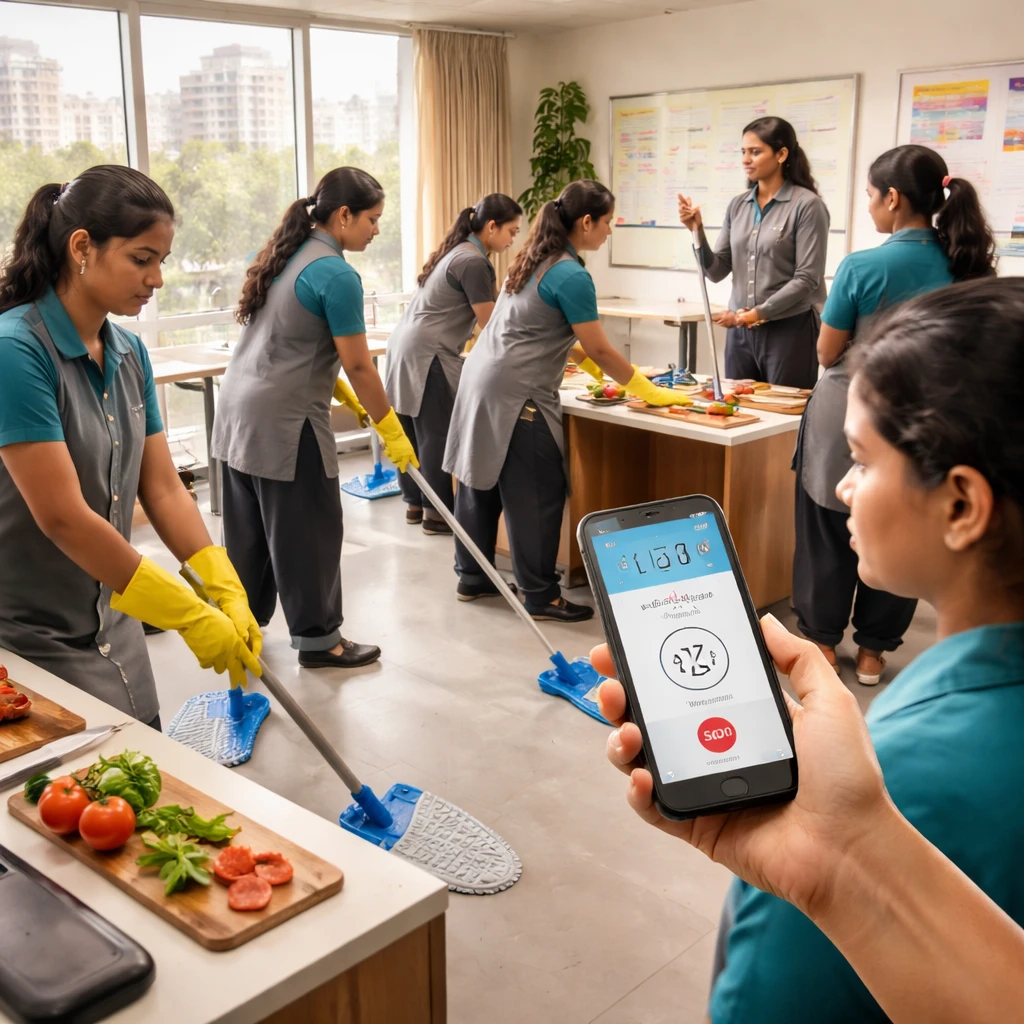
At a training centre run by Pronto in Mumbai, recruits practise cleaning tasks and are instructed on how to use an SOS feature should they feel unsafe while working in customers’ residences. The initiative is part of a fast-expanding wave of ultra-low-priced domestic services sweeping urban India - an ecosystem where assistance for household chores is being booked on apps for roughly $1 an hour.
For workers like Indu Jaiswar, 35, taking on such roles represents a first formal job and a pathway to fund family goals. "This is what we’ve been doing in our own homes for years. Might as well get paid for it," said the mother of two. The proposition resonates in a nation with an entrenched culture of outsourcing household tasks.
Startups Pronto and Snabbit, together with listed rival Urban Company, are training thousands of domestic helpers to operate in this newly competitive segment. Urban Company estimates the cleaning services market in India is worth about $9 billion and spans some 53 million households, underscoring the scale of the opportunity the firms are pursuing.
The service model mirrors app-based platforms in other sectors: workers receive bookings via their apps, are routed to apartments in specified neighbourhoods, and use an app timer that they start before commencing work. Firms portray the opportunity as economically meaningful for participants - potential annual earnings from working eight hours a day can reach as high as $5,000, a level that outstrips India’s per capita income of around $3,000.
These companies are investing heavily to win customers, offering under-99-rupee (about $1) sessions on an aggressive pricing front that has little precedent globally. Comparable services are cited at roughly $30 an hour in the United States and about $7 in China. But while demand from time-constrained urban professionals is surging, the expansion is accompanied by clear safety and financial trade-offs.
Safety concerns stem from the fact that, unlike couriers who interact briefly at doorsteps, housekeepers spend extended periods inside private residences, heightening their exposure to risks in a country with high rates of sexual harassment. Soumya Chauhan, a principal at Prosus, which holds an investment in Urban Company, characterised worker safety as the core operational challenge for platforms in this space. "The platforms that successfully crack the safety protocols will earn the deepest consumer loyalty and the most sustainable market returns," she said.
Startups acknowledge the problem and point to features intended to mitigate risk. Snabbit and Pronto said they have integrated an in-app SOS button to summon area supervisors, and Pronto also provides self-defence instruction. "In the offline world, the rate of abuse for a lot of these domestic workers is super high," said Pronto’s 23-year-old CEO Anjali Sardana, noting that the company offers legal and medical support to reassure staff.
Urban Company declined to comment for this coverage but has previously described a women-only safety helpline and an SOS app capability. Activists, however, warn that existing measures may not be enough. Shabnam Hashmi, a women’s rights campaigner, acknowledged that firms conduct extensive background checks on workers but argued that customer vetting is insufficient. She asked, "How is it ever possible for these jobs to be safe for women - even with an SOS button? Unless they carry cameras, which is of course impossible, there is no way to know what happens behind that door."
Some workers have adopted personal precautions. Pronto worker Jaiswar reported she now calls customers before arriving and only accepts jobs when a woman is present in the home.
Despite the safety debate, demand metrics show rapid adoption. Urban Company registered a peak of 50,000 home services bookings in one day in February. Snabbit reported growth to 35,000 orders per day. Bain Capital-backed Pronto logged a record 22,000 daily bookings in March, a sharp rise from 2,500 daily orders recorded in October, and announced $25 million in fresh funding.
Sardana said she launched Pronto last year after identifying three converging market needs: customers seeking dependable short-duration help, workers desiring steadier and safer employment, and a lack of scalable options in the market. "It’s possible to build a win-win-win business," she told Reuters.
Consumer behaviour in India also helps explain the momentum. The country lacks a strong do-it-yourself tradition for household tasks and there is a cultural preference for cost-effective service solutions. In Bengaluru, a 30-year-old user identified as Dhruv said he paid 100 rupees per hour to Urban Company for help unpacking utensils and hanging curtains after moving. The service saved him time and effort, he said, adding that price sensitivity matters: "I wouldn’t pay 400 or 500 rupees for it."
Snabbit’s founder Aayush Agarwal described growing popularity among young couples and singles who prefer to schedule occasional help rather than maintain monthly domestic staff, who are sometimes known to skip work. To attract customers, Pronto has advertised some visits at 25 rupees with taglines such as "Maid on Leave? Don’t grieve", while Urban Company offers a three-visit pack that prices at 66 rupees an hour. Snabbit promotions highlighted micro-tasks booked through the platform, including one customer who engaged a helper "just to peel 20 potatoes" and another to "separate LEGO blocks by colour."
Financial sustainability remains a pressing issue. To entice both workers and customers, companies are currently supplementing worker pay from their own pockets and providing steep discounts to users, a strategy that burns cash during rapid expansion. Urban Company disclosures for the October-to-December quarter show it handled 1.61 million home-help orders, with each order generating a loss of 381 rupees. The company has stated that discounts are moderating but that order values must nearly double to reach breakeven.
Investors familiar with the sector expect unit economics to improve over time. Rahul Taneja, a partner at Lightspeed, which has invested in Snabbit, said: "Over a period of time, it is safe to say that it will become an earn-as-you-go model."
At the Pronto training facility, visual materials outline projected payouts that underline the tension between worker compensation and customer pricing. Posters indicate that home helpers could earn $1.60 per hour if working 12 hours daily over a month - a figure described as 48% more than what a new customer pays. The implication is that subsidies and reallocation of payments are currently necessary to sustain the advertised worker earnings.
For workers such as Nisha Chandaliya, 22, the income potential is compelling. Having left a call-centre role that paid about $180 a month, she said Pronto offers more than $500 a month if she works the advertised hours. "It’s exhausting to clean six-seven homes, but I need the stability. I can’t afford to go back," she said.
The services market is thus at a crossroads: rapid consumer adoption and worker intake are juxtaposed with operational risks and significant cash burn. How platforms resolve safety protocols, tighten unit economics and manage customer and worker trust will shape whether this segment evolves into a durable business model or remains a heavily discounted growth experiment.
($1 = 93.3010 Indian rupees)