
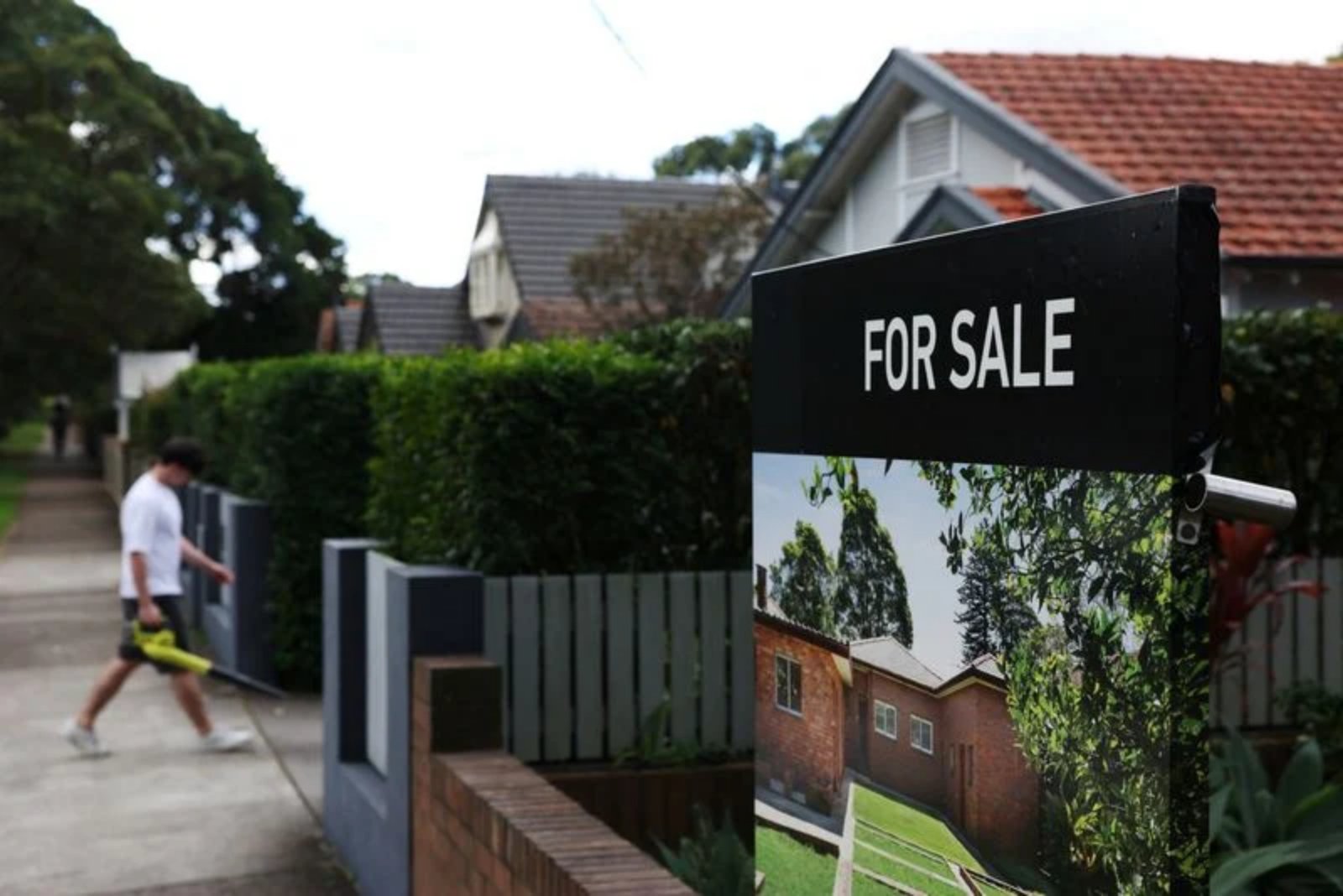
Sydney, June 23 - The allure of Australian real estate is cooling rapidly. A short walk from the sun-soaked sands of Bondi Beach, auctioneer Clarence White recently found himself unable to secure a single bid for a luxurious five-bedroom, three-storey residence. Priced at A$5.2 million, the property, which featured an expansive outdoor lounge area, failed to attract buyers. “We know everyone’s cagey at the moment, but that’s okay ... all power to those who are registered and those who take action,” White remarked to a modest gathering of observers and prospective buyers, none of whom stepped forward to bid.
Failed auctions like this one, once rare occurrences in Sydney's historically buoyant housing market, are now becoming more common. Nationwide auction clearance rates have plummeted to below 50% in the month following the government's announcement of sweeping tax reforms. According to data from property research firm Cotality, this marks the lowest clearance rate since the pandemic era. The policy shift, unveiled last month, is widely regarded as one of the most significant changes to Australia's tax framework in decades. Critics and observers alike suggest it could fundamentally alter the nation's long-standing relationship with property, which has long been the primary vehicle for wealth accumulation.
Ray White's Brisbane-based agent, Avi Khan, reported a dramatic drop in buyer interest. “Our viewer numbers are halved, the number of bidders for properties have halved, clearance rates have gone down to about 30, 35%,” he noted. The decline is particularly acute in auction environments, where the absence of competing bids has left many sellers struggling to find matches.
Targeting Investor Dominance
The Labor government, representing the political centre-left, has positioned these tax reforms as a necessary intervention to address growing disparities in intergenerational wealth. Starting in July 2027, the capital gains tax (CGT) discount will be scrapped. Furthermore, negative gearing, a mechanism that currently allows investors to offset rental property losses against their taxable income, will be banned on existing housing stock. The reforms specifically target property investors, aiming to level the playing field for first-time home buyers who have increasingly struggled to compete in a market dominated by cash-rich investors.
However, the shift has sparked concern among investors, who are bracing for potential price declines of up to 10%. Experts warn that such a correction could have unintended consequences, given how heavily Australian household wealth is tied to real estate. According to AMP, approximately 70% of total wealth is linked to the value of homes, which encompasses both land and dwellings, and closely tracks housing price movements. The Central Bank estimates that around two million Australians, or roughly 10% of the working-age population, own at least one investment property. Of these, an estimated 70% hold a single investment property, while the remainder manage more extensive portfolios.
Auctioneer White observed a tangible shift in the composition of buyers at recent auctions. “It’s a tougher market that we’re working in,” he stated. “It is mainly owner-occupiers that we’re dealing with.” This trend is echoed by Kellie Adamson, a Sydney-based investor who owns two residential properties, including one that is negatively geared, with a combined value of A$3 million. Adamson admitted she had “completely backflipped” on her buying strategy. “I would want to be moving actually outside of Sydney altogether whereas before, I would never have considered that,” she explained. “I would even consider commercial (properties) as well.”
Redefining Investment Strategies
Queensland-based investor Shaun Craike, who holds a portfolio of ten properties valued at A$6 million, estimates that the budget changes have already reduced his portfolio's worth by approximately A$500,000. Although he has noted some recent signs of market recovery, Craike believes the reforms will disproportionately affect investors with less established portfolios. While the tax changes do not apply retroactively to investors who acquired properties before the May announcement, the forward-looking nature of the policy has fundamentally altered market dynamics. “It’s those people that are wanting to get into the property market and wanting to grow a portfolio that it really starts to affect,” Craike commented.
The impact is also being felt by younger buyers. Veronica Morgan of Good Deeds Property Buyers estimates that around 6,500 “rentvestors” enter the market annually. These individuals, typically first-home buyers, purchase a property but choose to rent it out or return to living with their parents, leveraging negative gearing concessions to offset costs. “They needed negative gearing to be able to do that. And they now no longer can do that,” Morgan explained.
AJ Clores, a 27-year-old rentvestor in Sydney, has already adjusted his timeline. Currently holding an A$3.2 million portfolio, Clores plans to pause further acquisitions for several years. “I would start looking again probably in 2028,” he said. “But I wouldn’t be in a rush.”
Market Correction and Affordability
Combining the collapse in auction activity with recent interest rate increases, economists now project that housing prices could drop between 5% and 10% over the next year. These projections have ignited debate over whether the current downturn is a temporary correction or the beginning of a more permanent structural shift. Nick Gill, an agent with Sotheby’s International Realty in Byron Bay, noted, “There is definitely a market correction and it’s probably the largest I’ve seen.”
Louis Christopher, managing director at SQM Research, anticipates that the housing market downturn will extend into 2027. His firm forecasts that Sydney prices could decline by up to 9% in 2026, while Melbourne is expected to see a drop of as much as 7%. “This is now becoming an extended period which would signify that this downturn is being consolidated, it is a deep downturn and the indications are that it’s going to be with us for quite some time,” Christopher observed.
While a decline in prices may improve affordability for first-time buyers, Christopher cautioned that entering the market prematurely carries risks. “That should improve affordability for first home buyers, but he said buying now was like 'trying to catch a falling knife'. The problem is you buy now but the market could very well fall further,” he added.
For younger buyers like Devin Familton, a 28-year-old accounts manager in Melbourne, the reduction in investor competition offers a glimmer of hope. After six months of unsuccessful searches, Familton believes the changing dynamics could finally make homeownership achievable. “The investors that have cash and can just go in and buy things without worrying about mortgages or first home buyer grants and just get them as investment properties - I think if you scare them off, it’ll make things a little bit easier,” he said.
As the tax reforms take shape, the Australian property market stands at a crossroads. The era of unchecked investor enthusiasm appears to be waning, replaced by a more cautious approach from buyers and sellers alike. Whether this shift will result in lasting affordability improvements or trigger broader economic ripple effects remains to be seen, but the immediate impact on auction activity, investor sentiment, and price trajectories is undeniable.