
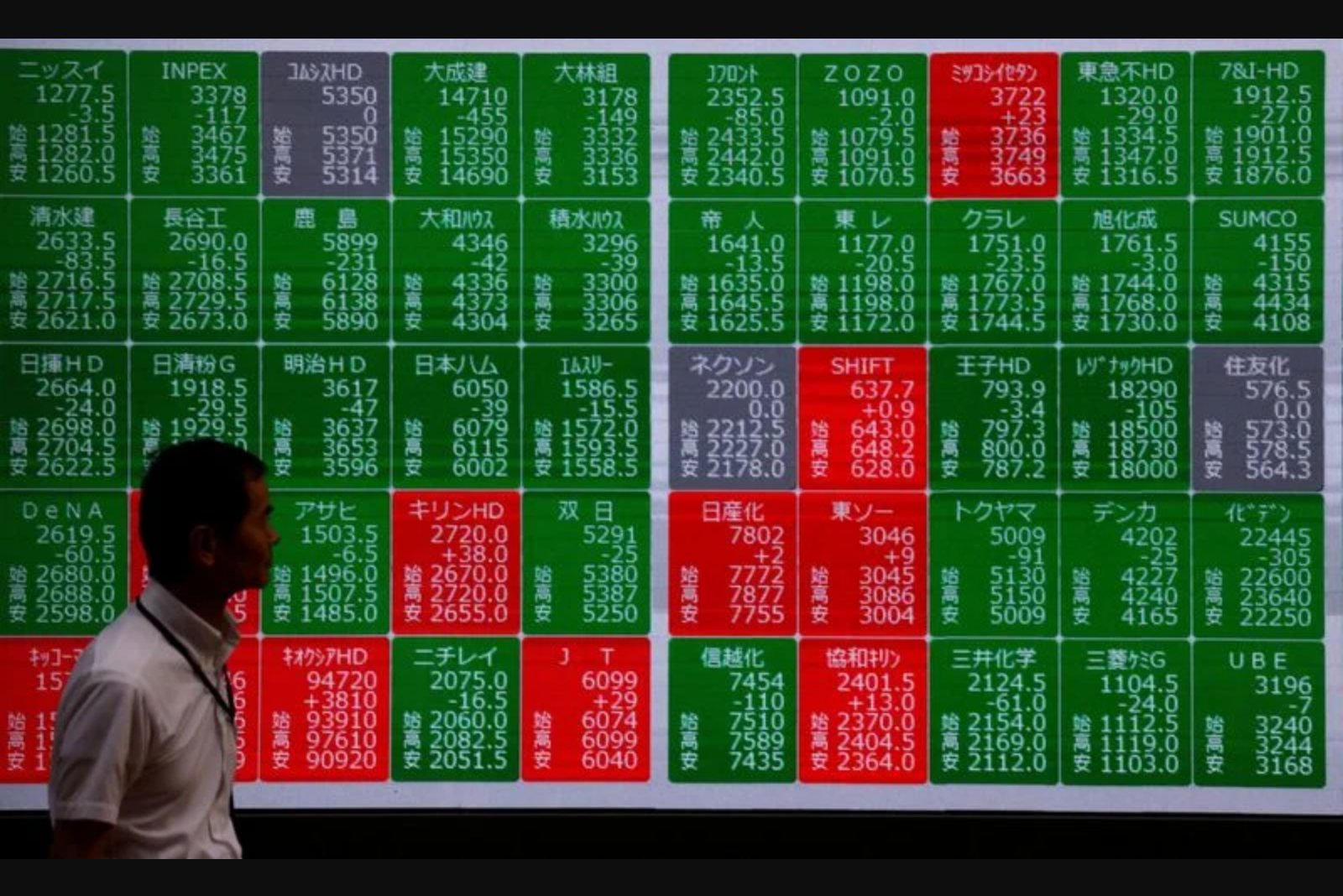
Asian equity markets posted a general decline on Tuesday as financial participants recalibrated their positions in response to shifting monetary policy expectations and evolving geopolitical dynamics. The MSCI broadest index of Asia-Pacific shares, excluding Japan, retreated by 0.5 percent. Concurrently, S&P 500 e-mini futures in the United States dipped 0.2 percent. In the energy sector, Brent crude contracts gained ground, rising 0.2 percent to settle at $78.03 per barrel. This upward movement in oil prices followed earlier volatility where supply concerns had eased after U.S. Vice President JD Vance indicated progress in negotiations with Iran and confirmed that the Strait of Hormuz remained open.
Market momentum appears to be shifting away from high-growth technology sectors toward more stable, defensive investments. Chris Weston, head of research at Pepperstone Group Ltd in Melbourne, observed that the market environment is far from stagnant. He noted that the "former generals of the market," a term often used to describe dominant mega-cap technology firms, have lost some of their previous momentum. Consequently, investors are rotating capital into sectors that offer more predictable cash flows and are less heavily dependent on artificial intelligence narratives.
This rotation was reflected in overnight trading on Wall Street, where the S&P 500 fell 0.4 percent and the Nasdaq Composite declined 1.3 percent. The tech-heavy index was weighed down by drops in major technology corporations, including Alphabet and SpaceX. Despite this broader weakness, regional markets showed mixed signals. Japan's Nikkei 225 index fell 0.6 percent, although it managed to retrace some earlier losses after data revealed robust growth in Japan's manufacturing sector during June, with new orders accelerating to their fastest pace in over four years. South Korean shares fluctuated between gains and losses, closing 2 percent lower. Taiwanese stocks, however, opened 0.9 percent higher, reaching a new all-time high.
In currency markets, the Japanese yen remained flat against the U.S. dollar at 161.55 yen. The currency hovered near its weakest levels in four decades following a turbulent trading session in the United States overnight. Concerns regarding sharp currency fluctuations prompted a late Monday online meeting between Japanese Finance Minister Satsuki Katayama and U.S. Treasury Secretary Scott Bessent. Meanwhile, the British pound stayed flat at $1.3247 after Prime Minister Keir Starmer announced his resignation on Monday, signaling an anticipated orderly transition of power to the frontrunner, Andy Burnham. The U.S. dollar index, which tracks the greenback against a basket of six major currencies, traded at 101.04, marking levels close to its highest point since May of the previous year.
Monetary policy expectations have intensified significantly. Traders are now grappling with the prospect of an accelerated schedule of rate hikes under a more aggressive Federal Reserve led by new Chair Kevin Warsh. According to the CME Group's FedWatch tool, Fed funds futures are now pricing in a 54 percent probability of at least two 25-basis-point rate increases before the end of the year. This represents a substantial increase from the 15.2 percent probability observed just one week prior. In response to these shifting dynamics, the yield on the U.S. 10-year Treasury bond decreased by 0.2 basis points to 4.501 percent.
Other asset classes also reflected the cautious sentiment. Gold prices declined 0.2 percent to $4,180.38. Cryptocurrency markets saw modest reductions, with bitcoin sliding 0.8 percent to $63,873.71 and ether falling 0.5 percent to $1,724.08. Investors are currently seeking clarity in a market environment characterized by rapid repricing of central bank policies and geopolitical developments, emphasizing the importance of data-driven decision-making over intuitive speculation.