
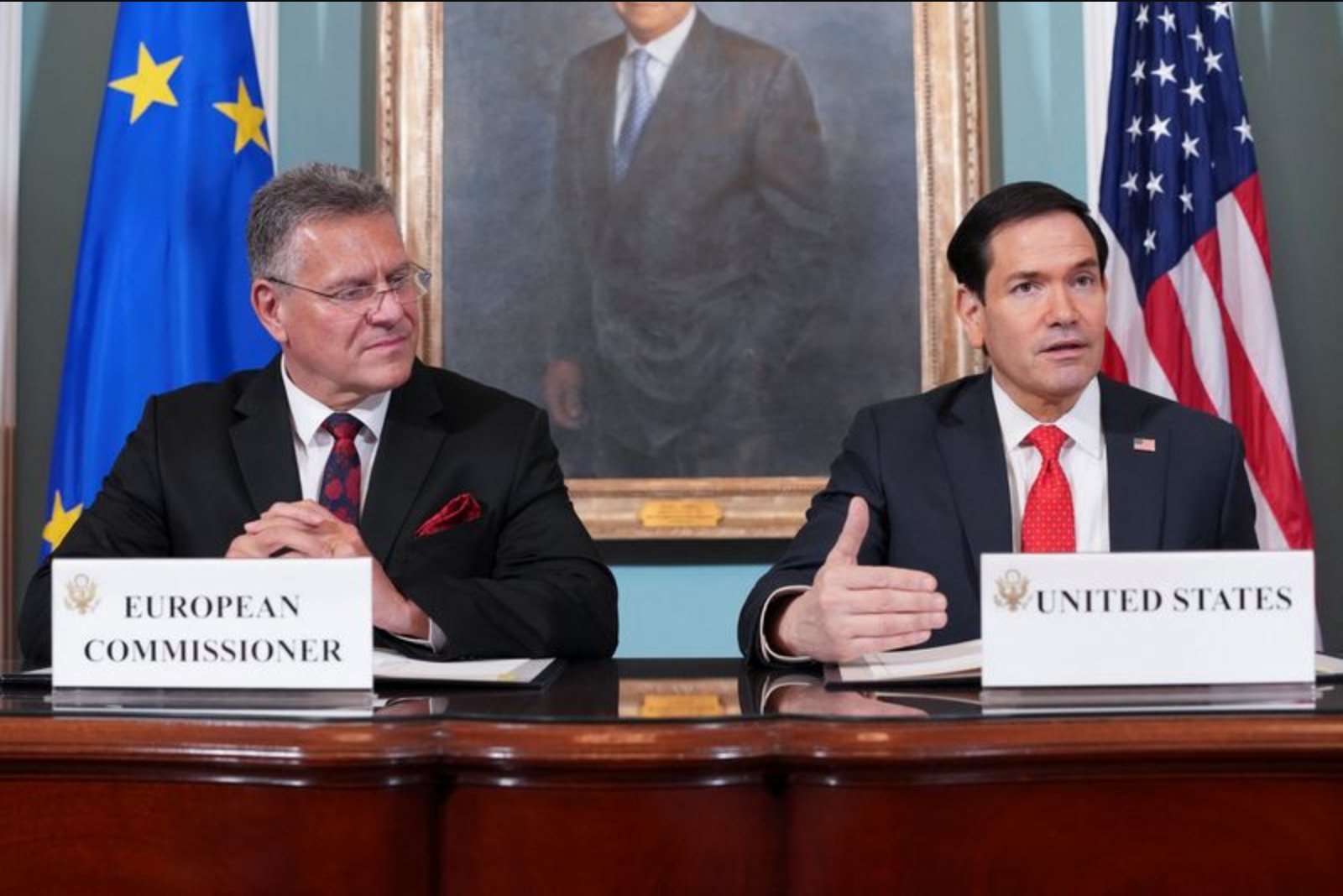
The United States and the European Union deepened their cooperation on critical minerals in a move designed to strengthen supply-chain resilience for materials used in semiconductors, electric vehicles and advanced weapons.
At a signing ceremony, U.S. Secretary of State Marco Rubio and European Union Trade Commissioner Maros Sefcovic formalized a memorandum of understanding for a partnership focused on producing and securing critical minerals. The agreement accompanies an action plan announced by U.S. Trade Representative Jamieson Greer that outlines coordinated trade policy measures to address what the two sides described as "pervasive non-market policies and practices" distorting critical minerals supply chains.
Rubio, speaking ahead of the memorandum signing, did not name any country explicitly. He said the preliminary accord with Brussels reflected a growing recognition among Western allies of how vital reliable supply chains and critical minerals are to economic success. He warned that an over-concentration of resources in one or two places represented an unacceptable risk and said diversity in supply chains was needed, repeating the line: "The over-concentration of these resources, the fact that they’re dominated by one or two places, is an unacceptable risk. We need diversity in our supply chains."
Greer, who was scheduled to meet separately with Commissioner Sefcovic the same day, described the separate action plan as a tool to coordinate trade responses to the non-market policies and practices that have, in their words, left market-oriented economies vulnerable to a range of disruptions including economic coercion. He said Washington and Brussels would explore trade measures such as border-adjusted price floors as part of an effort to strengthen domestic critical minerals industries and the downstream sectors that support industrial competitiveness.
Sefcovic, addressing reporters at the State Department, framed the agreements as a means to reinforce the transatlantic relationship and accelerate joint objectives. He emphasized the need to move from signed agreements to execution, asking: "How can we transform these agreements which we are signing into concrete, tangible projects to deliver for our business operators?"
Background on earlier steps
Washington and Brussels initially announced their intention to develop a coordinated action plan in February when U.S. Vice President JD Vance outlined plans to create a preferential trade bloc for critical minerals, potentially incorporating coordinated price floors. The United States has already signed similar action plans with Japan and Mexico, according to the announcement.
The U.S.-EU action plan states an imperative to address what it calls "pervasive non-market policies and practices (that) have left critical minerals supply chains of market-oriented economies vulnerable to a myriad of disruptions, including economic coercion." The plan also casts a longer-range objective of developing a plurilateral initiative with like-minded partners to bolster resilience across critical minerals supply chains.
Measures under consideration
The two parties listed a range of possible measures and mechanisms for discussion. These include coordinated trade policies and mechanisms based on reference prices - for example, border-adjusted price floors - as well as standards-based markets, price gap subsidies, or offtake agreements. The focus would be on mutually agreed select critical minerals and the associated supply chains.
They also agreed to examine standards for mining, processing, recycling and trade in critical minerals; technical and regulatory cooperation; investment promotion and screening cooperation; and coordinated rapid responses to prevent disruptions and crises. Stockpiling cooperation was listed as another possible measure for consideration.
Implications and next steps
Officials framed the agreements as a step to translate shared concerns about concentrated processing and supply into coordinated policy tools and project-level cooperation. The emphasis from Brussels and Washington was on execution and on converting signed documents into tangible projects and industrial capacity for business operators across economies that rely on these minerals.
What remains is the detailed design and implementation of the trade and industrial measures the action plan signals, and the extent to which other like-minded partners will join a possible plurilateral effort to diversify and secure critical minerals supply chains.