
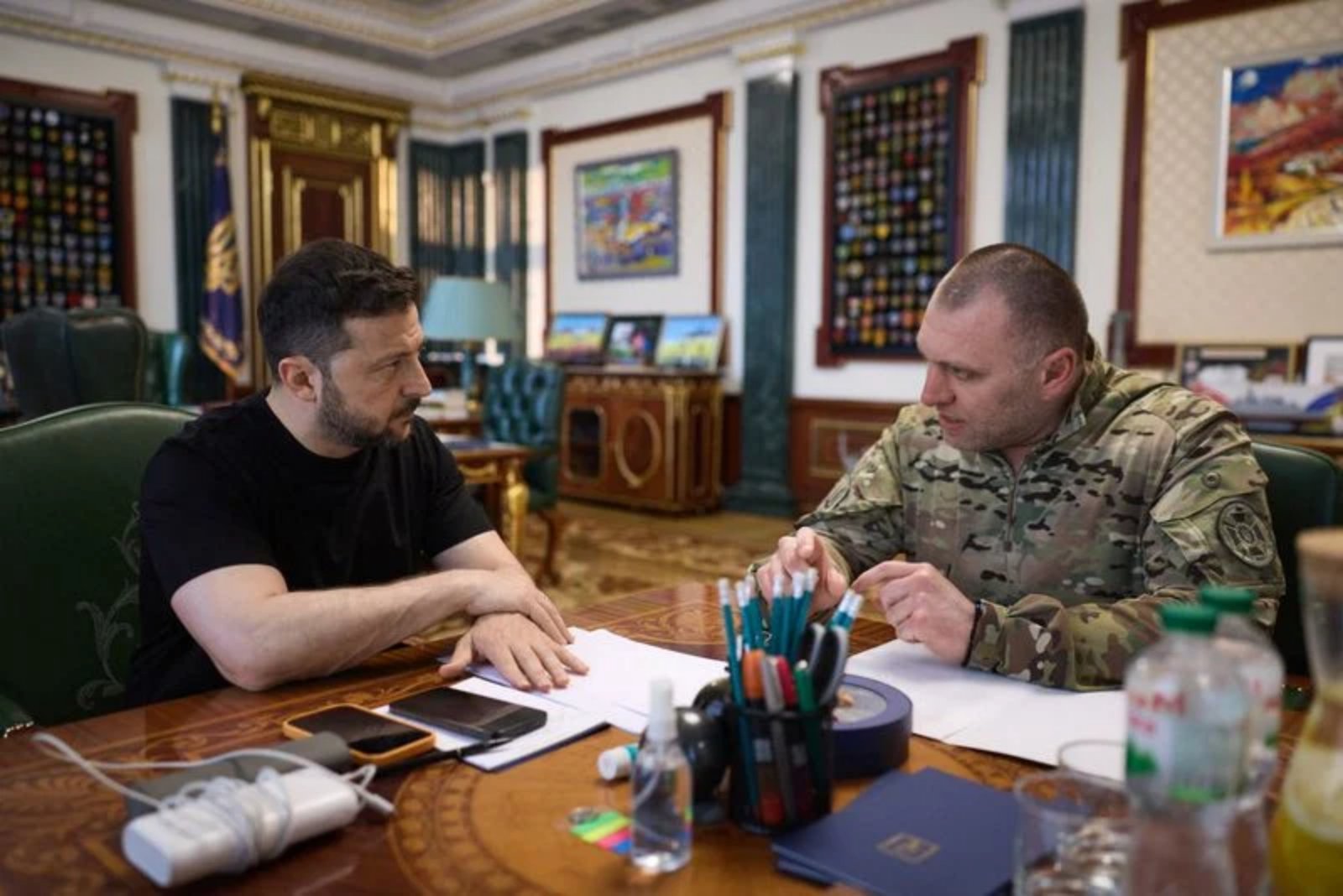
Deep beneath the surface, in a cramped operations room where banks of screens stream battlefield telemetry and footage, the commander of Ukraine’s unmanned systems is directing what he describes as a campaign to cut off Crimea from Russia.
Robert Brovdi - known by his call sign "Madyar" - oversees a force that archives terabytes of data each day and uses those records to plan and verify strikes across Russian-occupied areas. Authorities on the peninsula introduced fuel rationing last month after a spate of drone attacks disrupted logistics and supplies, and Brovdi said the strikes have reduced traffic along a key supply artery - the Novorossiya highway - by more than two thirds over the past month.
"We will isolate Crimea in the near future," Brovdi said in an interview inside his bunker, sipping black tea and smoking a cigarette. He added that within another month Ukraine would have total control over the road. Describing engagements on the exposed highway, he said striking vehicles was "as easy as shooting partridges in an open field."
Russia seized the Crimea peninsula and swathes of eastern Ukraine in 2014. Russia's defence ministry did not provide comment for this account, and President Vladimir Putin has acknowledged that drone strikes are causing damage while saying they do not threaten Russia's economy.
Military analysts cited by Brovdi and others say the campaign of mid-range strikes inside Russian-controlled territory has cut supplies to front-line units - bringing their advance to a near standstill last month - and has degraded air defences. That erosion of air protection, the analysts say, has opened routes for longer-range strikes that have damaged oil infrastructure and weapons manufacturing deeper inside Russia.
Brovdi framed part of his strategic objective in blunt terms: to force Moscow to pull back troops rather than to push forward. "We will create conditions that will make it extremely difficult for any military personnel or those working in the defence industry to remain in Crimea, in the temporarily occupied territories, or use the access routes to them," he said.
From trader to drone commander
Brovdi, 50 years old, has described a personal transition from a successful grain trader to a military commander over more than four years since the conflict expanded. He took command of Ukraine’s Unmanned Systems Forces last June and has rapidly scaled up operations since then.
Under his leadership, the number of mid-range combat sorties has increased 28-fold over the year, while deep strikes into Russian territory have increased almost four-fold over the same period, he said. In the first five months of this year, his units report destroying 174 Russian air defence complexes with an estimated value of about $5.4 billion, an effort he says has cleared paths to other targets.
He described the campaign as systematic: targeting Russian military manpower, oil facilities, and weapons production with the aim of inflicting losses severe enough to erode Moscow's ability - and willingness - to continue the war.
"We’re opening the door to vast spaces where the pain of the war, which is felt in nearly every Ukrainian town, should be felt, including in the consciousness of residents," he said, dressed in a black cap and black T-shirt. He was emphatic that Ukraine has not, and will not, strike directly at civilians and civilian targets. Russia has recently accused Kyiv of killing dozens of civilians in occupied areas.
Operations, technology and data
Brovdi runs his air campaign from a deep subterranean facility close to the frontline. Visitors are brought in a van with blacked-out windows and led downstairs into a corridor lined with sleeping pods that opens onto a room of dozens of screens displaying real-time battlefield data. Brightly coloured paintings by leading Ukrainian artists hang alongside captured Russian drones.
He created his unit - known as "Madyar’s Birds" - from scratch after volunteering at the start of the full-scale invasion in 2022. That unit has become one of Ukraine’s largest and most active drone brigades, according to Brovdi’s account.
Every strike is filmed, verified and logged. Monitors on a wall display a detailed scorecard that is updated in real time. Between 10 and 12 terabytes of information are archived daily for use by future artificial intelligence models, he said, adding that the data-driven approach is intended to reduce human errors. "A person can be tired, can be biased, can make mistakes," he said.
He often frames the campaign in business terms, repurposing practices from his commercial past. "This is our accounting from previous business projects, which we adapted just for military purposes: changed grain carriers, wagons and grain to types of weapons, ammunition, and our clientele is a little different," he said.
Human cost metrics and force composition
After his units achieved high strike rates, Brovdi became an integral part of Kyiv’s approach to using drone power to target individual Russian soldiers and compensate for Ukraine’s manpower shortages. He provided specific figures for recent operations.
According to data shared by Brovdi, in the first five months of 2026 the drone forces were responsible for more than 50,900 Russian servicemen killed and struck over 176,500 enemy targets. He said the average daily kill rate during that period was 337 Russian soldiers and 1,169 enemy targets. Brovdi’s data also put the average cost of killing one Russian soldier at around $918 over the past year.
The figures have not been independently verified. Brovdi said drone units make up 2.5% of Ukraine’s armed forces and, based on their data, accounted for roughly a third of Russian losses over the past 12 months. He plans to expand drone units to 5% of the army, arguing that scaling up unmanned aerial vehicle usage across the armed forces will significantly increase the number of targets destroyed.
Strategic context and countermeasures
Military analysts quoted in Brovdi’s account say improvements in drone technology make it feasible over time to sever land access to Crimea. However, they also note that achieving a broader strategic reversal of Russian-controlled areas would still require a coordinated ground offensive. At the same time, Russia’s own elite drone unit - known as Rubicon - is reportedly working to blunt Ukraine’s current advantage in mid-range unmanned systems.
Brovdi himself is a high-value target for Moscow. He was convicted in absentia in Russia on terrorism charges in March, according to his account. The campaign he runs, he said, seeks to make life on the occupied peninsula and the access routes to it untenable for military personnel and defence industry workers.
Verification and limitations
Many of the operational statistics and strike tallies presented by Brovdi are drawn from data collected and displayed by his unit. The figures have not been independently verified in this account, and the precise battlefield effects and broader strategic outcomes remain subject to competing claims and ongoing military dynamics.
What is clear from the material presented is that a data-centric drone campaign has been scaled rapidly, that attacks have disrupted logistics and fuel supplies to Crimea, and that the commander believes continued pressure can yield control over a key supply road in the near term.