
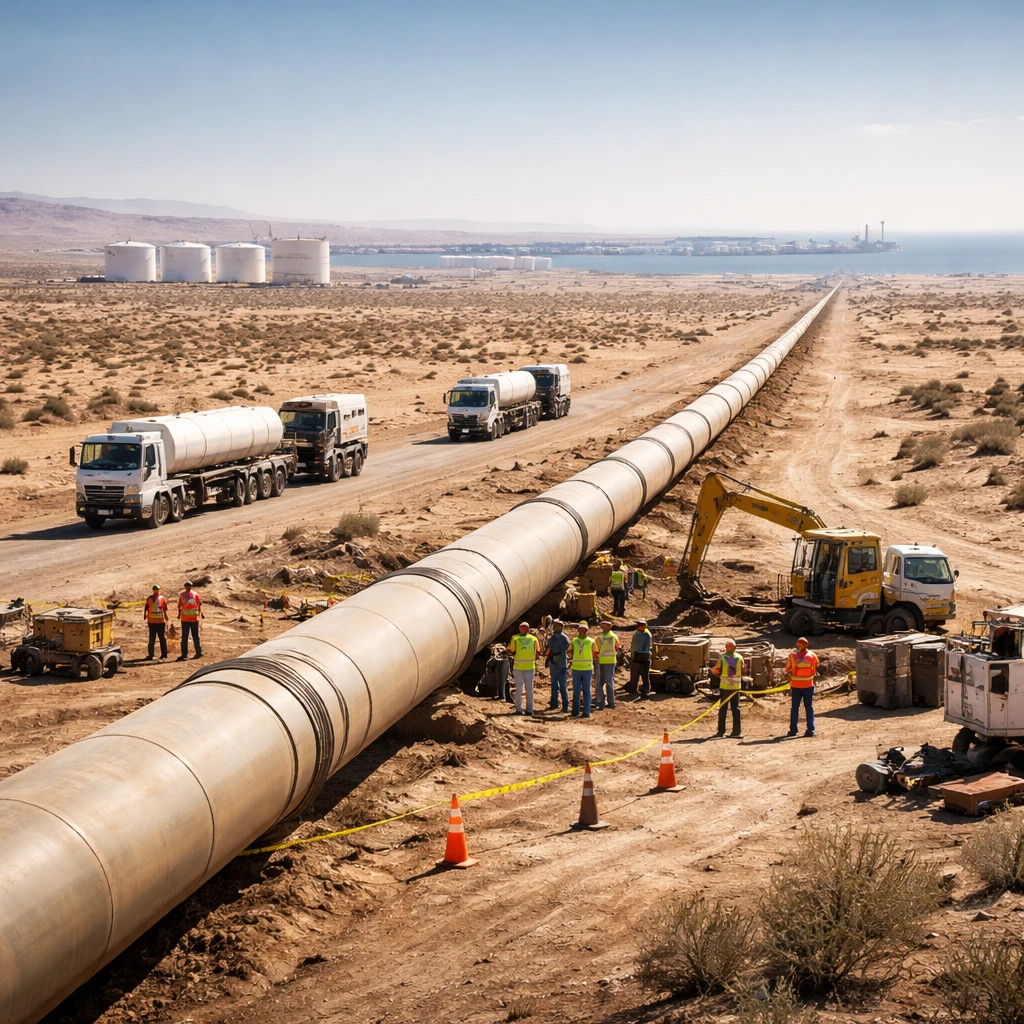
Oil markets reacted upward on Monday after confirmation that Saudi Arabia's East-West pipeline - a principal bypass linking the Gulf to the Red Sea - will be mostly out of service for repairs for a period projected at three to five weeks, following an attack the prior week.
Analysts at HSBC, led by Kim Fustier, called the outage "a negative surprise" relative to their baseline assumptions. Their base had presumed bypass infrastructure such as Saudi's East-West line and the UAE's ADCOP would remain available to help absorb shocks that stem from disruptions at the Strait of Hormuz.
HSBC's team noted that Saudi exports, which have largely been routed via the kingdom's West Coast since closures around the Strait of Hormuz, had already fallen to roughly 3 million barrels per day in August, down from 4-4.5 million bpd previously. That decline was driven by threats from Houthi forces. Removing that 1 million-plus barrels-per-day flow for an estimated month would equate to about 90 million barrels of supply lost over the outage period, the analysts said, compared with more than 500 million barrels of cumulative inventory draws since February.
Using those figures, HSBC calculated the global market could move into an approximate 6 million bpd deficit during the mid-September to mid-October disruption window. The team described that outcome as "the largest implied deficit since the start of the conflict." Such a shift would raise near-term upside risks to their baseline price forecasts.
Operationally, Saudi West Coast logistics had already been under strain before the pipeline damage. Yanbu loadings had declined, and exports were being rerouted north through Egypt's Suez Canal and the SUMED pipeline after a Houthi blockade was announced on July 20. Those re-routing trends contributed to the decline in Gulf product and crude flows observed by the analysts.
On refining, HSBC pushed back against a view advanced by the U.S. administration that Ukrainian attacks on Russian refineries are the main explanation for record U.S. diesel prices. The analysts maintained that the shock from the Middle East remains the dominant force behind current refining tightness. They pointed to a 3.4 million bpd reduction in product loadings from inside the Gulf, which includes 2.1 million bpd of diesel, jet fuel and gasoline.
The closure of the East-West line increases the probability of HSBC's more bearish "Stalemate" scenario, under which Brent could potentially reach $120 per barrel, the analysts said. They underlined that a key uncertainty is the speed of repairs - while the estimate is three to five weeks, Saudi Aramco's restoration track record gives some room for optimism. HSBC cited the company’s swift recovery at the Ras Tanura refinery after an Iranian attack in March as evidence the pipeline could possibly be restored sooner than the initial window.
HSBC set out several indicators to monitor as the situation evolves: any partial restart of the East-West pipeline, patterns of Yanbu loadings, and the pace at which global inventories continue to be drawn down. Those metrics would help clarify whether the implied deficit materializes and how long it might persist.
In short, HSBC's analysis frames the East-West outage as a material, near-term disruption to crude flows that compounds existing logistical constraints on the Saudi West Coast. The degree to which repairs can be accelerated, and how quickly alternative routing and inventories can compensate, will determine whether the market shift proves temporary or more prolonged.