
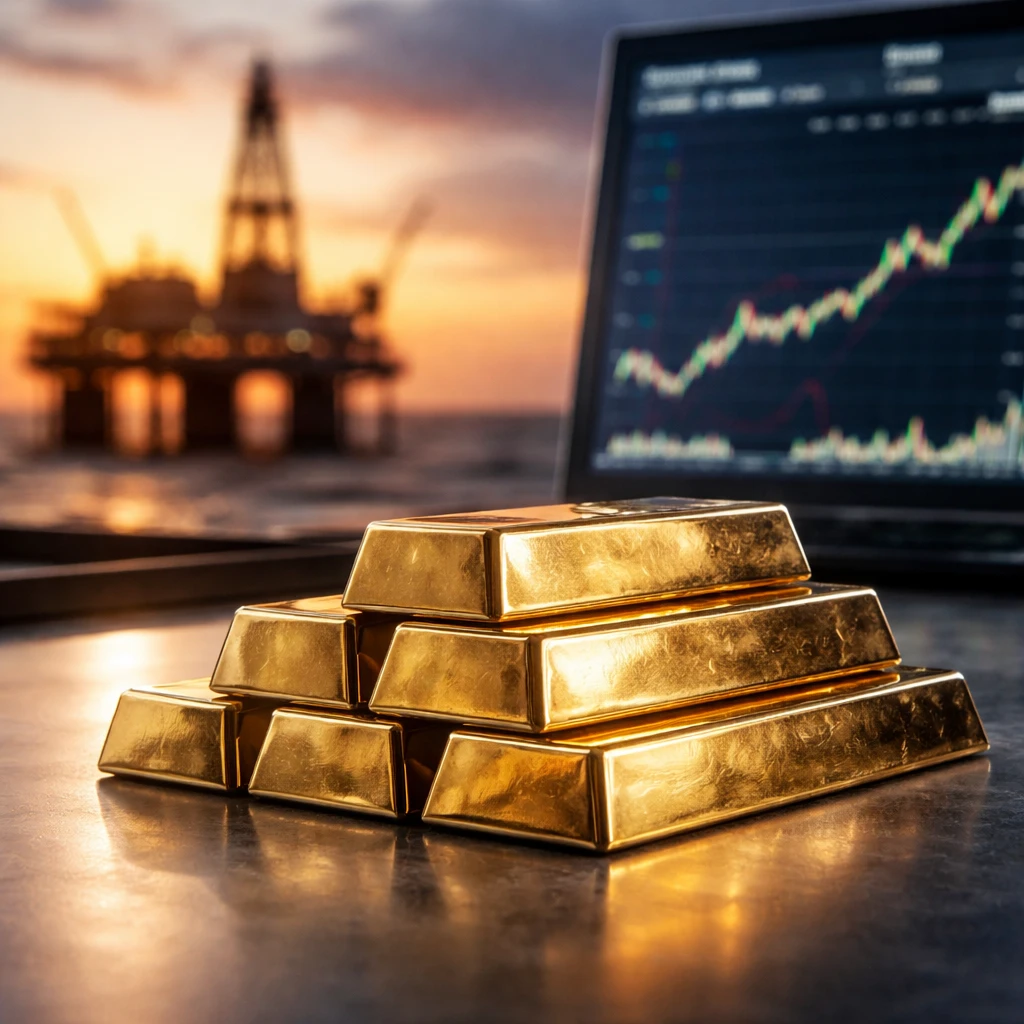
Gold held near recent lows on Thursday after suffering a sharp selloff a day earlier, with higher energy prices, a firmer dollar and an uptick in U.S. Treasury yields all weighing on the metal. Markets remained focused on how these developments might influence the Federal Reserve's policy path.
At 01:58 ET (05:58 GMT), XAU/USD was down 0.2% at $4,281.13 an ounce, while gold futures slipped 0.1% to $4,315.55. Other precious metals showed mixed moves: silver fell 0.6% to $64.09 an ounce, platinum gained 0.3% to $1,758.69 and palladium rose 0.4% to $1,273.79. The U.S. Dollar Index was little changed, trading at 101.13.
Oil strength has been an important factor behind renewed rate-hike expectations. Prices climbed after Iranian President Masoud Pezeshkian told the United Nations that Iran would not allow freedom of navigation through the Strait of Hormuz while sanctions and a U.S. blockade remain in place. His remarks highlighted the difficulty of securing a peace agreement with Washington, despite diplomatic efforts occurring this week.
Pezeshkian said Tehran remains willing to negotiate but would not respond to threats. He added that Iran does not seek to build a nuclear weapon, while insisting it will not give up its right to develop nuclear technology for economic purposes. Those comments followed a day in which President Donald Trump said U.S. officials had "very good" talks with Iranian envoys on the sidelines of the United Nations summit.
Since the outbreak of the U.S.-Iran war in late February, gold has fallen by roughly 20%, with energy prices and the outlook for Federal Reserve policy cited as major influences on the metal's move.
Compounding pressure on bullion, the U.S. Treasury market came under fresh selling after stronger-than-expected economic readings and a weak debt auction. The moves signaled rising expectations that inflation will remain sticky, with yields across most maturities reaching their highest levels in almost two decades. Notably, the five-year U.S. Treasury yield rose above 5% for the first time since 2007, an additional headwind for a metal that does not pay interest.
U.S. business activity expanded at its fastest pace in more than five years, reinforcing the narrative of resilient demand. Fed Governor Michael Barr said further rate increases are likely needed to bring inflation back to the central bank's 2% target, echoing similar warnings from other policymakers that price pressures remain persistent.
Market pricing in interest-rate derivatives shifted further toward tighter policy: swap markets are now factoring in at least three Fed rate hikes by April next year, an increase from expectations earlier this week.
Despite the immediate headwinds, analysts and market participants still see longer-term support for gold based on broader demand considerations. For the present, however, the combination of stronger-than-expected U.S. economic activity, higher Treasury yields, rising oil prices and a firmer U.S. dollar continued to place downward pressure on the metal.
Market snapshot
- XAU/USD: $4,281.13 an ounce (-0.2%)
- Gold futures: $4,315.55 (-0.1%)
- Silver: $64.09 an ounce (-0.6%)
- Platinum: $1,758.69 (+0.3%)
- Palladium: $1,273.79 (+0.4%)
- U.S. Dollar Index: 101.13 (little changed)